
ACSO Basic Electronic Warfare Practice Test
$69.00
- Buy to unlock unlimited access to all Quiz questions.
- After purchase you can print a PDF of the whole quiz at any point. The PDF will contain the questions and the correct answers.
About this Exam
The Air Combat Systems Officer (ACSO) Basic Electronic Warfare certification is a foundational milestone for military personnel specializing in the control of the electromagnetic spectrum. It is designed for newly commissioned or specialized officers entering the Electronic Warfare (EW) career field. This rigorous program provides the essential theoretical knowledge and practical skills required to navigate and dominate the complex, invisible battlefield of the modern era. Successfully passing the final exam confirms a candidate's readiness to proceed with advanced, aircraft-specific tactical training. The qualification is a testament to an individual's ability to protect friendly forces, deny enemy capabilities, and manage the electromagnetic environment under operational stress.
Ready to test your knowledge?
Buy Now to Access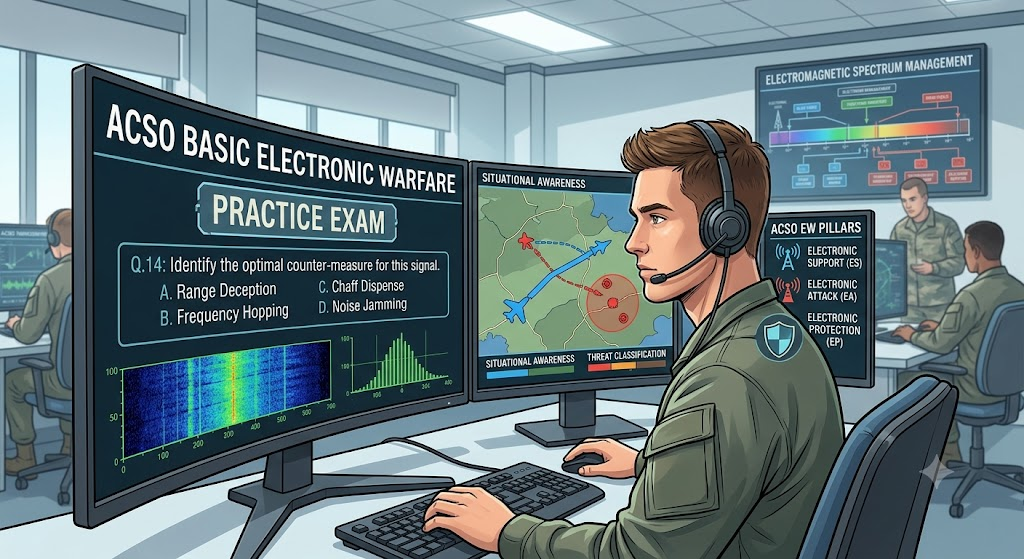
Additional Information
What the Course Entails and Exam Details
This comprehensive course merges classroom theory with state-of-the-art simulation training to ensure a deep understanding of Electronic Warfare. The syllabus is structured around the three primary pillars of EW: Electronic Attack (EA), Electronic Protection (EP), and Electronic Support (ES). Candidates will delve into topics including advanced radar principles, signal modulation, antenna theory, and the physics of electromagnetic wave propagation. Practical skills developed include the ability to analyze and classify emitters, apply various jamming techniques, and implement defensive counter-measures. Furthermore, the curriculum covers the integration of EW into broader joint operations, dynamic mission planning, and the essential rules of engagement governing electromagnetic spectrum operations.
What to Expect in the Final Exam
The final exam for the ACSO Basic Electronic Warfare certification is a comprehensive test of both theoretical knowledge and practical problem-solving ability. It is typically a computer-based, multiple-choice assessment designed to simulate the time-pressure of real-world scenarios. Students should anticipate several hundred questions that cover every aspect of the syllabus, requiring a quick recall of complex data and the application of logical reasoning. A passing score, often in the high-percentile range (e.g., 80% or above), is mandatory to achieve certification. The exam is often divided into two or three timed modules, and candidates must maintain full concentration and situational awareness throughout the duration.
How to Study and Exam Centers
Effective preparation is key, and students should utilize a blend of theoretical study and practical application. Begin by thoroughly reviewing all official course materials, textbooks, and technical manuals. Pay particular attention to the 'key concepts' and 'terminal learning objectives' provided by the instructors. Creating detailed flashcards for acronyms, signal types, and equation outcomes can be extremely helpful. Complement this with extensive practice on the course-specific simulators; aim to make the operational workflows second nature. Join or form a study group to discuss complex scenarios and test each other's knowledge. Due to the sensitive nature of the material, the final examination is conducted at authorized, secure military testing centers, often located at the same installations as the training schools (e.g., Canadian Forces School of Aerospace Studies in Winnipeg, or Naval Air Station Pensacola in Florida). The specific exam date and secure portal access will be scheduled through the chain of command.
Job Opportunities from the Course
A certification as an ACSO specializing in Basic Electronic Warfare opens specific, high-impact career paths within the military. Graduates are uniquely qualified for the following roles:
Air Combat Systems Officer (ACSO)
Electronic Warfare Officer (EWO)
Electronic Attack Specialist
Tactical Systems Officer (TSO)
Joint Electronic Warfare Analyst
Electronic Support Measures (ESM) Operator
EW/SIGINT Operations Liaison
Airborne Electronic Warfare Instructor
This study guide, combined with your dedication and training, will put you on the path to success. Good luck!
Frequently Asked Questions
Reviews
5.0
Based on 0 reviews
Leave a Review
No reviews yet. Be the first to review!