
Certified Electronic Reporter CER Practice Exam
$69.00
- Buy to unlock unlimited access to all Quiz questions.
- After purchase you can print a PDF of the whole quiz at any point. The PDF will contain the questions and the correct answers.
About this Exam
The AAERT Certified Electronic Reporter (CER) designation is
a premier certification for professionals in the legal field who specialize in
making the record using digital audio and video recording equipment.
This certification is designed for individuals who have a
strong foundation in legal procedures, terminology, and transcription, and who
operate, or intend to operate, electronic reporting systems in courtrooms,
depositions, and other official proceedings.
Earning the CER credential demonstrates a high level of
competence and adherence to professional standards, validating your skills to
potential employers and clients in the growing field of digital reporting.
This study guide and practice test are essential tools to
help you prepare effectively, build confidence, and achieve your certification
goals.
Ready to test your knowledge?
Buy Now to Access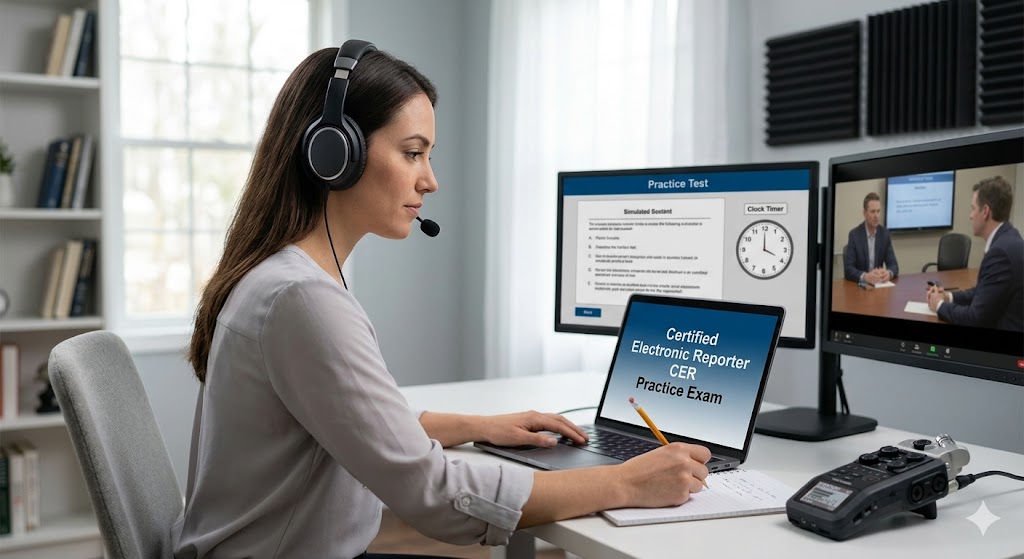
Additional Information
What the Course Entails and Exam Details
The path to CER certification involves mastering a diverse
set of skills that combine technical proficiency with a deep understanding of
the legal system.
Preparation for the exam covers core topics such as digital
recording technology, including microphone placement and mixer operations, and
efficient annotation methods to create an accurate log of proceedings.
Candidates must also demonstrate a comprehensive knowledge
of court procedures, roles of different participants in a trial, and the
ethical responsibilities of a reporter.
The exam itself is structured to test both your theoretical
knowledge and your practical application of these skills through a combination
of multiple-choice questions and a hands-on practical skills component.
The AAERT CER final exam is a comprehensive assessment that
is generally divided into two main components: a knowledge-based section and a
practical skills section.
The knowledge-based portion typically consists of
multiple-choice questions that cover a wide array of topics, including legal
terminology, court rules and procedures, professional ethics, and technical
aspects of audio and video recording.
The practical skills portion is a critical component that
simulates a real-world reporting environment. You may be required to listen to
a legal proceeding, such as a deposition or trial, and simultaneously create a
detailed log, identify speakers, and produce a brief, accurate transcript or
summary from your notes and audio.
Passing scores are set by the AAERT, and candidates must
achieve the minimum required score on both sections to earn the CER
certification. Be prepared for a timed exam that requires both speed and
precision.
4. How to Study and Exam Centers
Preparation for the CER exam should be a multi-faceted
approach. First and foremost, obtain and thoroughly study the official AAERT
CER Study Guide and best practices manual.
Leverage practice tests, like the one this guide supports,
to become familiar with the types of questions and the overall format of the
exam. This is a crucial step for building confidence and identifying areas that
require further study.
Practice your recording and annotating skills by listening
to online legal proceedings, such as published audio from supreme court cases,
and creating detailed logs and speaker identifications.
AAERT partners with professional testing services to
administer the CER exam, often providing online proctoring options that allow
you to take the exam from a secure location. Detailed information on current
test delivery and authorized centers is available through the official AAERT
website.
5. Job Opportunities from the Course
Earning the Certified Electronic Reporter (CER) designation
can significantly enhance your career prospects in the legal field. Here are
some of the primary job opportunities and career paths this certification
unlocks:
Electronic Court Reporter: Working directly for state or
federal court systems, capturing the official record of trials, hearings, and
other courtroom proceedings.
Deposition Reporter: Working for freelance reporting
agencies, capturing testimony in out-of-court legal proceedings like
depositions and examinations under oath.
Hearing Reporter: Providing recording services for
administrative law hearings, workers' compensation cases, and other specialized
tribunals.
Digital Transcriber: While not purely a reporting role,
CER-certified individuals are highly sought after for transcription roles
because of their accurate understanding of legal proceedings and high-quality
audio capture skills.
Scopist/Proofreader: Supporting other court reporters by
editing and proofreading transcripts, a role that benefits greatly from the
legal knowledge validated by the CER.
Frequently Asked Questions
Reviews
5.0
Based on 0 reviews
Leave a Review
No reviews yet. Be the first to review!