
ACS Physical Chemistry: Thermochemistry Practice Test
$69.00
- Buy to unlock unlimited access to all Quiz questions.
- After purchase you can print a PDF of the whole quiz at any point. The PDF will contain the questions and the correct answers.
About this Exam
Prepare effectively for the thermochemistry section of the ACS Physical Chemistry exam. This targeted study resource is designed for undergraduate chemistry students and individuals seeking a comprehensive review of advanced thermodynamic principles.
The guide and practice test validate deep understanding of heat, energy, work, and the laws governing chemical reactions on a macroscopic and microscopic scale.
Master these critical concepts to succeed in your physical chemistry course and broader chemical studies.
Ready to test your knowledge?
Buy Now to Access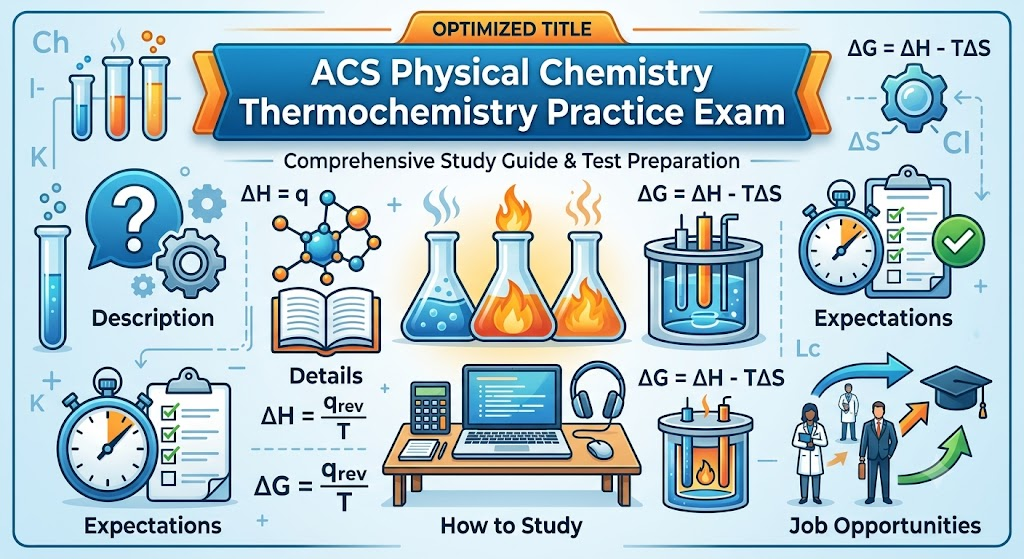
Additional Information
What the Course Entails and Exam Details
The scope of this exam covers core thermochemical and thermodynamic concepts typically encountered in a physical chemistry curriculum. Key topics include, but are not limited to: The First, Second, and Third Laws of Thermodynamics; precise concepts of Internal Energy (U), Enthalpy (H), Entropy (S), and Gibbs Free Energy (G).
You will be required to demonstrate understanding of specific heat and molar heat capacities; perform detailed calorimetry calculations for chemical reactions and physical transitions; apply Hess's Law and standard heats of formation/reaction (ΔH°); and understand and predict the spontaneity of reactions (ΔG°) using thermodynamic criteria, including the effect of temperature.
The section also requires mastery of phase transitions and phase diagrams, and the calculation of entropy changes in various processes and statistical contexts. Problem-solving skills on both qualitative conceptual questions and complex quantitative scenarios are thoroughly tested.
What to Expect in the Final Exam
The ACS Physical Chemistry exam typically consists of a set number of multiple-choice questions, which would include a dedicated section testing your knowledge and problem-solving abilities in thermochemistry and thermodynamics.
You will have a defined time limit, often around 110 minutes for the entire, broader exam, which demands efficiency in interpreting questions and selecting the correct answers.
Scores are often based on a percentile ranking relative to a national norm, rather than a fixed passing percentage. It is common that you must achieve a sufficient level of competence in all major areas, including thermochemistry, for an overall strong score.
Exam rules usually prohibit the use of unapproved resources, with restricted calculator models often being the only tool allowed. Expect a balanced mix of conceptual recall, analytical reasoning, and data interpretation challenges.
How to Study and Exam Centers
Maximize your preparation by integrating the study guide and practice tests into a structured review plan. First, review fundamental concepts and equations from your textbook and course notes.
Utilize this specific practice test as a diagnostic tool, taking it under timed conditions without aids to simulate test day. After completing the test, meticulously analyze each incorrect answer and any question where you guessed, understanding the underlying principles and correct solution methods.
Practice with additional ACS official study guides, textbooks, and relevant online resources. Regular, timed practice is crucial for building speed and confidence.
Regarding exam locations, ACS national standardized exams are generally not administered at public commercial testing centers like Pearson VUE. Instead, they are typically coordinated and proctored directly through educational institutions and specific departments—authorized schools—using their own facilities and faculty, often as a component of a physical chemistry final course grade or for educational assessment.
Contact your chemistry department, university testing service, or course instructor for the precise details on registration, location, and scheduling of the physical chemistry exam, and confirm how they deliver this standardized component. This targeted thermochemistry practice is designed to sharpen your skills for this official examination setting.
Job Opportunities from the Course
A strong performance on this exam section and the overall ACS Physical Chemistry course demonstrates a level of analytical thinking and chemical expertise valuable in numerous high-impact careers. Mastery of physical chemistry and thermodynamics unlocks doors to positions such as:
Research Scientist (Pharmaceutical, Materials, Energy)
Analytical Chemist
Quality Control Specialist
Environmental Scientist
Chemical Engineer (frequently requiring advanced degrees for R&D roles)
Science Educator
Technical Writer
Patent Agent (with further qualifications)
Roles in chemical manufacturing and regulatory agencies.
The skills you validate are essential for understanding reaction feasibility, energy efficiency, product stability, and advanced material properties.
Frequently Asked Questions
Reviews
5.0
Based on 0 reviews
Leave a Review
No reviews yet. Be the first to review!