
ACLS Rhythms Practice Test OLD
$69.00
- Buy to unlock unlimited access to all Quiz questions.
- After purchase you can print a PDF of the whole quiz at any point. The PDF will contain the questions and the correct answers.
About this Exam
Welcome to your comprehensive guide for mastering the ACLS Rhythms Practice Test, commonly referred to as the "OLD" version. This critical evaluation is a cornerstone for healthcare professionals who must demonstrate proficiency in Advanced Cardiovascular Life Support (ACLS). This specific practice assessment is meticulously designed to test your ability to rapidly identify and interpret complex cardiac rhythms—a life-saving skill in high-pressure emergency situations.
This certification preparation is essential for a wide range of medical personnel. It is primarily required for physicians, nurses, paramedics, respiratory therapists, and other allied health professionals working in critical care areas such as the Emergency Department (ED), Intensive Care Unit (ICU), and Cardiac Care Unit (CCU), as well as members of rapid response and code teams. Successfully navigating this rhythms test validates your capability to recognize arrhythmias that demand immediate intervention, forming the foundation for effective ACLS treatment protocols.
Ready to test your knowledge?
Buy Now to Access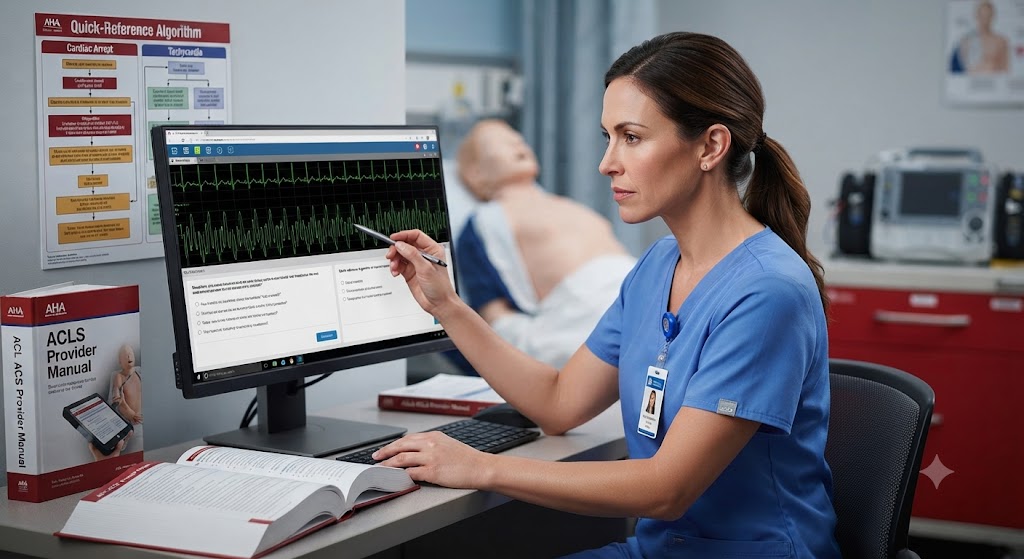
Additional Information
What the Course Entails and Exam Details
The foundational ACLS course (and its associated rhythm
proficiency test) goes far beyond basic cardiac monitoring. It provides a
systematic approach to cardiovascular emergencies, integrating pharmacology,
advanced airway management, and team dynamics. The core of the rhythm
evaluation lies in testing your cognitive mastery of electrocardiogram (ECG)
interpretation within the context of the ACLS algorithms.
The exam specifically evaluates your competency in several
key areas:
- Rapid
Rhythm Recognition: You must be able to instantly identify organized
rhythms, bradycardias, tachycardias (both narrow and wide-complex), and
pulseless arrest rhythms.
- Differentiating
Rhythms: The test challenges you to distinguish between rhythms that
may look similar but require vastly different treatments, such as
Supraventricular Tachycardia (SVT) versus Sinus Tachycardia, or
Ventricular Tachycardia versus SVT with aberrancy.
- ECG
Lead Interpretation: While the primary focus is often on the standard
limb leads, you may be tested on recognizing ischemia, injury, or
infarction patterns in various leads (e.g., recognizing an ST-elevation
myocardial infarction (STEMI) in a 12-lead ECG).
- Clinical
Correlation: Beyond mere identification, the exam tests your
understanding of the hemodynamic significance of the rhythm and how
it dictates the subsequent steps in the ACLS algorithm (e.g., when to
pace, when to cardiovert, and when to defibrillate).
What to Expect in the Final Exam
The ACLS Rhythms final evaluation (or the rhythm component
of the overall ACLS certification exam) is a rigorous assessment designed to
simulate the stress of clinical decision-making.
- Format:
The evaluation is typically administered in a computerized format, often
using dynamic rhythm simulators that mimic a real cardiac monitor screen.
You will be presented with a series of static or scrolling rhythm strips
and asked multiple-choice questions about identification and immediate
management steps based on current American Heart Association (AHA)
guidelines. You may also encounter clinical scenarios where you must
choose the correct next step in the algorithm based on the rhythm
presented.
- Passing
Score: This is a high-stakes exam. To pass, you are generally required
to achieve a score of 84% or higher. This high threshold ensures
that certified professionals possess the requisite competence to manage
life-threatening arrhythmias safely and effectively.
- Time
Limits: While the rhythm portion may not have a strict, separate timer
in all formats, it is integrated into the overall exam which is
timed. Therefore, you must be able to identify rhythms almost
instantaneously (within seconds) to allow sufficient time for the other
components of the exam. The "OLD" designation often refers to a
specific format where speed and accuracy are paramount.
- Rules:
The exam is strictly closed-book. You must rely solely on your
internalized knowledge of ACLS algorithms and rhythm recognition patterns.
No external study aids, notes, or communication devices are permitted
during the testing period.
How to Study and
Exam Centers
Preparing for the ACLS Rhythms exam requires dedicated
practice and strategic study. Relying solely on the course itself is rarely
sufficient for mastery.
- Actionable
Study Strategies:
- Repetition
is Key: Utilize online flashcard platforms (like Anki or Quizlet)
dedicated specifically to ACLS rhythms. Reviewing dozens of rhythm strips
daily builds pattern recognition.
- Simulators
and Apps: Take advantage of the numerous ACLS rhythm simulator apps
available for smartphones and tablets. These provide invaluable practice
in reading dynamic strips under timed conditions.
- Work
Through Practice Tests: Complete as many practice exams as you can
find, especially those simulating the "OLD" format which
emphasizes speed. Focus heavily on understanding why a specific
answer is correct according to the current AHA algorithms.
- Study
the Algorithms: Do not memorize rhythms in isolation. Always study
them in the context of the ACLS Cardiac Arrest and Tachy/Bradycardia
algorithms. Knowing the rhythm is only useful if you also know the
correct treatment pathway.
- Exam
Centers and Procedures:
- Authorized
Training Centers: The final ACLS certification exam, including the
rhythms component, must be administered by an American Heart Association
(AHA) Authorized Training Center (ATC). This could be a local hospital
education department, a private EMS training company, or a community
college.
- Blended
Learning (Online + Skills Session): Most modern ACLS courses use a
blended learning format. You will complete the cognitive portion (which
includes the rhythm exam) online through the AHA’s official online
portal (e.g., HeartCode® ACLS). Once you pass the online exam
(including the rhythm section), you will print your certificate of
completion and schedule an in-person Skills Session at an
Authorized Training Center.
- Traditional
Classroom: In some cases, the entire course and exam are conducted in
a traditional, instructor-led classroom setting over one or two days. The
rhythm exam would be administered via paper or computer during this time.
- Booking:
You must register for the course directly through the ATC. They will
provide access instructions for the online portion and schedule your
mandatory hands-on skills check-off.
Job Opportunities
from the Course
Achieving ACLS certification, which confirms your mastery of
advanced cardiac rhythms, is a mandatory requirement for many clinical roles
and significantly enhances your employability and career trajectory within the
healthcare sector.
- Registered
Nurse (RN): Mandatory for employment in Emergency Departments (ED),
Intensive Care Units (ICU), Cardiac Care Units (CCU), Cardiac
Catheterization Labs, Post-Anesthesia Care Units (PACU), and
Interventional Radiology.
- Physician
(MD/DO): Required for residents and attending physicians specializing
in Emergency Medicine, Cardiology, Critical Care, Anesthesiology, and
Hospitalist Medicine.
- Paramedic
(NRP/EMT-P): An absolute prerequisite for employment in high-acuity
911 emergency medical services and critical care transport (CCT).
- Respiratory
Therapist (RT): Essential for therapists working in critical care
units (ICU/NICU/PICU) and as part of rapid response or code teams.
- Nurse
Practitioner (NP) & Physician Assistant (PA): Required for
practice in acute care, urgent care, emergency departments, and specialty
cardiology or critical care roles.
- Advanced
Practice Roles: Serves as a foundational qualification for specialized
roles like Flight Nurse, Transport Nurse, and Clinical Nurse Specialist in
cardiology
Frequently Asked Questions
Reviews
5.0
Based on 0 reviews
Leave a Review
No reviews yet. Be the first to review!