
ACLS Resuscitation Quality Improvement (RQI) Practice Test
$69.00
- Buy to unlock unlimited access to all Quiz questions.
- After purchase you can print a PDF of the whole quiz at any point. The PDF will contain the questions and the correct answers.
About this Exam
The Advanced Cardiovascular Life Support (ACLS) Resuscitation Quality Improvement (RQI) program represents the cutting edge of resuscitation training.
It is designed specifically for healthcare professionals—including doctors, nurses, paramedics, and respiratory therapists—who are required to maintain ACLS certification as a core competency for treating adult cardiac arrest or other cardiovascular emergencies.
Unlike traditional biennial (every two years) classroom training, the RQI program focuses on dynamic, low-dose, high-frequency learning.
It shifts the paradigm from simple compliance to true competence by requiring quarterly, computerized, feedback-driven practice sessions that are proven to improve skill retention and patient outcomes in the "Chain of Survival."
Ready to test your knowledge?
Buy Now to Access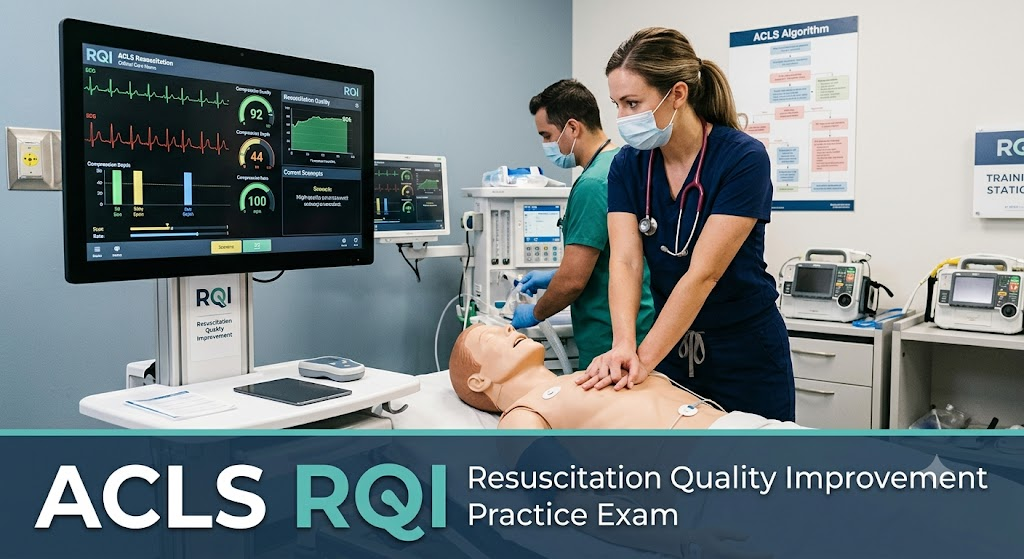
Additional Information
What the Course Entails and Exam Details
The core objective of the ACLS RQI curriculum is to verify mastery of standardized, evidence-based resuscitation protocols through both cognitive knowledge and psychomotor skill.
It is a modular, adaptive program that is completed entirely at your healthcare institution using an automated RQI station.
The course covers essential skills and knowledge areas, including:
ACLS Algorithms: Mastery of standard American Heart Association (AHA) treatment pathways, including Cardiac Arrest (VF/pVT, PEA/Asystole), Bradycardia with Pulses, Tachycardia with Pulses, Acute Coronary Syndromes (ACS), and Acute Ischemic Stroke.
High-Quality CPR (HQ-CPR): Continuous assessment of compression depth, rate, recoil, and minimizing pauses. The RQI system uses advanced, feedback-enabled mannequins to measure these precise metrics.
Advanced Airway Management: Protocols for correct endotracheal tube or supraglottic airway placement and ventilation rates during arrest.
Rhythm Recognition and Pharmacology: Identification of dynamic ECG rhythms and appropriate medication administration (e.g., Epinephrine, Amiodarone, Adenosine, Atropine).
Defibrillation and Cardioversion: Timing and correct application of electrical therapy.
Team Dynamics: Although computerized, the scenarios emphasize the roles within a high-performance resuscitation team, focusing on closed-loop communication and leadership.
What to Expect in the Final Exam
"The final exam" in ACLS RQI differs significantly from a traditional 2-day workshop.
There is no physical classroom component or separate test day. Instead, your "final exam" consists of two primary components integrated into each of your mandatory quarterly RQI station sessions:
1. The Cognitive Assessment (Online Modules): Before you use the physical RQI station, you must complete online, adaptive learning modules. These modules present you with multiple-choice questions based on real-world patient scenarios and ACLS algorithms. The system adapts to your knowledge level, providing immediate feedback and requiring you to demonstrate competency in all algorithm pathways before moving on. There is no traditional "passing score" (like an 84%); you must achieve 100% mastery of the material in the adaptive learning system.
2. The Psychomotor Skill Assessment (The RQI Station): Once the online modules are complete, you visit the RQI station—a localized kiosk featuring computer monitors and specialized adult and infant mannequins. Here, you must perform a dynamic, integrated mega-code simulation. This simulation tests all your skills simultaneously: CPR quality (measured in real-time), ventilation quality, algorithm application, and treatment decisions (like charging the defibrillator, selecting drugs, or identifying rhythms). This simulation is dynamic; the mannequin's condition changes based on your interventions. You must pass both adult HQ-CPR and ventilation modules to achieve compliance for the quarter.
Because RQI must be completed quarterly to maintain active certification, your preparation is an continuous process rather than a single event.
How to Study and Exam Centers
Studying for the ACLS RQI Practice Test requires active, rather than passive, preparation.
Actionable Study Strategies:
Utilize the Practice Mannequins Early: The single best way to study for RQI is to use the RQI station before your quarterly assessment deadline. Many institutions have a dedicated RQI champion or station available for practice. Spending 15 minutes practicing chest compressions with the real-time feedback monitor is more valuable than hours of reading.
Master the AHA Handbooks: The official AHA ACLS Provider Manual and the Handbook of Emergency Cardiovascular Care (ECC) are the foundational reference materials. Review the flowcharts for all algorithms until they are second nature.
Engage with Online Practice Scenarios: RQI is simulation-based. Engage with computerized "mega-code" generators or ACLS algorithms practice websites. Practice making rapid decisions about drug doses and interventions when presented with dynamic ECG rhythms.
Focus on 'The Quality' of CPR: In RQI, simple compressions aren't enough. You must understand the metrics that define high-quality CPR (Rate: 100-120 bpm; Depth: 2.0-2.4 inches; full chest recoil; minimizing pauses to <10>
Exam Centers and How to Take the Test:
ACLS RQI is not available at public testing centers like Pearson VUE. Because it requires physical, highly specialized high-fidelity mannequins and subscription hardware, RQI is implemented exclusively within subscribing healthcare institutions.
You cannot "sign up" for RQI as an individual at a public school; you must be employed by or affiliated with an organization that has an RQI program agreement (e.g., hospitals, large health systems, or EMS agencies).
When it is time for your assessment, you will log into your organization's RQI portal (e.g., RQI 1Stop) and complete your online cognitive modules. Once approved, you visit your designated, dedicated on-site RQI station—often located in a training room, clinical area, or dedicated simulation lab—to perform your psychomotor skill assessment.
Job Opportunities from the Course
A current ACLS certification is a non-negotiable requirement for licensure and employment in nearly all high-acuity healthcare environments treating adult patients. Maintaining this competency via the gold-standard RQI program signifies a highest level of commitment to patient safety and skill retention.
Specific job titles and career paths this certification unlocks include:
Emergency Room (ER) Nurse / Trauma Nurse
Critical Care/ICU Nurse (e.g., CVICU, MICU, SICU)
Paramedic / Flight Paramedic
Emergency Medicine Physician
Hospitalist
Anesthesiologist
Cardiac Cath Lab Technologist / Electrophysiology (EP) Tech
Respiratory Therapist
Rapid Response Team (RRT) Member
Advanced Practice Provider (Nurse Practitioner / Physician Assistant) in Acute Care
Frequently Asked Questions
Reviews
5.0
Based on 0 reviews
Leave a Review
No reviews yet. Be the first to review!