
ACI Aggregate Base Testing Technician Practice Test
$69.00
- Buy to unlock unlimited access to all Quiz questions.
- After purchase you can print a PDF of the whole quiz at any point. The PDF will contain the questions and the correct answers.
About this Exam
The ACI Aggregate Base Testing Technician certification is a critical credential for professionals working in construction materials testing, particularly with aggregate base and soil materials. This program is specifically designed to recognize individuals who can properly perform, record, and report the results of basic field and laboratory procedures. Achieving this certification validates your expertise in essential test methods and ensures that construction projects maintain high standards for base layer stability and quality. It is an ideal step for current laboratory personnel, field inspectors, and individuals looking to advance their careers in construction quality control and assurance.
Ready to test your knowledge?
Buy Now to Access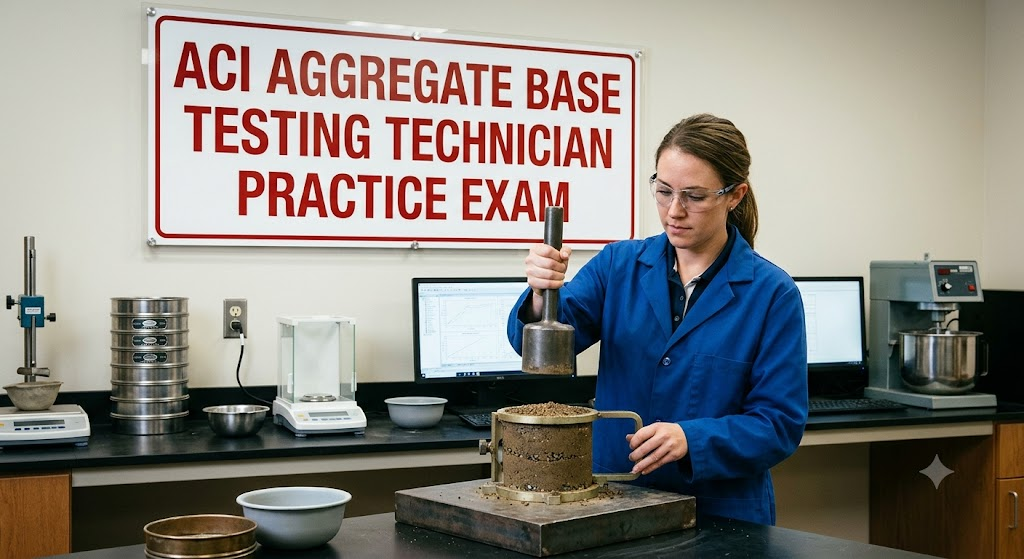
Additional Information
What the Course Entails and Exam Details
The path to full ACI Aggregate Base Testing Technician certification requires demonstrating proficiency through both a written and a performance examination. The program body of knowledge is extensive, covering key AASHTO or ASTM standards for materials testing. Core topics include sampling aggregates (AASHTO R 90/ASTM D75), reducing samples of aggregate to testing size (AASHTO T 248/ASTM C702), and dry preparation of disturbed soil samples (AASHTO R 58/ASTM D421). You will gain deep knowledge in determining moisture content (AASHTO T 265/ASTM D2216), particle size analysis (AASHTO T 88/ASTM D422), and determining the liquid and plastic limits of soils (AASHTO T 89/T 90/ASTM D4318). A significant component is mastering moisture-density relations, including both the standard (AASHTO T 99/ASTM D698) and modified (AASHTO T 180/ASTM D1557) Proctor tests. Practice exams are designed to mirror the knowledge required for the written portion of this comprehensive program.
What to Expect in the Final Exam
While a practice test focuses on preparing you for the written content, understanding the final, multi-part certification process is crucial. The final ACI certification requirements consist of:
Written Examination: This is an open-book exam, usually lasting two hours. It consists of multiple-choice questions (often around 75-100 questions, with specific allocations for each standard). To pass, candidates must achieve a minimum overall score of 70% and a score of at least 60% on each of the individual standards covered.
Performance Examination: This is a closed-book, practical test where you must physically demonstrate the ability to perform the required laboratory and field procedures correctly, exactly as prescribed in the standards.
You must successfully pass both components to be certified, and the performance exam must be completed within a specific timeframe (often within one year) of passing the written exam. ACI certification is valid for five years.
How to Study and Exam Centers
Effective preparation for the ACI Aggregate Base Testing Technician written exam requires a structured approach. First, obtain the relevant ACI workbook (e.g., CP-47 or CP-46) and carefully study the text of the standards themselves. Use the official ACI Job Task Analysis (JTA) as a detailed study guide checklist to ensure you are familiar with every knowledge point. Take high-quality practice tests, like this one, multiple times to simulate the exam's time pressure, build familiarity with the multiple-choice format, and identify specific standards where you need more review. For the performance exam, practical experience is key; seek out opportunities to perform the tests under the guidance of certified colleagues.
ACI certification exams, both written and performance, are administered locally through sponsoring groups, which include local ACI chapters, state departments of transportation, and pre-approved testing facilities. You can find and register for an upcoming exam session in your area through the American Concrete Institute’s main website and its affiliated network.
Job Opportunities from the Course
Earning the ACI Aggregate Base Testing Technician certification opens up specific career paths and positions in the construction, pavement, and materials testing industries. Key job roles and titles include:
ACI Aggregate Base Testing Technician
Soil and Aggregate Laboratory Technician
Construction Materials Testing Specialist
Field Inspector for Road and Pavement Construction
Quality Control (QC) Technician for Aggregate Production
Construction Quality Assurance (QA) Inspector
Civil Engineering Technician (focusing on materials)
Testing and Inspection Manager
Frequently Asked Questions
Reviews
5.0
Based on 0 reviews
Leave a Review
No reviews yet. Be the first to review!