
ACF Certified Fundamental Cook Practice Test
$69.00
- Buy to unlock unlimited access to all Quiz questions.
- After purchase you can print a PDF of the whole quiz at any point. The PDF will contain the questions and the correct answers.
About this Exam
The American Culinary Federation (ACF) Certified Fundamental Cook (CFC) certification is the foundational milestone for any aspiring culinary professional. This recognized industry credential is a direct testament to your commitment and ability, validating that you possess the essential knowledge and core skills required to excel in a professional kitchen. It is specifically designed for students graduating from culinary programs, high school CTE programs, and early-career cooks who want to prove their proficiency to potential employers. Earning the CFC demonstrates to the entire foodservice industry that you have met a standardized benchmark of competence in food safety, nutrition, and classic cooking techniques, giving you a distinct advantage as you begin your culinary journey.
Ready to test your knowledge?
Buy Now to Access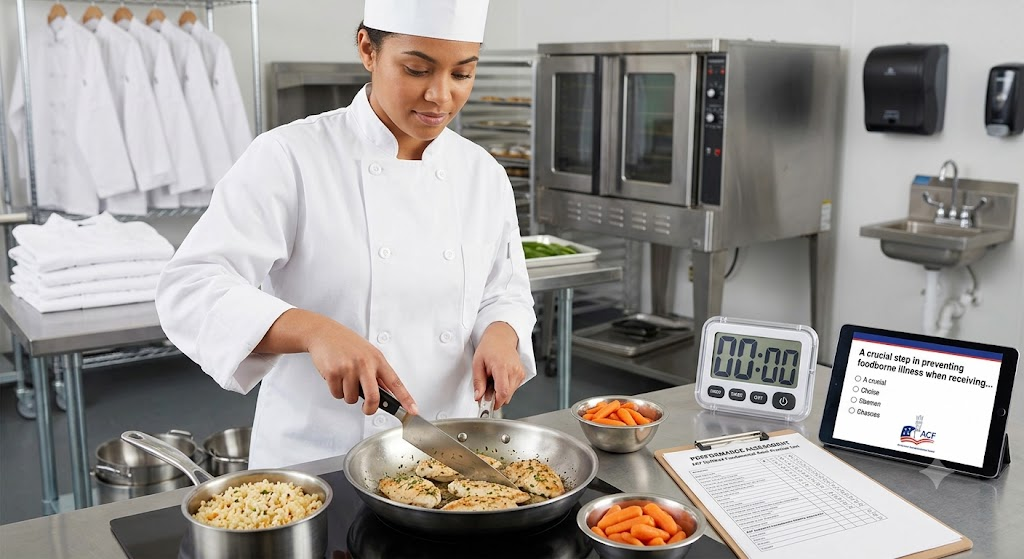
Additional Information
What the Course Entails and Exam Details
This comprehensive assessment is a dual-component process, evaluating both your technical understanding and your practical application. It is not tied to a single "course," but rather serves as the culmination of essential culinary education. To be eligible, candidates typically must have completed significant instructional hours or have specific experience. The exam content, provided in partnership with NOCTI, is structured around four major pillars:
Food Safety and Sanitation: This is paramount. Expect detailed questions on identifying contaminants, understanding microorganisms and requirements for their growth, time/temperature controls for potentially hazardous foods, personal hygiene, and internal procedures for pest control and emergency kitchen/dining room injuries.
Culinary Nutrition: This section focuses on applying sound nutritional principles. You will cover USDA guidelines, major nutrient functions, identifying and substituting for common food allergies (gluten, sugar, lactose), and interpreting food labels for portion size and nutritional value.
Introduction to Food Service Concepts: This area provides industry context, including professionalism, basic menu planning, purchasing, and the overall functional areas of a hospitality organization.
Basic Food Preparation: This evaluates your core cooking skills. It includes proper kitchen safety, knife care, and the principles of heat transfer for all major cooking methods: roasting, baking, broiling, grilling, sautéing, frying, deep-frying, braising, stewing, poaching, and steaming. You must also understand recipe conversions, flavor development, classical cuts, and the process for making mother sauces, stocks, and soups.
What to Expect in the Final Exam
The full final examination consists of two distinct parts that must be completed to earn the certification: a Written Assessment and a Performance Assessment.
The Written Assessment
Format: This is a comprehensive, proctored multiple-choice exam, often administered through the online assessment system.
Number of Questions: You can typically expect 100 to 134 questions.
Time Limit: The allowed time is usually 2 or 3 hours, depending on the specific blueprint.
Passing Score: Candidates must achieve a minimum score of 70% or 75% to pass, according to different testing outlines.
The Performance Assessment
Format: This is a hands-on, observed practical exam where you will prepare specific dishes to demonstrate skill proficiency.
Typical Requirements: For example, you may be required to prepare a main course of sautéed chicken with fine herb sauce, rice pilaf, and steamed carrots. This allows judges to evaluate your knife skills, cooking methods, speed, sanitation, and final product presentation.
Time Limit: The practical component usually has a set time, often around 2 hours and 30 minutes for the example above.
Passing Score: Candidates must achieve a minimum score of 75% on the performance assessment.
How to Study and Exam Centers
Preparation for the ACF Certified Fundamental Cook exam must integrate focused academic study with deliberate practical practice.
Effective Study Strategies:
Utilize Official Blueprints: Obtain the latest "exam blueprint" from NOCTI or the ACF. This is your master list of all topics covered and their weighting, ensuring you focus your efforts.
Dive Into Recommended Texts: Use the primary culinary textbooks recommended by the ACF for certification, such as "Culinary Fundamentals" or similar foundational guides, specifically focusing on the sections regarding safety, nutrition, and basic preparation.
Take ACF Practice Tests: The ACF and NOCTI offer practice tests and quiz tools. Use these repeatedly to become familiar with the multiple-choice format, style of questioning, and time constraints.
Practice Your Practical Component: Determine the exact dishes required for your performance assessment. Practice making them from start to finish, multiple times. Time yourself and focus on organization, cleanliness, and the exact cooking techniques required (e.g., proper sauté, correct knife cuts).
Complete Mandatory Pre-Courses: Remember that you must provide documentation of completing specific 30-hour courses in Nutrition and Food Safety and Sanitation before receiving your final certification. These are critical resources themselves.
Exam Centers:
The ACF Certified Fundamental Cook exam is primarily administered through NOCTI. These are not taken in a public Pearson VUE-style testing center, but are typically arranged locally. Assessments are most often coordinated through approved secondary or post-secondary culinary programs, high schools, or technical centers that have a partnership with NOCTI and the ACF to proctor these exams for their students. For independent candidates, the ACF can help facilitate finding an approved local proctor to administer the online written assessment.
Job Opportunities from the Course
Earning the ACF Certified Fundamental Cook credential is an effective accelerator for your culinary career, unlocking numerous early-level positions that require verified core competence. The skills and knowledge you prove through this certification are in high demand across a wide variety of foodservice operations. Specific job titles and career paths this certification opens include:
Prep Cook: The essential role responsible for executing the bulk of ingredient preparation for a professional kitchen.
Line Cook / Station Cook: Positions on the cooking line, from initial entry to taking charge of a specific station like sauté or grill.
Restaurant Cook: A versatile role in various dining establishments, from casual to fine dining.
Cafeteria Cook: Positions in corporate, university, or institutional dining, preparing food on a larger scale.
Dietary Aide: Role in healthcare settings focusing on preparing nutritionally compliant food.
Personal Cook: Early-stage personal chef services, preparing meals for clients in a home setting.
Garde Manger: Specializing in the "cold kitchen," including salads, appetizers, and charcuterie.
Frequently Asked Questions
Reviews
5.0
Based on 0 reviews
Leave a Review
No reviews yet. Be the first to review!