
ACCA Advanced Audit and Assurance (AAA) Practice Exam.
$69.00
- Buy to unlock unlimited access to all Quiz questions.
- After purchase you can print a PDF of the whole quiz at any point. The PDF will contain the questions and the correct answers.
About this Exam
The ACCA Advanced Audit and Assurance (AAA) exam is the final, top-level paper for aspiring auditors seeking to qualify as Chartered Certified Accountants. This advanced certification is designed for senior accountants, audit managers, and financial professionals who aim to build leadership careers in auditing, assurance, and corporate reporting. It validates a critical understanding of complex audit environments, standard application, and ethical decision-making.
Ready to test your knowledge?
Buy Now to Access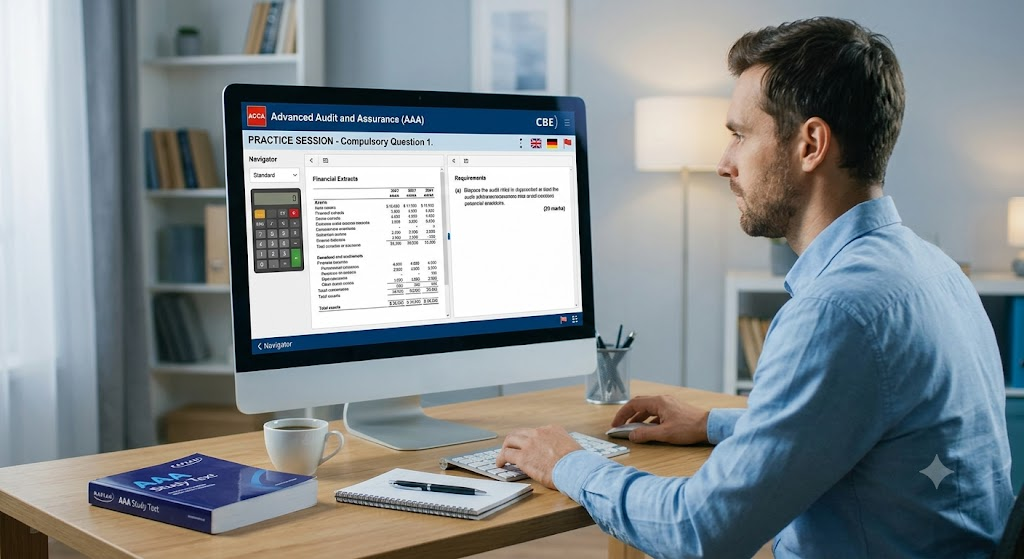
Additional Information
What the Course Entails and Exam Details
The ACCA AAA syllabus delves deep into the theoretical framework and practical application of audit and assurance engagements. The course covers critical areas such as:
Regulatory environments, corporate governance, and professional ethics.
Advanced auditing of financial statements, complex groups, and specialized accounting.
Internal control assessments, risk evaluation, and planning.
Fraud detection, forensic auditing, and environmental audits.
Other assurance services, like review engagements and prospective financial information.
Standard application, including International Standards on Auditing (ISAs) and their impact.
Performance management and quality control within an audit firm.
The actual ACCA AAA exam is an demanding assessment designed to evaluate a candidate's practical, professional, and strategic audit skills.
What to Expect in the Final Exam
The final exam for ACCA Advanced Audit and Assurance is comprehensive and entirely computer-based (CBE). Here is what students can expect:
Format: The exam consists of multi-part questions, based on detailed case studies and realistic scenarios. Candidates must analyze information, perform risk assessments, evaluate audit evidence, and draft responses that simulate real-world audit reports or management letters. It is highly practical and application-focused.
Passing Score: The pass mark is 50%. However, achieving this requires a demonstration of sophisticated knowledge and practical application, not just factual recall.
Time Limits: The exam duration is 3 hours and 15 minutes. Time management is crucial for successfully addressing all questions and sub-questions.
Rules: The AAA exam follows strict ACCA guidelines, and being a strategic-level professional paper, it evaluates professional skepticism and judgement. Students cannot use textbooks or pre-prepared notes, but specific professional publications might be permitted depending on the exam session rules.
How to Study and Exam Centers
Succeeding in the ACCA AAA exam requires a dedicated and multifaceted approach. Essential study strategies include:
Thoroughly studying an approved textbook from ACCA-approved content providers like BPP or Kaplan.
Diligently reviewing the official ACCA AAA syllabus and study guide.
Practicing extensively with past exam papers and official ACCA practice exams on the digital platform. This is vital for understanding the CBE structure and expected answering style.
Focusing on professional skills, including skepticism, commercial acumen, and communication.
Reading "Examiner's Reports" from previous exam sessions to understand common student mistakes and successful answering strategies.
Simulating full exam conditions during practice sessions.
ACCA provides flexible options for taking the AAA exam. Students can attempt the computer-based exam at a wide range of official computer-based exam centers globally, often operated by partners like Pearson VUE or specific approved training centers and universities. Remote invigilation (at-home testing) is also available in many countries, offering convenience while maintaining standard security protocols.
Job Opportunities from the Course
Qualifying in ACCA AAA unlocks diverse and rewarding career paths. Graduates are equipped for various roles in the professional services, audit, and finance sectors. Potential job titles include:
External Auditor
Internal Auditor
Audit Manager / Senior Audit Manager
Financial Controller
Risk Management Specialist
Forensic Accountant
Technical Accounting Specialist
Chief Financial Officer (CFO) in medium-sized organizations
Accounting Practice Partner
Frequently Asked Questions
Reviews
5.0
Based on 0 reviews
Leave a Review
No reviews yet. Be the first to review!