
AC-HPAT Chemistry Practice Test
$69.00
- Buy to unlock unlimited access to all Quiz questions.
- After purchase you can print a PDF of the whole quiz at any point. The PDF will contain the questions and the correct answers.
About this Exam
The AC-HPAT, or Algonquin College Health Programs Admission Test, is a critical assessment for students aiming to enter specific health programs at Algonquin College in Ontario, Canada. It is a unique institutional exam, designed to evaluate applicants' knowledge and readiness in various science and math subjects relevant to healthcare studies. The Chemistry portion is specifically intended for students applying to competitive programs and assesses foundational knowledge essential for success in fields demanding a strong scientific background. This exam ensures that candidates possess the requisite conceptual understanding to excel in a rigorous healthcare academic environment and, ultimately, a demanding professional career.
Ready to test your knowledge?
Buy Now to Access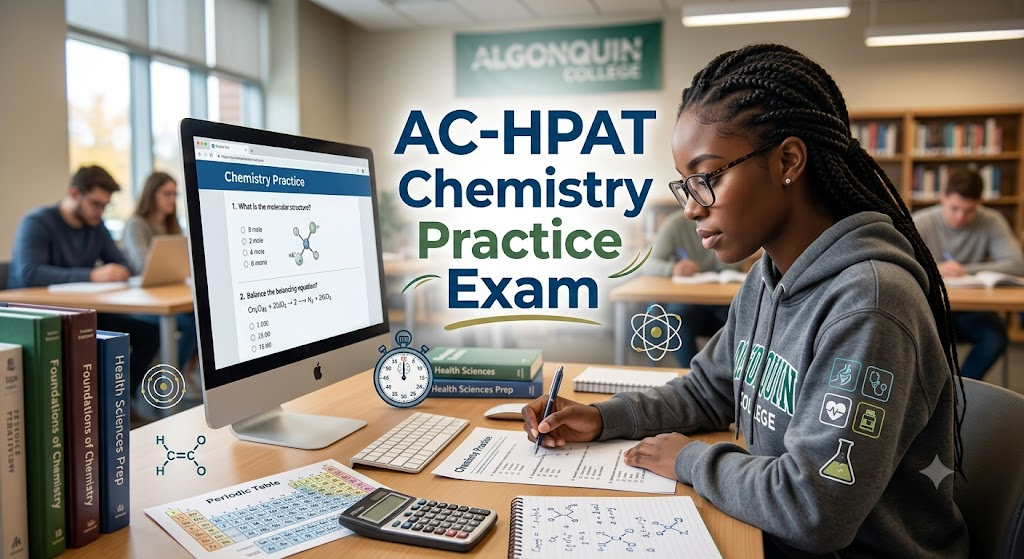
Additional Information
What the Course Entails and Exam Details
This section outlines the common domains and concepts assessed within the Chemistry component of the AC-HPAT. While the exact structure of the real exam may vary annually, comprehensive study and high-quality practice tests typically focus on fundamental principles such as:
Atomic Structure & Properties: Understanding elements, compounds, isotopes, electron configurations, and periodic trends (atomic size, electronegativity, etc.).
Chemical Bonding & Interactions: Differentiating between ionic, covalent, and other interactions, molecular geometry, and intermolecular forces.
Stoichiometry & Reactions: Writing and balancing chemical equations, understanding reaction types (synthesis, decomposition, single-displacement, double-displacement), mole calculations, and stoichiometry in gaseous and solution forms.
Acids & Bases: Conceptual understanding of theories, pH calculations, titration concepts, and buffer systems.
Organic Chemistry Fundamentals: Common functional groups (e.g., carboxylic acids, alcohols, amines), nomenclature basics, and common reactions relevant to biological systems.
Solutions & Thermodynamics: Concepts of solubility, concentrations, thermochemical equations, and principles of energy change in reactions.
Gases & Gas Laws: Ideal Gas Law and fundamental gas behavior principles.
A successful score indicates a robust grasp of these essential concepts, proving readiness for further specialized studies. High-yield practice tests and structured study guides will usually cover these core topics, often including detailed explanations for every answer, aiding in both assessment and learning. The specific details of questions per section and current syllabus nuances should always be confirmed through official Algonquin College resources.
What to Expect in the Final Exam
When sitting for the actual AC-HPAT Chemistry portion (and the test overall), candidates should be prepared for specific conditions and rules:
Format: The AC-HPAT is entirely proctored and usually consists of multiple-choice questions, covering all required test domains (Biology, Chemistry, Physics, Arithmetic, etc.).
Proctoring & Rules: The real exam must be taken in a highly controlled environment. It is typically administered at Algonquin College Test Centres in person or virtually through an approved virtual proctoring service. Strict rules apply, including bans on calculators (unless explicitly stated and provided within the test platform), cell phones, and external materials. A valid government-issued photo ID is always required.
Time Limit: The overall AC-HPAT assessment is extensive. While the specific allocation for the Chemistry section is not always explicitly publicized separately and can vary, Algonquin College generally schedules test sessions of approximately 3 hours for the complete assessment, and extended time is possible. Candidates must manage their time effectively across all required components.
Scores: The test doesn’t usually have a single 'passing score' but provides scores for each section that are then used as part of the overall admission criteria for specific programs. Each program sets its own desirable score ranges.
Unique to Algonquin: It is vital to remember that the AC-HPAT is specific to Algonquin College and is not used by or transferable to other institutions.
Practice tests are key: Quality practice tests, like the one indicated in this guide, are structured to give a realistic preview of the final exam's depth, difficulty, and question style, including detailed answer explanations to enhance learning and strategic preparation. The core of this study guide is to prepare you using such tools for the conditions and level of the actual institutional test.
How to Study and Exam Centers
Preparation is paramount. Here are actionable strategies and crucial logistical details:
How to Study:
Utilize Practice Tests: Engaging with multiple, high-quality practice tests that cover the full spectrum of anticipated Chemistry topics is one of the most effective study methods. These mimic the actual test's style, help with time management, and identify areas needing further review.
Concept Review: Systematic review of fundamental chemistry principles using textbooks, educational websites, and structured study notes.
Note-Taking & Flashcards: Create concise notes and flashcards for key definitions, equations, and rules.
Practice Problem Solving: Work through numerous chemistry problems, especially in areas like stoichiometry, balancing equations, and calculations.
Simulate Test Conditions: Take practice tests under timed and quiet conditions, as closely mirroring the actual exam environment as possible, and strictly adhere to the rule of no unapproved calculators/resources.
Exam Centers:
Official Administration: The actual AC-HPAT can only be taken as an Algonquin College admission assessment.
Locations: It is administered:
In-Person at dedicated Algonquin College Test Centres. These are located on their Ottawa, Pembroke, and potentially other physical campus sites.
Virtually via an approved virtual proctoring service (such as Meazure Learning/Examity), allowing you to take the exam from a quiet, secure, and private location, provided you meet the technological requirements.
Booking: All official AC-HPAT exams must be booked through the student's Algonquin College application portal (ACSIS) or directly via instructions provided during the application process. Fees are associated with the official test.
While this guide focuses on preparation with practice material, always verify the most current details regarding registration, official resources, rules, and procedures directly with the Algonquin College Test Centre and Admissions office.
Job Opportunities from the Course
A strong performance on the AC-HPAT, including the Chemistry portion, is the first step toward entering competitive healthcare programs. Successful completion of these programs can unlock diverse and rewarding career paths, such as:
Registered Nurse (BScN Program)
Practical Nurse (PN Program)
Medical Laboratory Technologist
Paramedic (Advanced Care and Primary Care)
Respiratory Therapist
Dental Hygienist
Veterinary Technician
Cardiovascular Technologist
Diagnostic Medical Sonographer
Medical Radiation Technologist
These are not the direct job titles the exam itself grants, but rather the professional outcomes made possible by successfully passing the required admissions criteria (including this test) and completing the corresponding diploma or degree program at Algonquin College.
Frequently Asked Questions
Reviews
5.0
Based on 0 reviews
Leave a Review
No reviews yet. Be the first to review!