
Abret Practice Test & Exam Prep
$69.00
- Buy to unlock unlimited access to all Quiz questions.
- After purchase you can print a PDF of the whole quiz at any point. The PDF will contain the questions and the correct answers.
About this Exam
The ABRET (American Board of Registration of Electroencephalographic Technologists) credentialing process is a prestigious achievement for neurodiagnostic professionals. These certifications validate a technologist's knowledge and skills, confirming their ability to provide high-quality patient care and reliable diagnostic data. The ABRET EEG Practice Exam is designed for individuals seeking registration as an Electroencephalographic Technologist (R. EEG T.). This study guide serves as a critical stepping stone for students, recent graduates of neurodiagnostic programs, and working technologists aiming to formalize their expertise and advance their careers in the field of electrodiagnostic technology. Achieving an ABRET credential, such as the R. EEG T., is widely recognized by employers and marks a commitment to professional excellence.
Ready to test your knowledge?
Buy Now to Access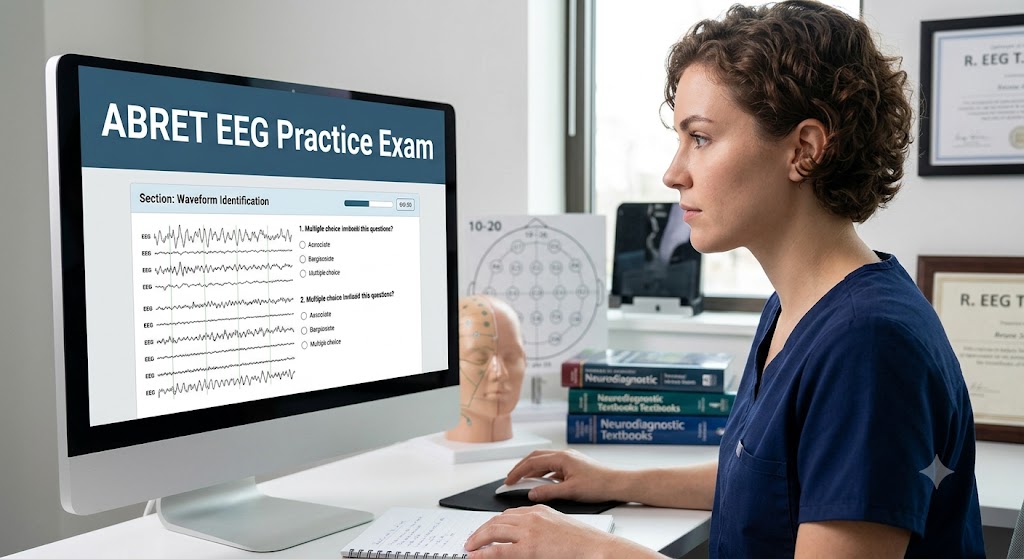
Additional Information
What the Course Entails and Exam Details
The path to an ABRET R. EEG T. credential involves rigorous
preparation. The "course" is typically a combination of formal
education, clinical experience, and dedicated self-study. The core topics
covered are extensive and demanding, divided into several key areas:
- Pre-Study/Patient
Preparation (25%): This section focuses on essential non-technical
skills, including patient history taking, communication and establishing
rapport, medical and EEG terminology, and understanding relevant
diagnostic procedures. It also covers common medications and their
effects, HIPAA compliance, and a detailed understanding of neurologic
disorders and neuropathology, such as tumors, encephalopathy, vascular
conditions, and seizure classifications. A strong foundation in
neuroanatomy and neurophysiology is paramount. Candidates must also master
fundamental concepts like electrode properties, placement using the 10-20
System, special electrodes, obtaining acceptable impedances, infection
control, and both patient and electrical safety. The ABRET Code of Ethics
is also a key component here.
- Performing
the EEG Study (75%): This major portion of the examination evaluates
the technologist's ability to ensure the integrity of the collected data.
This includes accurate documentation, age- and state-specific monitoring
techniques, implementing recording strategies like appropriate montages
and parameter changes, and understanding digital instrumentation, filters,
and digital recording. Recording strategies involve managing activation
techniques (and their contraindications), identifying and eliminating
artifacts, troubleshooting equipment, and effectively managing clinical
events. A significant part of this section is waveform identification,
including distinguishing sleep stages, sleep patterns, and identifying
sleep disorders. Localization and polarity analysis are also critical
skills tested.
What to Expect in
the Final Exam
The actual R. EEG T. exam is a formal, comprehensive
assessment. It is a computer-based examination composed entirely of multiple-choice,
objective questions. Candidates are given a total testing time of four
(4) hours to complete the test. The exam content is weighted according to
the domains outlined above, with a heavy emphasis on practical performance and
data interpretation. Passing score requirements are determined by ABRET and can
vary slightly between exam forms, based on difficulty, but generally reflect a
high standard of mastery. There are strict rules regarding what candidates can
bring into the testing center, and the exam is proctored to ensure validity and
security.
How to Study and
Exam Centers
Preparation is the absolute key to success on an ABRET
examination. A multi-faceted approach is most effective:
- Utilize
Official Resources: ABRET offers its own official self-assessment
program called ASAP (ABRET Self Assessment Program) through the Test Run
platform. This tool provides unlimited online practice exams, visual
performance assessments, progress reports, and custom study materials. While
it doesn't guarantee a pass, it offers realistic practice with questions
from all relevant exam categories, custom-designed by credentialed
professionals.
- Review
Exam Outlines: The official content outline provided by ABRET is your
roadmap. Structure your study sessions around each point, ensuring you
have a deep understanding of every topic and sub-topic.
- Engage
in Practice Tests: Take as many practice tests as possible. This helps
you get comfortable with the exam format, time management, and the types
of questions asked. Focus not just on getting the correct answer, but on
understanding the rationale behind each question and answer option.
- Clinical
Experience: There is no substitute for hands-on, clinical experience.
The theoretical knowledge gains meaning and stickiness when applied in a
real-world setting. Pay close attention to troubleshooting, patient safety
protocols, and waveform analysis during your clinical rotations.
- Exam
Centers: The ABRET exam is administered through standard testing
centers, such as Pearson VUE. To find the most current list of authorized
physical testing centers and learn about potential remote proctoring
options, you must visit the official ABRET website or the testing vendor's
portal. Scheduling an exam requires creating an account, paying the
application fee, and choosing an available date and location.
Job Opportunities
from the Course
Earning the ABRET R. EEG T. credential opens doors to a
rewarding and growing career field. It signifies to employers that you have met
the highest standard of competence. Here are some of the job opportunities and
career paths available:
- Registered
Electroencephalographic Technologist (R. EEG T.): The direct result of
the certification, working in hospitals, clinics, and research settings.
- Neurodiagnostic
Technologist: A broader role that may include EEG along with other
modalities like EP (Evoked Potentials).
- EEG
Lab Supervisor/Manager: Leadership roles responsible for overseeing an
entire neurodiagnostic department.
- Intraoperative
Neurophysiologic Monitoring (IONM) Technologist: Specialized role in
the operating room (may require further CNIM certification).
- Long-Term
Monitoring (LTM) Technologist: Working in specialized units for
epilepsy monitoring (may require CLTM certification).
- Neurodiagnostic
Educator: Teaching in accredited neurodiagnostic programs.
- Clinical
Research Coordinator: Working on studies involving neurodiagnostic
data collection and analysis
Frequently Asked Questions
Reviews
5.0
Based on 0 reviews
Leave a Review
No reviews yet. Be the first to review!