
ABRET Digital Instrumentation Practice Test
$69.00
- Buy to unlock unlimited access to all Quiz questions.
- After purchase you can print a PDF of the whole quiz at any point. The PDF will contain the questions and the correct answers.
About this Exam
The ABRET Digital Instrumentation Practice Test is a vital resource for Neurodiagnostic Technologists aiming to solidify their understanding of the technical principles behind their equipment.
Designed by the American Board of Registration of Electroencephalographic and Technologists (ABRET), this practice exam allows candidates to assess their knowledge of digital data acquisition, processing, and display, which are crucial skills for maintaining high standards in neurodiagnostic testing.
Whether you are preparing for your initial registration (such as R. EEG T. or R. EP T.) or are a seasoned technologist looking to sharpen your technical expertise, this practice test serves as a crucial benchmark of your readiness in digital instrumentation concepts.
Ready to test your knowledge?
Buy Now to Access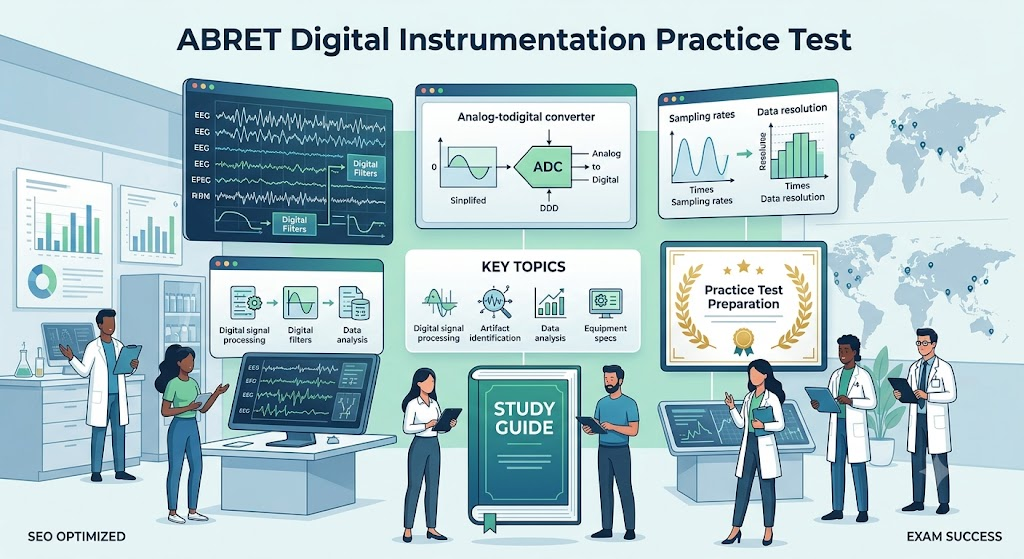
Additional Information
What the Course Entails and Exam Details
This practice test focuses specifically on the digital aspects of neurodiagnostic instrumentation, a field that has transitioned away from analog systems. The course content and practice exam details generally cover:
Principles of Digital Recording: Understanding the process of converting analog physiological signals into digital data.
A/D Conversion and Sampling Rates: Mastering the concepts of Analog-to-Digital (A/D) converters, Nyquist theorem, sampling frequencies, and their impact on data accuracy.
Digital Filters: Comprehensive knowledge of high-pass, low-pass, and notch filters, including their effects on waveforms and how to use them effectively during recording.
Data Acquisition and Display: Understanding screen resolution, data storage, impedance testing, and the effect of varying settings on signal presentation.
Artifact Recognition and Troubleshooting: Developing the ability to identify both physiological and non-physiological artifacts and knowing how to troubleshoot equipment issues.
Patient Safety: Ensuring proper grounding, equipment maintenance, and adherence to safety protocols in a digital neurodiagnostic lab environment.
What to Expect in the Final Exam
While a practice test is a study tool, it is designed to mimic the actual ABRET digital instrumentation-related questions you will encounter on full certification exams. Here is what to expect from the practice exam experience:
Multiple-Choice Format: The practice test consists of multiple-choice questions, challenging your recall of definitions, technical principles, and application of knowledge.
Technical Focus: Expect questions to be highly technical, testing your deep understanding of concepts like sampling theory, filter slopes, and digital signal pathways.
Immediate Feedback: A major benefit of this practice tool is often immediate feedback or score reports that highlight your strong areas and topics where more study is required.
Simulation of actual test constraints: Practice exams often have timed sections to help you develop the pacing skills needed for a proctored, high-stakes examination.
How to Study and Exam Centers
Preparation for this practice test and the subsequent certification exams requires a dedicated study plan.
Study Strategies:
Utilize ABRET Resources: Begin with the official ABRET examination outlines and reference lists. This ensures your study efforts are aligned with the material you will be tested on.
Review Textbooks: Deeply study neurodiagnostic technology textbooks like those by Fisch and Spehlmann, focusing particularly on chapters covering digital instrumentation, filters, and safety.
Take Advanced Courses: Enroll in online or in-person advanced courses on digital EEG concepts or neurodiagnostic instrumentation fundamentals.
Practice Frequently: The best way to use a practice test is as a repetitive tool. Take the test, study your weak areas, and retake it to measure your improvement.
Exam Centers and Access:
Practice Test Access: The ABRET Digital Instrumentation Practice Test is typically available online directly through the ABRET website or their designated education portal. It can often be taken at your own pace from any computer with internet access.
Official Certification Exams: When you are ready to take a full, proctored ABRET certification exam (like the R. EEG T.), these are typically administered at authorized testing centers such as Pearson VUE, or via secure online proctoring services.
Job Opportunities from the Course
Mastering digital instrumentation through this practice test greatly enhances your skills and bolsters your candidacy for advanced and specialized roles in neurodiagnostics.
Career paths this certification support include:
Registered Electroencephalographic Technologist (R. EEG T.)
Registered Evoked Potential Technologist (R. EP T.)
Certified Long-Term Monitoring Technologist (CLTM)
Neurodiagnostic Department Lead/Manager
Intraoperative Neurophysiological Monitoring (IONM) Technologist
Neurodiagnostic Educator
Clinical Research Coordinator (in Neurodiagnostics)
Frequently Asked Questions
Reviews
5.0
Based on 0 reviews
Leave a Review
No reviews yet. Be the first to review!