
ABRET Electroencephalography (EEG) Practice Test
$69.00
- Buy to unlock unlimited access to all Quiz questions.
- After purchase you can print a PDF of the whole quiz at any point. The PDF will contain the questions and the correct answers.
About this Exam
The ABRET Electroencephalography (EEG) Practice Test is an invaluable tool designed to help neurodiagnostic technologists prepare for the comprehensive Registered EEG Technologist (R.EEG T.) certification exam, awarded by the American Board of Registration of Electroencephalographic Technologists (ABRET).
Earning the R.EEG T. credential is a hallmark of professional competence and dedication in the field of clinical neurophysiology.
This practice test provides a realistic simulation of the actual examination environment, allowing candidates to assess their current knowledge, identify critical learning gaps, and build the stamina required for a lengthy testing session.
It is tailored for students in accredited neurodiagnostic programs, as well as working professionals seeking to formalize their experience through certification.
Ready to test your knowledge?
Buy Now to Access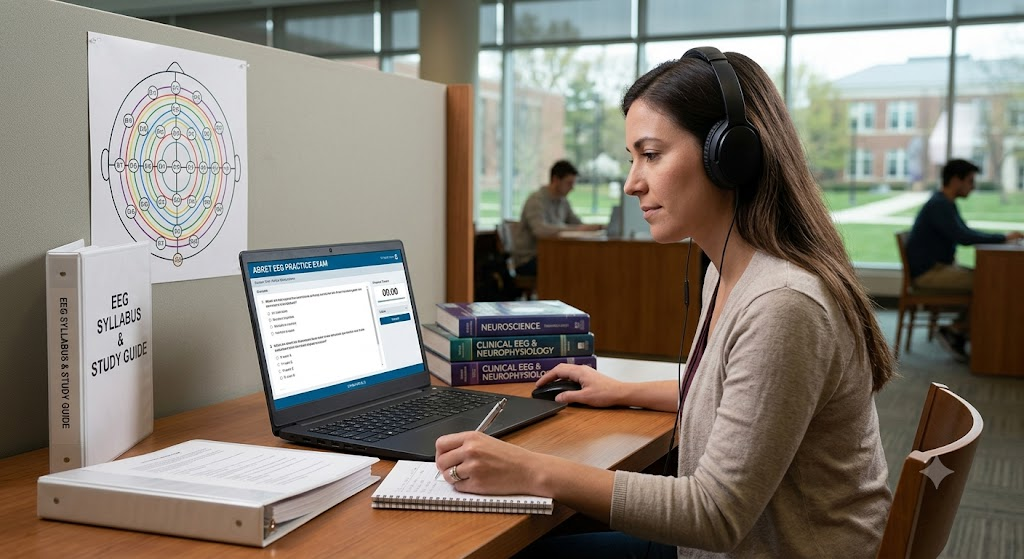
Additional Information
What the Course Entails and Exam Details
This ABRET EEG Practice Exam content is modeled directly on the R.EEG T. certification blueprint, ensuring a highly accurate practice experience.
It assesses a candidate's mastery across all major domains of neurodiagnostic technology.
Key subject areas covered in the practice questions include: Patient Care and Preparation (such as medical history, safety, and the International 10-20 system of electrode placement), EEG Instrumentation (including digital concepts, filters, and safety), EEG Recording and Concepts (covering waveform polarity, localization, montages, and artifact identification), and Procedural Considerations for various patient populations.
The practice test is delivered in an online format, often with hundreds of multiple-choice questions that can be taken multiple times to track progress and master difficult concepts.
What to Expect in the Final Exam
It is essential to understand that while the practice test is a powerful study aid, it is different from the official ABRET R.EEG T. final examination.
The actual R.EEG T. exam is a computer-based test consisting of 200 multiple-choice questions.
Candidates are given a total time limit of up to four (4) hours to complete the examination.
The exam uses a scaled scoring system; therefore, there is no set raw number of correct answers needed to pass.
Instead, the difficulty of the individual questions is accounted for in the final score calculation.
Following the exam, candidates receive an instant, unofficial notification of their pass/fail status, with official, detailed score reports following a few weeks later.
How to Study and Exam Centers
Effective preparation is key to success on the ABRET EEG exam.
Start by obtaining the official ABRET candidate handbook and content outline, using them as your primary study guide.
Incorporate the ABRET EEG Practice Test early in your study process to establish a baseline of your knowledge. Use the practice test in different ways: as a focused tool with rationales to learn why an answer is correct, and in a timed, "simulated mode" without aid to practice under pressure.
Create flashcards for difficult concepts such as waveform localization and specific neurological disorders. For the actual final exam, you will not use the online practice portal, but will instead schedule your test at a professional, physical testing center, typically provided by ABRET through services like Prometric, which has locations globally.
Job Opportunities from the Course
Successfully passing the ABRET EEG certification exam and earning the R.EEG T. credential opens numerous doors within the field of neurodiagnostics. Here are some of the career paths and job titles this certification unlocks:
Registered EEG Technologist (R.EEG T.)
Neurodiagnostic Technologist (I, II, and III)
Lead EEG Technologist
Clinical Neurophysiology Technologist
EEG Laboratory Supervisor or Manager
Neurodiagnostic Educator in academic settings
This certification is highly regarded in hospitals, dedicated neurology clinics, outpatient facilities, and research laboratories.
Frequently Asked Questions
Reviews
5.0
Based on 0 reviews
Leave a Review
No reviews yet. Be the first to review!