
Wset Practice Test & Exam Prep
$69.00
- Buy to unlock unlimited access to all Quiz questions.
- After purchase you can print a PDF of the whole quiz at any point. The PDF will contain the questions and the correct answers.
About this Exam
The Wine & Spirit Education Trust, commonly known as WSET, provides globally recognized qualifications in wines, spirits, and sake. These courses are designed for a dual audience, catering equally to hospitality and trade professionals looking to advance their careers and enthusiastic consumers wishing to deepen their product knowledge. Ranging from one-day beginner workshops (Level 1) to the expert-level Diploma (Level 4), WSET offers a structured learning path that builds foundational skills and theoretical expertise. Successfully completing a WSET exam awards a valuable certificate and, at higher levels, a respected post-nominal, marking a significant milestone in any drinks professional’s journey.
Ready to test your knowledge?
Buy Now to Access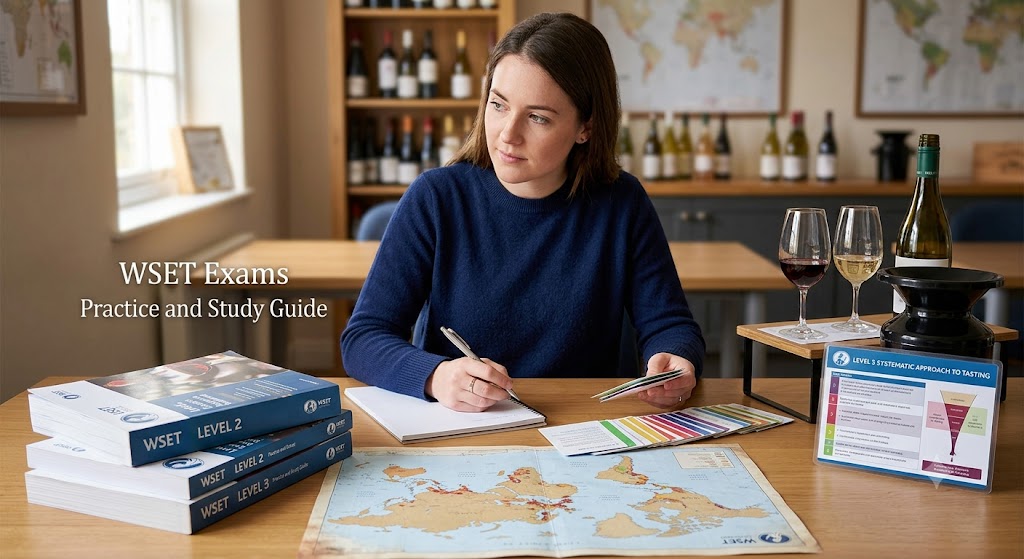
Additional Information
What the Course Entails and Exam Details
WSET courses combine theoretical knowledge with practical
sensory analysis. The specific content increases in complexity and detail as
you progress through the levels. Fundamentally, all courses aim to build an
understanding of the key factors that influence the style, quality, and price
of drinks. The common thread across all levels is the application of the WSET
Systematic Approach to Tasting (SAT), which provides a standardized framework
for describing and evaluating wines, spirits, or sake. This approach ensures
consistent communication within the global industry.
As you advance, the syllabi cover in-depth studies of global
wine regions, viticulture, winemaking, and the key categories of spirits and
sake. While a Level 1 award focuses on a basic overview and service skills, a
Level 3 award requires detailed, critical thinking and a sophisticated
understanding of regional identity and production methods. You must register
for these courses and exams through an Approved Program Provider (APP). The
course duration varies from a few hours for Level 1 to several years of study
for the Level 4 Diploma.
What to Expect in the Final Exam
While specific formats differ by level, all WSET exams are
closed-book and are designed to assess both your product knowledge and
analytical skills.
For Level 1 and Level 2 Awards, the assessment is typically
a single timed, multiple-choice exam paper.
Example breakdown for a Level 2 Award in Wines:
- Format:
50 multiple-choice questions
- Time
limit: 60 minutes
- Passing
score: 55%
For Level 3 and Level 4 Diploma, the exams become more
comprehensive, with separate units and components.
Example breakdown for a Level 3 Award in Wines:
- Unit
1 (Theory): Consists of a multiple-choice section (50 questions) and a
paper requiring short written answers. You have two hours to complete both
parts.
- Unit
2 (Practical): A blind tasting exam of two wines, requiring you to write
detailed tasting notes and identify specific attributes using the Level 3
SAT card. You have 30 minutes.
- Passing
requirement: A minimum mark of 55% in each of the two units.
How to Study and
Exam Centers
Effective study for a WSET exam involves a balanced
approach, mixing rigorous theory revision with focused tasting practice. Your
official WSET course text and study guide are the ultimate resources and should
be your primary focus.
Actionable study strategies include:
- Flashcards:
Create flashcards for key terms, grapes, regions, and rules.
- Active
Recall: Test yourself frequently on facts without looking at the
material.
- Region
Maps: Print and color-code maps of key wine regions, noting major
grapes and styles.
- Practice
the SAT: Use the WSET Systematic Approach to Tasting (SAT) card for
every tasting, making structured notes and calibrating your palate.
- Mock
Exams: Utilize any official or provider-issued practice tests to
understand the question style and time constraints.
- Writing
Practice: For Levels 3 and 4, practice writing clear, concise short
answers and essays. Focus on interpreting command words like
"describe," "explain," and "compare."
WSET exams are not taken at open testing centers; you must
register and sit them with an Approved Program Provider (APP), often the school
where you took your course. These providers can offer the exam in a physical
classroom setting. For Level 1 and Level 2, many APPs also offer online exams
via Remote Invigilation, allowing you to take the test from your home while
being digitally monitored. When choosing a school, ensure they are listed as an
Approved Program Provider on the WSET website.
Job Opportunities
from the Course
A WSET qualification is highly regarded globally and serves
as a powerful validation of expertise, opening doors to diverse career paths
within the drinks industry and beyond.
Possible job titles and roles include:
- Sommelier
(especially for Level 3 and above)
- Assistant
Sommelier or Wine Waiter (Level 2)
- Wine
Educator or Tasting Host
- Wine
and Spirits Buyer
- Retail
Manager or Wine Merchant
- Wholesale
Sales Representative
- Account
Manager for Wine and Spirits Distributors
- Brand
Ambassador for a Winery or Distiller
- Wine
Journalist or Content Creator
- Industry
Consultant
Frequently Asked Questions
Reviews
5.0
Based on 0 reviews
Leave a Review
No reviews yet. Be the first to review!