
West Virginia CDL Practice Test 2
$69.00
- Buy to unlock unlimited access to all Quiz questions.
- After purchase you can print a PDF of the whole quiz at any point. The PDF will contain the questions and the correct answers.
About this Exam
The West Virginia Commercial Driver's License (CDL) is your vital gateway to a fulfilling and essential career in the professional driving industry. This certification authorizes you to safely operate diverse commercial vehicles, such as powerful long-haul semi-trucks, school buses, city transit buses, and large delivery vans, within and across the state. Designed for individuals seeking to join the professional workforce, advance their driving careers, and contribute significantly to West Virginia's economy and infrastructure, the CDL requires applicants to demonstrate a comprehensive understanding of complex road rules, vehicle control, safety regulations, and specialized knowledge. The path involves passing both critical knowledge tests (written exams) and demanding skills tests (driving exams). Your preparation, including using tools like the West Virginia CDL Practice Test 2 and studying the official WV CDL manual, is a crucial step towards mastering the requirements and unlocking this valuable professional license.
Ready to test your knowledge?
Buy Now to Access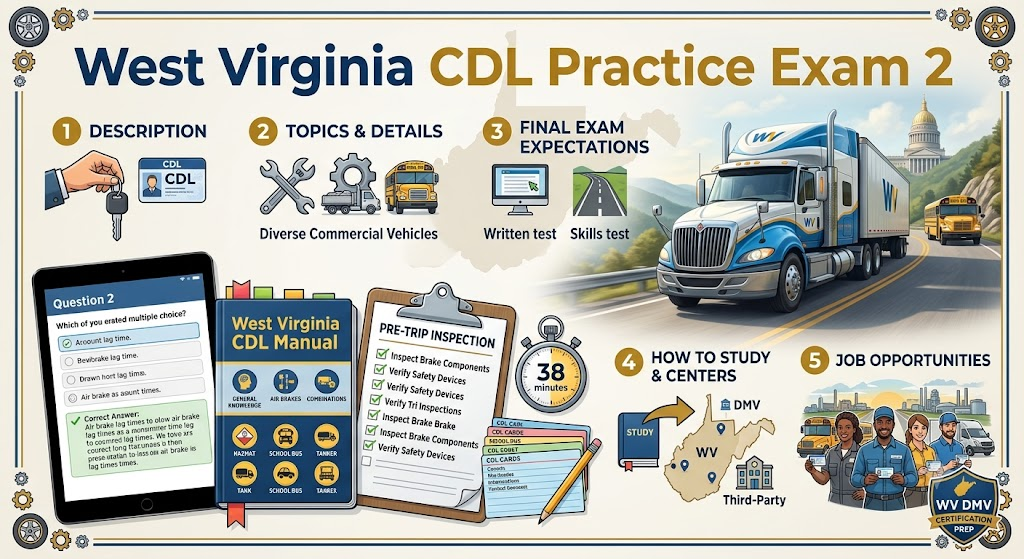
Additional Information
What the Course Entails and Exam Details
Your comprehensive journey to a West Virginia CDL encompasses a wide array of vital topics, ensuring you are thoroughly prepared for the entire exam process. The core content you must master includes:
General Knowledge: Foundational road safety, intricate traffic rules, vehicle inspection protocols (including critical pre-trip checks), basic vehicle operation, advanced space management, night driving safety, navigating challenging weather conditions, effective emergency response procedures, and cargo security guidelines.
Air Brakes: If applicable, this section covers system components, operational principles, dual air brake setups, rigorous inspection techniques, system failure recognition, and professional braking techniques.
Combination Vehicles: Required for a Class A CDL, detailing safe operation, trailer types, coupling and uncoupling procedures, combination-specific driving hazards, and space considerations.
Endorsement Specializations: Depending on your chosen career path, you'll study specialized topics like:
Passenger (P) Endorsement: Safely transporting people.
School Bus (S) Endorsement: Student loading/unloading, specialized regulations, and school bus-specific safety.
Hazardous Materials (H) Endorsement: Rigorous rules for transporting hazardous goods.
Tank Vehicle (N) Endorsement: Safe operation of liquid or gas bulk transports.
Doubles/Triples (T) Endorsement: Mastering multiple trailer combinations.
Skills Testing Preparation: While practice tests and guides prepare you for the written content, you will also need to master the practical skills tested on the road, including:
Pre-Trip Vehicle Inspection: Demonstrating the ability to identify critical parts and verify safety.
Basic Vehicle Control: Performing specific skills and maneuvers in a controlled area.
On-Road Driving: Executing various driving tasks and maneuvers safely in real traffic conditions.
The exam process requires you to first pass the knowledge tests for your intended class and endorsements at a DMV Regional Office. Upon success, you will receive a Commercial Learner Permit (CLP), which must be held for at least 14 days and may require you to complete Entry-Level Driver Training before you can schedule and attempt the skills test. The comprehensive knowledge of these subjects and mastery of physical driving skills are the cornerstones of obtaining your WV CDL.
What to Expect in the Final Exam
While you prepare using study materials and practice tests, it’s essential to understand the structure of the actual comprehensive exams you will take to earn your license:
Knowledge Tests (Written Exams):
Format: These exams consist of multiple-choice questions administered via computer at West Virginia DMV Regional Offices.
Passing Score: For each component (General Knowledge, each endorsement), you must generally achieve a score of 80% or higher to pass. For example, on a 50-question general knowledge test, you typically need to answer at least 40 questions correctly, allowing for a maximum of 10 mistakes. For a 25-question Air Brakes test, you must correctly answer at least 20.
Time Limits: West Virginia DMV offices generally do not impose a strict time limit on the CDL knowledge tests. Most applicants finish the general knowledge portion in approximately 60-90 minutes and endorsement tests in 30-45 minutes. You should plan your session carefully if taking multiple tests.
Retakes: If you do not pass a particular knowledge test, you are required to wait at least seven (7) days before retesting on that specific section. Use this time to revisit your study materials and practice tests.
Specific Rules: All CDL knowledge tests in West Virginia are administered in English, in adherence to federal regulations. You must demonstrate adequate English proficiency.
Skills Tests (Practical Driving Exams):
Prerequisites: You must hold a valid Commercial Learner Permit (CLP) for at least 14 days and may be required to complete approved Entry-Level Driver Training before attempting the skills test.
Three Parts: The comprehensive skills test in West Virginia includes three distinct components:
Pre-Trip Inspection: A structured evaluation of your ability to thoroughly inspect a commercial vehicle and explain its critical safety components.
Basic Vehicle Control: A sequence of practical driving exercises and maneuvers performed in a controlled off-road area.
On-Road Driving: A dynamic driving assessment in various real traffic conditions, which will test your overall safe driving knowledge and vehicle handling.
Who Conducts them: Unlike knowledge tests, all CDL skills tests in West Virginia are conducted by State-certified third-party testers, not the DMV. The DMV website and manual list authorized third-party testing locations and contact information.
Specific Rules: You must bring an eligible and properly functioning commercial vehicle of the class for which you are testing. You should also be prepared with all required documentation.
How to Study and Exam Centers
Preparation is paramount to your success, and following these effective strategies will greatly enhance your readiness:
Actionable Study Strategies:
Study the Official Manual Thoroughly: Your most critical resource is the official West Virginia Commercial Driver License Manual (PDF), available on the WV Division of Motor Vehicles website and at DMV regional offices. Read and re-read this manual carefully, as it is the primary source of the information tested.
Use Practice Tests Effectively: Make the most of tools like the West Virginia CDL Practice Test 2 and other available online practice tests. These resources help you familiarize yourself with the question format, quiz your knowledge across various topics, and identify areas where you need further review. Practice consistently until you are confident with all concepts. Understand why an answer is correct, not just which one it is. Look for practice materials that include detailed answer explanations to deepen your comprehension.
Focus on Rules and Regulations: Pay close attention to federal and state rules, safe driving practices, and the specifics of each knowledge and skills area, including air brakes, combinations, and endorsements.
Seek Entry-Level Driver Training (ELDT): Completion of approved ELDT is required for many applicants and is highly beneficial. Look for reputable CDL training schools in West Virginia and neighboring states to provide both theoretical and practical instruction and hands-on driving practice.
Get Practical Practice: Hands-on experience is irreplaceable for the skills test. Seek instruction and practical driving opportunities, especially for the pre-trip inspection, basic control maneuvers, and real-world driving. Understand and practice the procedures required for third-party skills tests.
Test and Exam Centers:
Knowledge Tests: You must complete knowledge testing for your intended CDL class and endorsements at a West Virginia DMV Regional Office or authorized Exam Center. These locations can be found throughout the state and are typically open during regular business hours, with some offices offering extended hours. Examples of locations mentioned in official materials include Kanawha City, Morgantown, Weirton, Franklin, Moundsville, Welch, Huntington, Parkersburg, and Williamson. Remember that third-party testing sites only conduct skills, not knowledge, exams.
Skills Tests: CDL skills tests (Pre-Trip, Basic Vehicle Control, On-Road Driving) in West Virginia are only conducted by State-certified third-party testers (e.g., approved CDL schools, trucking companies, or other authorized entities). You can find a list of authorized third-party testers on the WV DMV website and in the CDL manual. You will need to contact and schedule your skills test with an authorized third-party tester directly.
Job Opportunities from the Course
A West Virginia CDL opens a wealth of career pathways across various industries, both within the state and across the nation, supporting vital transport, construction, and public service sectors. Specific job titles and roles unlocked by this professional license include:
Class A Truck Driver: Long-haul, regional, and dedicated truck drivers operating large combinations, dry vans, flatbeds, or specialized trailers. Many roles offer weekly home time and potentially significant earning potential, especially for those with experience and endorsements.
Class B Truck Driver: Regional and local delivery drivers, dump truck operators, waste management drivers, and drivers of other non-combination vehicles.
Bus Driver:
School Bus Driver: Crucial roles in student transport, requiring Passenger (P) and School Bus (S) endorsements.
Charter & Public Transit Bus Driver: Operating for tour companies or public transit systems, requiring a Passenger (P) endorsement.
Local Delivery & Route Driver: Driving Class B or Class C vehicles for food service, retail, and general delivery, often with daily home time.
Heavy Equipment Operator & Commercial Vehicle Driver: Roles requiring CDL in construction, mining, and remediation settings for hauling equipment or operating large vehicles like grapple trucks or dump trucks.
Tanker Vehicle Driver: Transporting bulk liquids or gases, requiring a Tank Vehicle (N) endorsement and potentially a Hazardous Materials (H) endorsement.
Hazardous Materials Transporter: Driving vehicles carrying hazardous substances, requiring a Hazardous Materials (H) endorsement.
Foreman/Operations Supervisor: Experienced commercial drivers may advance into leadership roles with transportation or logistics companies.
Earning your WV CDL signifies specialized knowledge and skill, making you a highly marketable professional with competitive earning potential, comprehensive benefits (e.g., healthcare, 401(k), paid time off, sign-on bonuses), and essential job security within the critical transportation industry. The state’s diverse landscape, spanning everything from mountainous areas to industrial zones, and the consistent demand for professional drivers contribute to a dynamic job market.
We hope this study guide proves useful for your final exam. You can download this guide for your own private study or share it with others. Good luck with your study, and we hope to see you on the road in the near future!
Frequently Asked Questions
Reviews
5.0
Based on 0 reviews
Leave a Review
No reviews yet. Be the first to review!