
Washington CDL Air Brakes Practice Test
$69.00
- Buy to unlock unlimited access to all Quiz questions.
- After purchase you can print a PDF of the whole quiz at any point. The PDF will contain the questions and the correct answers.
About this Exam
The Washington CDL Air Brakes Practice Test is a crucial stepping stone for any current or prospective commercial driver in the state of Washington who intends to operate a vehicle equipped with an air brake system. This assessment is not for an additional endorsement; rather, it is the required knowledge test to remove the "No Air Brakes" restriction (Restriction L) from your Commercial Driver's License (CDL). Successfully passing this test demonstrates that you possess the necessary understanding of air brake systems, components, and safe operational procedures. It is designed for drivers of heavy vehicles, such as semi-trucks, tractor-trailers, various types of buses, and large construction or delivery vehicles that rely on this critical safety technology.
A CDL with the air brake restriction removed is a requirement for the vast majority of professional driving careers involving larger vehicles, significantly broadening your career opportunities and ensuring you meet essential safety standards.
Ready to test your knowledge?
Buy Now to Access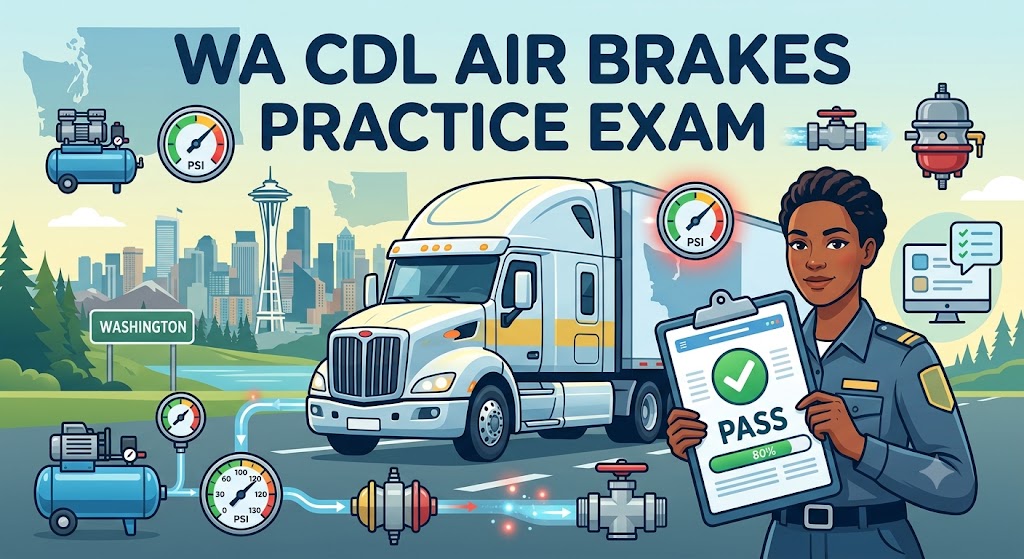
Additional Information
What the Course Entails and Exam Details
This "course" isn’t typically a structured,
in-person class but refers to your comprehensive self-study or preparation
using the official Washington State CDL Manual (specifically the Air
Brakes section) and various high-quality practice materials. To prepare, you
will need to master a detailed syllabus covering:
- The
Basics of Air Brake Systems: How air is compressed, stored, and used
to apply the brakes.
- Air
Brake Components: Understanding the function and importance of dual
air systems, compressors, governors, air storage tanks, drain valves,
safety valves, brake pedals, brake chambers, slack adjusters, brake
drums/discs, S-cam systems, wedge brakes, and spring brakes.
- Dual
Air Brake Systems: Recognizing the differences and increased safety of
dual systems, including how to identify which system applies.
- System
Knowledge and Operation: Reading air pressure gauges, recognizing and
reacting to low-pressure warning devices, and understanding the
cut-in/cut-out pressure settings.
- Inspection
Procedures: Mastering the steps for a pre-trip and ongoing air brake
inspection, including the static and applied pressure tests, the low air
warning test, and the automatic emergency brake tests.
- Safe
Driving Techniques: Knowing how to properly use air brakes in normal
driving, emergency situations (including stability and control, and proper
use of parking and emergency brakes), and techniques for long, steep
downgrades, preventing overheating and fade.
Exam Details:
The official exam is a comprehensive, multiple-choice
knowledge test administered by the Washington Department of Licensing (DOL).
The exact number of questions may vary slightly with different test versions,
but you can typically expect around 15-25 targeted questions designed to
thoroughly assess your proficiency. The primary requirement for success is:
- Passing
Score: You must achieve a minimum score of 80%. This means you
can only afford to answer a few questions incorrectly.
What to Expect in
the Final Exam
When you arrive for your scheduled test at a WA DOL
facility, you can expect the following:
- Format:
The test will be presented in a multiple-choice format, often taken on a
computer. Each question is carefully crafted to test either direct factual
knowledge, procedural sequences, or safe driving judgment related to air
brakes.
- Environment:
The testing area will be professional and controlled. All materials,
personal devices (especially smartphones), and unofficial notes must be
put away.
- Questions:
The questions will be directly derived from the information contained in
the official Washington State CDL Manual's air brakes section. You may
encounter diagrams and must be able to identify system components or
correct operational steps.
- Results:
Upon completing the test, your score and pass/fail status should be
immediately generated.
- Time
Limits: While typically not strictly limited by a ticking clock in the
same way some exams might be, there is a reasonable expectation to
complete the test within the session timeframe. Be prepared and focused.
- Retakes:
In the event that you do not pass, you will need to wait and retake the
test. The WA DOL typically imposes a minimum one-day waiting period, and a
re-examination fee may apply for subsequent attempts.
The best approach is diligent preparation so you can
confidently walk in and pass on your very first try!
How to Study and
Exam Centers
Preparation is paramount. Here are actionable study
strategies and information on where and how to take your exam:
How to Study
Master the Manual: Your
primary and most authoritative study resource is the Washington State CDL
Handbook. Deeply read and thoroughly understand Section 5 (Air Brakes).
This section is the source of all exam questions. Re-read critical concepts,
take notes, and memorize inspection sequences and pressure ranges.
Take Practice Tests: This
is crucial. Use multiple high-quality online practice tests (like those
found on Driving-Tests.org, CDLtest.co, or commercial training sites) to
simulate the exam experience. This helps reinforce knowledge, identify weak
areas, and become comfortable with the multiple-choice format and phrasing.
Focus on understanding the reasoning behind the correct answers, not
just memorizing.
Create Study Aids: Use
flashcards for key components, terms, and pressure values. Write out the steps
for the pre-trip air brake inspection sequence multiple times until it becomes
second nature.
Visualize and Observe: If
possible, observe a pre-trip inspection being performed on a real vehicle.
Watch video tutorials that clearly show the components and procedures.
Visualizing the systems can make abstract concepts much clearer.
Be Consistent: Dedicate
regular time each day to study and practice. Breaking down the material over a
period is much more effective than cramming.
Exam Centers & Process
In Washington, you will typically take your CDL knowledge
tests, including the air brakes test, at a Department of Licensing (DOL)
office.
Find a DOL Office: Visit
the official WA DOL website to
find the nearest location that offers CDL testing. While some skills tests are
at specific sites, knowledge tests are available at numerous DOL offices across
the state, including major areas like Seattle, Tacoma, Spokane, Everett,
Vancouver, and many others.
Check for Scheduling/Walk-ins:
DOL offices often require or strongly recommend that you schedule an
appointment in advance for knowledge tests. Check their current policies and
available appointment times online or by calling the office directly. Some
locations may offer limited walk-in services, but appointments are generally
safer and more efficient.
Gather Required Documents:
Before you go, ensure you have all necessary documentation, including your
current Washington driver's license (or other proof of identity and residency),
your existing CDL (if applicable), any required medical certification, and any
applicable fees. Consult the WA DOL website for the exact requirements.
Authorized CDL Training
Schools: While the ultimate testing for knowledge occurs at the DOL, some
authorized CDL training schools in Washington might incorporate the knowledge
test or provide training that culminates in taking the test directly, or guide
you through the process effectively. The formal final testing environment is
typically a state-run facility, but schools are invaluable resources for
comprehensive education.
Job Opportunities
from the Course
A CDL with the air brake restriction removed (Restriction L
removed) is not just a qualification; it is a gateway to the majority of
high-paying and diverse careers in commercial driving. Here are specific job
titles and career paths this certification unlocks or significantly enhances:
- Long-Haul
Truck Driver: Operating large tractor-trailers across state lines.
- Regional
Delivery Driver: Driving large trucks for localized deliveries (e.g.,
fuel, groceries, furniture).
- Transit
Bus Driver: Providing public transportation on city bus routes.
- School
Bus Driver: Safely transporting students (requires additional
passenger endorsement P & S).
- Motorcoach
Driver: Operating large, comfortable coaches for charter tours,
cross-country travel, and private groups.
- Construction
Vehicle Operator: Driving heavy construction equipment requiring a CDL
(e.g., dump trucks, ready-mix concrete trucks, large cranes).
- Waste
Management/Refuse Driver: Operating residential or commercial trash
collection trucks.
- Utility
& Service Vehicle Driver: Driving large service trucks for
utilities (electric, water, telecommunications) or municipal services.
- Hazardous
Materials Hauler: Driving specialized tanker or freight trucks
(requires H endorsement).
- Freight
& Cargo Transport: Working in logistics and freight distribution
with large vehicle fleets.
Frequently Asked Questions
Reviews
5.0
Based on 0 reviews
Leave a Review
No reviews yet. Be the first to review!