
VTNE Laboratory Procedures Practice Test Questions Answers
$69.00
- Buy to unlock unlimited access to all Quiz questions.
- After purchase you can print a PDF of the whole quiz at any point. The PDF will contain the questions and the correct answers.
About this Exam
The Veterinary Technician National Examination (VTNE) is the critical gateway for aspiring veterinary technicians to gain their professional credentials in the United States and Canada.
Owned and administered by the American Association of Veterinary State Boards (AAVSB), this rigorous computer-based exam evaluates the entry-level competency of graduates from AVMA- or CVMA-accredited veterinary technology programs.
Becoming a Registered, Licensed, or Certified Veterinary Technician (RVT, LVT, CVT) demonstrates your commitment to the field and confirms you possess the essential knowledge needed to provide exceptional animal care.
This specific practice resource focuses intently on one of the nine primary domains of the VTNE: Laboratory Procedures.
Successful technicians must be proficient in a wide range of diagnostic tests, and this module is designed to challenge your understanding of sample handling, analysis, and interpretation for a variety of species.
Whether you are fresh out of school or reviewing before your scheduled test window, these practice questions will help you identify weak areas and build the confidence required to pass the VTNE on your first attempt.
Ready to test your knowledge?
Buy Now to Access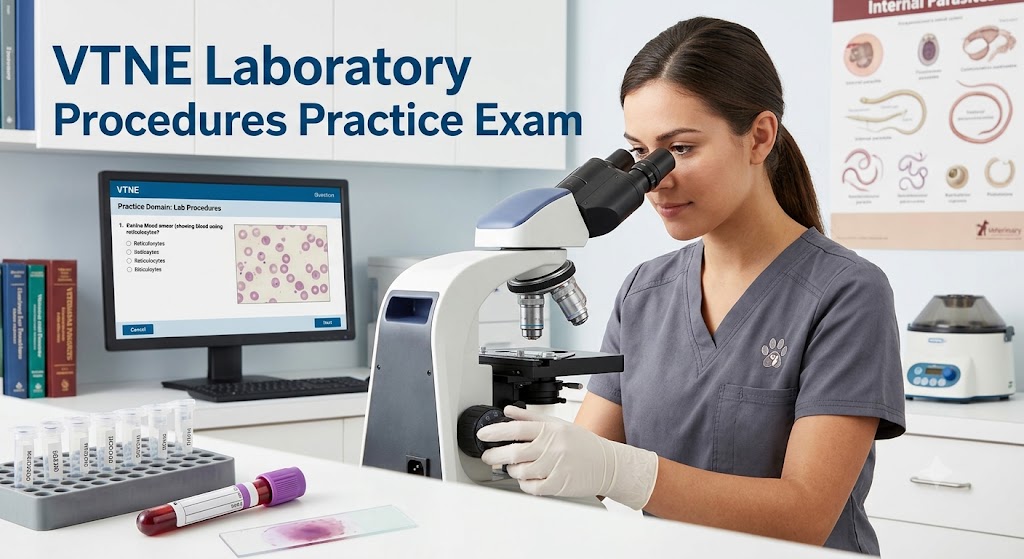
Additional Information
What the Course Entails and Exam Details
The Laboratory Procedures domain of the VTNE is not just about identifying cells under a microscope; it covers the holistic management of the veterinary diagnostic lab.
This section evaluates your ability to properly collect, handle, and store specimens to ensure test integrity.
You must demonstrate expertise in operating, troubleshooting, and maintaining common laboratory equipment, such as centrifuges, refractometers, and automated analyzers.
Core topics covered within this practice exam and the actual VTNE Laboratory Procedures domain include:
Hematology and Coagulation: Understanding complete blood counts (CBC), identifying blood cell morphology, performing packed cell volumes (PCV), and assessing clotting functions.
Urinalysis: Performing physical, chemical (dipstick), and microscopic examination of urine sediment.
Parasitology: Identifying internal parasites via fecal flotation, sedimentation, or direct smears, and recognizing external parasites.
Clinical Chemistry: Understanding common chemistry panels, evaluating organ function (e.g., kidney, liver), and handling serum/plasma samples.
Microbiology and Mycology: Collecting samples for culture, performing Gram staining, and identifying common bacterial and fungal pathogens.
Cytology and Immunology: Preparing slides for cytological examination and understanding basic immunologic testing principles.
What to Expect in the Final Exam
When you arrive at the testing center for the actual VTNE, you will be taking a comprehensive exam that includes Laboratory Procedures alongside eight other domains.
The VTNE is a three-hour, computer-based examination consisting of 170 multiple-choice questions.
It is important to know that while there are 170 questions, only 150 are operational and count toward your final score.
The remaining 20 questions are pilot questions being tested for future exams and are scattered throughout the test; you will not know which questions are which, so you must treat every question as if it counts.
The scores are scaled, ranging from 200 to 800.
To pass, you must achieve a scaled score of 425 or higher.
The Laboratory Procedures domain traditionally makes up approximately 12% to 14% of the exam questions.
This means you can expect around 20 to 24 questions strictly focused on lab techniques during your three-hour window.
How to Study and Exam Centers
Preparation is key to conquering the VTNE.
Because Laboratory Procedures relies heavily on visual identification (parasites, blood cells, urine sediment), your study strategy must include strong visual components.
We recommend creating or using flashcards for visual recognition and "medical math" formulas used in lab calculations.
Utilize comprehensive review textbooks, such as "Mosby's Comprehensive Review for Veterinary Technicians," and engage in spaced repetition testing.
Taking practice exams like this one is one of the most effective ways to study because it simulates the pressure of the actual test format and helps you improve your pacing.
Registering and Taking the Exam:
You must apply to take the VTNE through the AAVSB website during specific application windows, which occur three times a year (spring, summer, and winter).
Once your eligibility is confirmed by your state board and the AAVSB, you will receive an Authorization to Test (ATT) letter.
The VTNE is administered by a third-party proctoring service.
You will need to schedule your specific appointment at a dedicated physical testing center, typically managed by companies like Prometric or PSI, which have locations throughout the U.S. and Canada.
Make sure to arrive at the testing center early with the required identification listed in your ATT letter.
Job Opportunities from the Course
Successfully passing the VTNE and earning your credentials dramatically expands your career horizons and earning potential.
Veterinary practices actively seek credentialed technicians because they are legally allowed to perform a wider range of duties than non-credentialed assistants.
Proficiency in laboratory procedures is highly valued in many specialized settings.
Here are specific job opportunities and career paths that passing the VTNE unlocks:
Registered/Licensed Veterinary Technician (RVT/LVT) in Private Practice: Performing diagnostics, anesthesia monitoring, and nursing care in companion animal, exotic, or mixed practices.
Specialty Technician (Internal Medicine): Focusing deeply on laboratory diagnostics and advanced care in a specialty referral hospital.
Veterinary Laboratory Specialist: Working specifically within high-volume commercial veterinary diagnostic laboratories.
Research Veterinary Technician: Assisting in biomedical research settings, ensuring humane animal care and managing laboratory protocols.
Zoo and Wildlife Technician: Providing specialized diagnostic lab support for exotic and wild species in captivity or rehabilitation.
Veterinary Technology Educator: Teaching the next generation of technicians in AVMA-accredited programs.
Hospital Manager or Practice Manager: Utilizing your technical background to manage clinical operations.
Frequently Asked Questions
Reviews
5.0
Based on 0 reviews
Leave a Review
No reviews yet. Be the first to review!