
VTNE Diagnostic Imaging Practice Test Questions Answers 2026
$69.00
- Buy to unlock unlimited access to all Quiz questions.
- After purchase you can print a PDF of the whole quiz at any point. The PDF will contain the questions and the correct answers.
About this Exam
The Veterinary Technician National Examination (VTNE) is the critical gateway to becoming a credentialed Veterinary Technician in the United States and Canada. This standardized exam validates that entry-level technicians possess the essential knowledge required to practice competently and safely. It is designed for graduates of veterinary technology programs accredited by the American Veterinary Medical Association (AVMA) or the Canadian Veterinary Medical Association (CVMA). This article specifically highlights the Diagnostic Imaging domain, which is a key component of the overall exam, focusing on your ability to produce high-quality medical images while adhering to vital safety protocols.
Ready to test your knowledge?
Buy Now to Access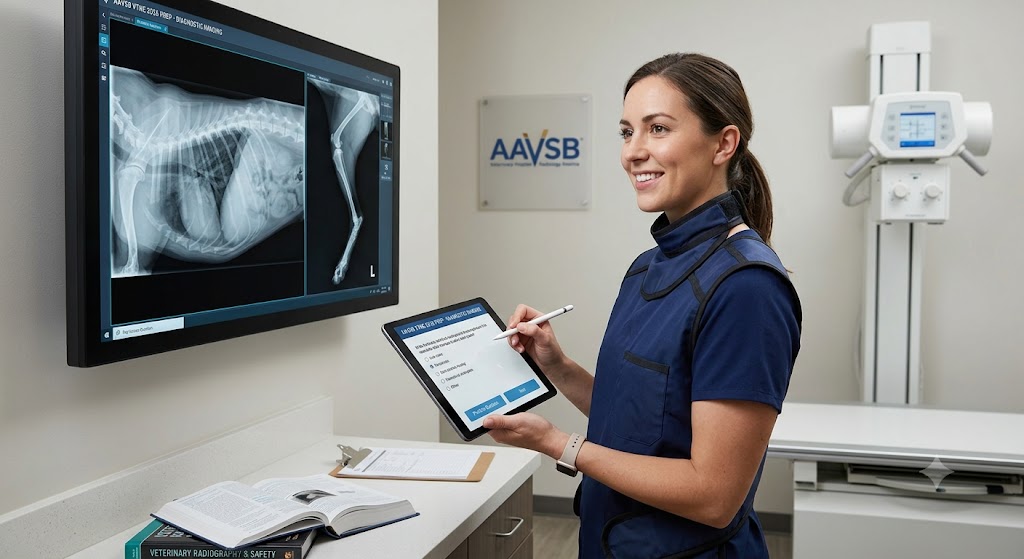
Additional Information
What the Course Entails and Exam Details
As part of your preparation for the diagnostic imaging section of the VTNE, you must master several core competencies essential to daily clinical practice. This domain does not exist as a separate course but is a vital skill set acquired during your veterinary technology education.
The content area encompasses three main pillars:
Producing Diagnostic Images: This includes mastering patient positioning for various species and views (such as orthogonal radiographs, skull, or dental), selecting appropriate exposure factors (kVp, mAs), and utilizing alternative modalities like ultrasound when indicated.
Equipment and Material Maintenance: Candidates are tested on their ability to operate, troubleshoot, and maintain radiology equipment, including digital radiography (DR) and computed radiography (CR) systems, processors, and safety gear.
Safety Protocols: Above all, the VTNE emphasizes radiation safety. You must know how to properly use personal protective equipment (PPE), apply dosimetry principles, implement collimation, and understand the biological effects of radiation to protect yourself, the patient, and your team.
What to Expect in the Final Exam
The diagnostic imaging section is not a standalone exam; it is a dedicated "domain" within the full Veterinary Technician National Examination.
Here is what you can expect from the VTNE 2026 structure:
Exam Format: The full VTNE is a computer-based, multiple-choice examination.
Total Questions: You will answer 170 multiple-choice questions total.
Scored Questions: Only 150 of these questions count toward your final score. The remaining 20 are "pilot" questions being pre-tested for future exams and are not identified.
Time Limit: You are allotted three (3) hours to complete the entire exam.
Imaging Weight: The Diagnostic Imaging domain typically represents approximately 7% of the scored questions (roughly 10-11 questions).
Passing Score: The passing score is determined by the American Association of Veterinary State Boards (AAVSB) using a scaled scoring system; a scaled score of 425 is generally required to pass.
How to Study and Exam Centers
Preparation for the VTNE Diagnostic Imaging section requires a strategic blend of theoretical knowledge and practical application.
Review Core Textbooks: Focus your study on the relevant chapters of primary veterinary technology texts, such as McCurnin's Clinical Textbook for Veterinary Technicians and Mosby's Comprehensive Review for Veterinary Technicians.
Utilize Focused Practice Tests: Dedicate significant time to practice test questions labeled specifically under "Diagnostic Imaging." Review not only the correct answers but also the rationale for why other options were incorrect.
Master Positioning and Safety: Practice creating positioning charts and radiation safety checklists. Visualize or physically practice positioning models to solidify your understanding of anatomical landmarks and beam center.
Simulate Exam Conditions: In the weeks leading up to the exam, take full-length practice tests to improve your pacing and build stamina for the three-hour testing window.
Where and How to Take the Exam
The VTNE is administered by the American Association of Veterinary State Boards (AAVSB).
You must first apply through the AAVSB portal and receive an Authorization to Test (ATT) letter. Once you have this letter, you will schedule your exam through the authorized test vendor. For 2026, the AAVSB partners with PSI testing centers. You can choose to take the exam at a physical PSI center located throughout the US and Canada, or you may have the option for Live Remote Proctoring (LRP) if your setup meets strict security requirements.
Job Opportunities from the Course
Successfully passing the VTNE is the definitive step to earning your credential (CVT, RVT, or LVT depending on your jurisdiction). This certification is often mandatory for employment and unlocks numerous specialized career paths within the veterinary industry.
Unlock job titles such as:
Credentialed Veterinary Technician (General Practice)
Veterinary Technician Specialist (VTS) in Diagnostic Imaging
Emergency and Critical Care Veterinary Technician
Radiology Department Supervisor/Lead Technician
Research Veterinary Technician (Biomedical/Pharmaceutical)
Veterinary Application Specialist (Imaging Equipment Sales/Training)
Zoo or Wildlife Veterinary Technician
Anesthesia and Surgical Veterinary Technician
Frequently Asked Questions
Reviews
5.0
Based on 0 reviews
Leave a Review
No reviews yet. Be the first to review!