
VTNE Anesthesia and Analgesia Practice Test 2026
$69.00
- Buy to unlock unlimited access to all Quiz questions.
- After purchase you can print a PDF of the whole quiz at any point. The PDF will contain the questions and the correct answers.
About this Exam
Welcome to your comprehensive guide to mastering the most critical components of your upcoming Veterinary Technician National Examination. The VTNE Anesthesia and Analgesia Practice Test 2026 is an essential tool designed exclusively for veterinary technician students and graduates preparing for their credentialing exam. Passing the VTNE is the vital final step toward becoming a Certified, Licensed, or Registered Veterinary Technician (CVT, LVT, RVT) in North America. This specialized practice resource focuses specifically on two of the highest-stakes domains on the entire exam: Anesthesia and Pain Management/Analgesia. These areas require not only rote memorization but also critical thinking and real-world application of physiology and pharmacology. By using this practice test, you are prioritizing patient safety and proving your readiness to handle complex, real-life surgical scenarios.
Ready to test your knowledge?
Buy Now to Access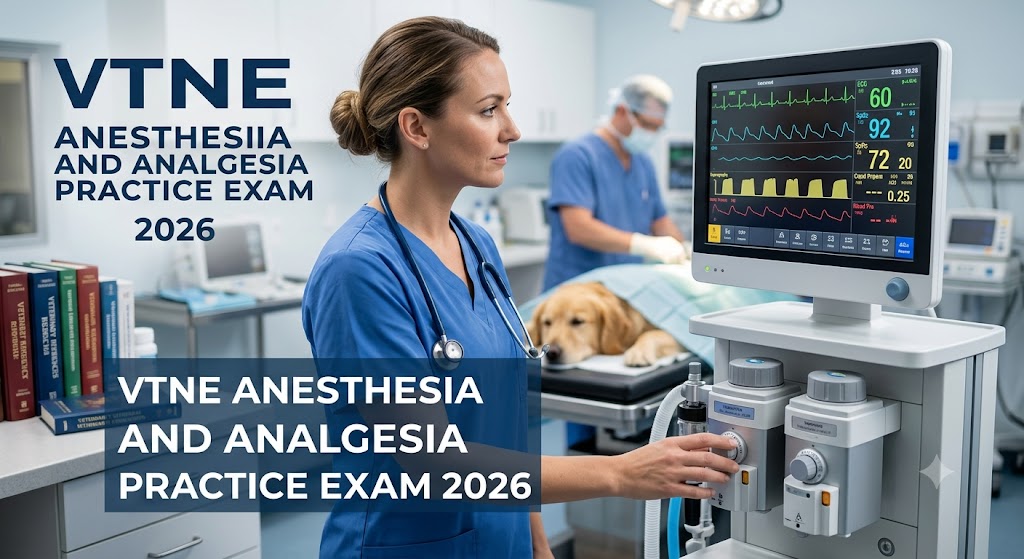
Additional Information
What the Course Entails and Exam Details
A practice course focused on the Anesthesia and Analgesia domains is extensive, aiming to duplicate the cognitive demand of the actual VTNE. You must prove fluency in the full cycle of patient care. In the Anesthesia domain, the curriculum covers pre-anesthetic patient assessment, including physical exam findings and ASA physical status classification. You will practice developing appropriate anesthetic plans, choosing pre-medications, and managing the induction and maintenance phases using both injectable and inhalant agents. Crucial knowledge includes mastery of the anesthesia machine, breathing systems, and comprehensive monitoring of vital signs like ECG, capnography, and blood pressure. You must also be prepared to recognize and troubleshoot anesthetic complications and manage a smooth recovery phase. In the Analgesia domain, the course requires understanding pain physiology, recognizing pain behavior in varied species, and applying multi-modal pain management strategies. This includes mastery of drug classes such as opioids, NSAIDs, local anesthetics, and alpha-2 agonists.
What to Expect in the Final Exam
While this practice resource is specialized, it is vital to understand the structure of the actual final VTNE you will take for your credentials. The VTNE is a rigorous computer-based examination consisting entirely of 170 multiple-choice questions. Only 150 of these questions are scored, while the remaining 20 are pilot questions being pre-tested for future exams. You will not know which questions are which. You will have exactly three hours (180 minutes) to complete the entire test. The domains covered by this practice test are heavily represented on the real VTNE: the Anesthesia domain traditionally accounts for approximately 22 questions, and the Pain Management/Analgesia domain accounts for approximately 11 questions. Together, these two critical areas make up nearly 25% of your total scored exam, making mastery here absolutely non-negotiable for success.
How to Study and Exam Centers
Effective study for the Anesthesia and Analgesia domains requires a mix of active recall and practical simulation. When using this practice test, do not merely identify the correct answer. Take the time to understand the rationales provided for why the correct answer is best, and—crucially—why the distractors are wrong. Anesthesia questions often involve "best next step" scenarios, so critical thinking is essential. Create flashcards for drug dosages, reversal agents, and specific side effects of common anesthetics. Draw and label the anesthesia machine gas flow pathway multiple times until you can do it from memory. Study groups are excellent for discussing complex cases and troubleshooting scenarios. When you are ready for the official VTNE, the exam is administered by the American Association of Veterinary State Boards (AAVSB) and is delivered primarily through specialized Pearson VUE testing centers located throughout the United States and Canada, though live remote proctoring options may be available under specific circumstances.
Job Opportunities from the Course
Successfully passing the VTNE and becoming a credentialed Veterinary Technician opens a multitude of professional pathways where your specialized knowledge in anesthesia and analgesia will be highly valued.
Credentialed Veterinary Technician (CVT/LVT/RVT) in General Practice
Anesthesia Veterinary Technician Specialist (VTS - Anesthesia/Analgesia)
Surgical Veterinary Technician in Specialty Hospitals
Emergency and Critical Care Veterinary Technician
Research Veterinary Technician (handling anesthesia for varied species)
Zoo or Exotic Animal Technician (specialized anesthesia)
Anesthesia Lead Technician in large referral centers
Veterinary Technologist Educator
Frequently Asked Questions
Reviews
5.0
Based on 0 reviews
Leave a Review
No reviews yet. Be the first to review!