
Virginia CDL Practice Test
$69.00
- Buy to unlock unlimited access to all Quiz questions.
- After purchase you can print a PDF of the whole quiz at any point. The PDF will contain the questions and the correct answers.
About this Exam
The Virginia Commercial Driver's License (CDL) Practice Test is your essential first step towards a rewarding and high-demand career in the transportation industry. This is not the final official exam but a powerful practice tool specifically designed for individuals aspiring to drive commercial motor vehicles (CMVs) legally in the Commonwealth of Virginia. Whether you aim to command a massive semi-truck, navigate city streets in a bus, or transport specialized goods in a tanker, this practice test accurately simulates the official general knowledge exam. This critical step confirms your grasp of the theoretical foundation required by both the Virginia Department of Motor Vehicles (DMV) and federal regulations to safely operate heavy or specialized vehicles.
Ready to test your knowledge?
Buy Now to Access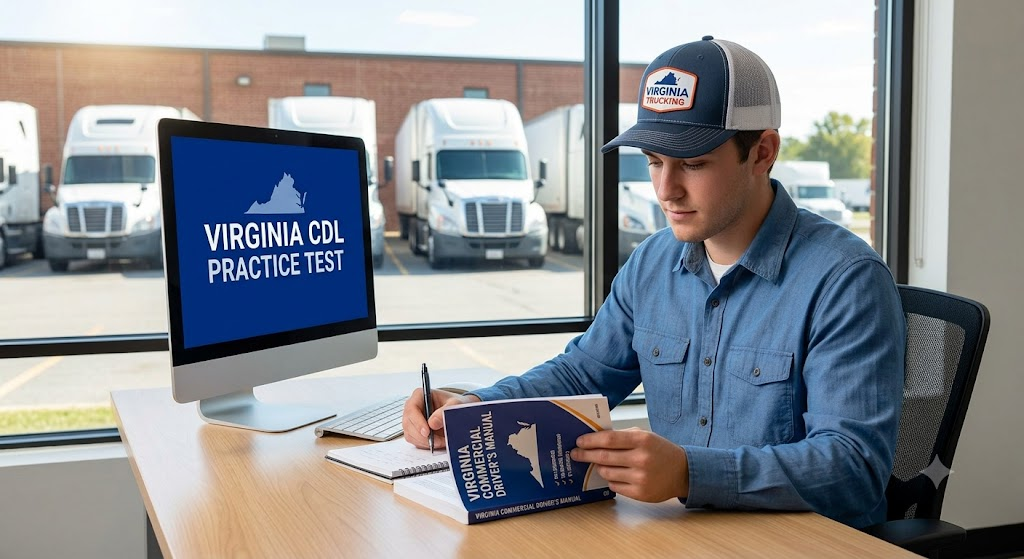
Additional Information
What the Course Entails and Exam Details
Preparation for the Virginia CDL begins with a deep dive into the mandatory material found in the Virginia Commercial Driver’s License Manual, which can be easily obtained through the Virginia DMV. The primary focus for all applicants, and what this main practice test rigorously evaluates, is the "General Knowledge" section. This essential section is mandatory for any class of CDL and covers the critical universal rules of the road for heavy vehicles, including complex braking techniques (both standard and air brakes), intricate maneuvering procedures, and strict federal safety regulations (such as hours-of-service limitations). It’s important to note that the official testing process usually involves adding specific "endorsements" based on the exact type of vehicle you intend to drive and the cargo you will transport. Common supplementary tests you will need to master include "Passenger Transport" for bus drivers, "School Bus" (which often requires the Passenger endorsement first), "Tanker Vehicles" for hauling liquids or gases, "Hazardous Materials (HazMat)" which requires a prerequisite background check and fingerprinting, and "Double/Triple Trailers." While this guide focuses on the universal General Knowledge test, candidates often take multiple practice exams tailored to each endorsement they require.
What to Expect in the Final Exam
When you feel fully prepared, you will take the official written exams at a local Virginia DMV customer service center. These exams are delivered digitally on computers, ensuring instantaneous grading and immediate results. The core "General Knowledge" exam is comprehensive, demanding that you answer a minimum of 80% of the questions correctly to achieve a passing score. The questions themselves are multiple-choice, derived entirely from the comprehensive Virginia CDL Manual. There are no surprise time constraints mentioned specifically for the Virginia test, although the number of questions (often in the 50-question range for general knowledge) dictates that efficient, well-practiced candidates perform best. Importantly, the official licensing process requires candidates to pass these multiple-choice knowledge tests first, before they are granted a Commercial Learner's Permit (CLP). Once you possess a CLP, you must wait a required period and then successfully complete the three-part "Skills Test," which is the final practical component, typically taken in the type of vehicle you are licensed for. This skills test includes a detailed pre-trip inspection, rigorous basic vehicle control maneuvers (such as backing and parking), and a thorough on-road driving evaluation with a certified state examiner. You must pass all components of the knowledge and skills tests to obtain your official Commercial Driver's License.
How to Study and Exam Centers
Effective study strategies are crucial for success, given the depth and breadth of the material. Your foundational, mandatory resource is the official Virginia CDL Manual, which you should read cover-to-cover multiple times. The most effective actionable strategy is to integrate continuous practice using online simulators. High-quality practice tests, such as those that closely mirror the phrasing and difficulty of the official DMV questions, are vital for identifying gaps in your knowledge and familiarizing yourself with the multiple-choice format. You should prioritize taking these practice tests repeatedly, carefully reviewing the rationale behind any answers you get incorrect, until you consistently achieve a score of 90% or higher. For comprehensive training that covers the complex practical skills test, many students enroll in state-approved and authorized CDL training schools across Virginia. To find official written testing, you must visit a physical Virginia DMV customer service center during their standard business hours. It is highly recommended to check the DMV website beforehand to confirm the specific center offers CDL testing, verify acceptable payment methods (typically credit/debit, check, or cash for exam fees), and determine if an appointment is necessary. For the final practical Skills Test, locations can vary widely, sometimes administered at specific DMV hubs, dedicated large-vehicle testing grounds, or occasionally by authorized third-party examiners at CDL training facilities. Always confirm the exact location and requirements for your Skills Test when you register for it after obtaining your CLP.
Job Opportunities from the Course
Earning your Commercial Driver’s License in Virginia opens doors to diverse and financially rewarding career paths. Successfully passing your Virginia CDL practice test marks the true starting point, eventually enabling you to secure numerous job roles, including:
Regional Truck Driver: Focuses on shorter routes within several neighboring states, often delivering goods to major distribution hubs and warehouses.
Over-the-Road (OTR) Truck Driver: These long-haul drivers traverse the entire country, managing extensive cross-country logistics and moving a vast range of industrial or consumer products.
City Transit Bus Driver: Vital for urban infrastructure, this role involves safely navigating busy city routes while operating large passenger buses.
School Bus Driver: Requires specific endorsements for passenger and school bus operation, ensuring the safe transport of students on established routes.
Charter Bus Driver: Operates buses for organized groups, private organizations, or touring companies, often traveling on variable, non-standard routes.
Fuel Delivery Driver: A specialized role requiring tanker and hazardous materials endorsements to transport gasoline or diesel safely.
Food and Beverage Distributor: Local and regional delivery of products from manufacturers to retail and food service locations, demanding precision and often physical unloading.
Industrial Waste Driver: Operates large trucks for the removal of municipal, recycling, or specialized industrial waste.
Dump Truck Operator: Frequently engaged in construction or landscaping projects, transporting aggregate materials, soil, or debris.
Frequently Asked Questions
Reviews
5.0
Based on 0 reviews
Leave a Review
No reviews yet. Be the first to review!