
Utah CDL Practice Test
$69.00
- Buy to unlock unlimited access to all Quiz questions.
- After purchase you can print a PDF of the whole quiz at any point. The PDF will contain the questions and the correct answers.
About this Exam
The Utah Commercial Driver’s License (CDL) Practice Test is a critical preparatory tool designed for aspiring commercial truck and bus drivers in the state of Utah. This resource is essential for anyone aiming to obtain their Commercial Learner Permit (CLP) and, eventually, their full CDL. The certification is designed for individuals seeking a stable, rewarding career in the transportation industry, covering the essential knowledge required to operate heavy vehicles safely and legally on Utah roads. Whether you are pursuing a Class A, Class B, or Class C license, mastering the material on this practice test is the first step toward professional driving success.
Ready to test your knowledge?
Buy Now to Access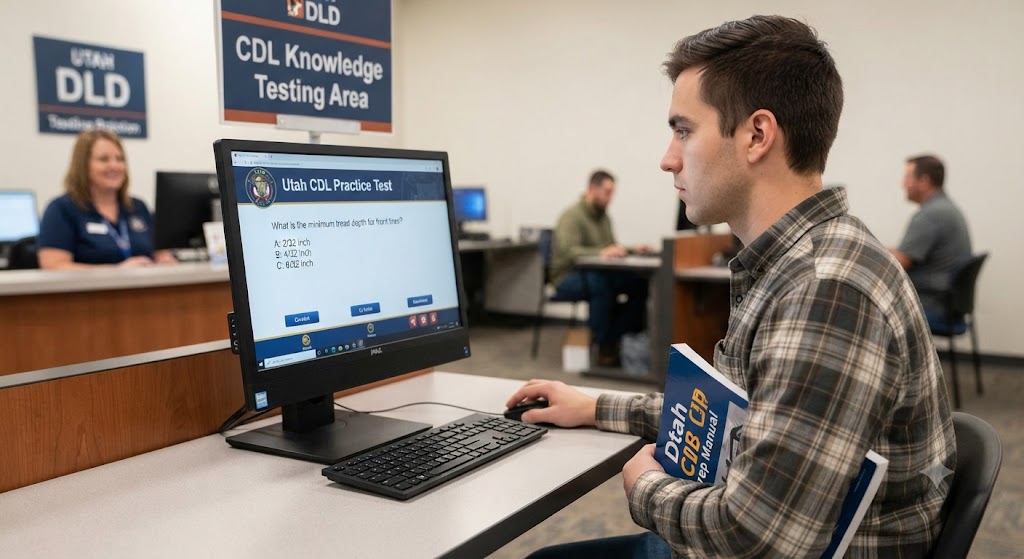
Additional Information
What the Course Entails and Exam Details
Before taking the final Utah CDL exam, you must understand
that the process is structured into two main phases: the written knowledge test
and the behind-the-wheel skills test. The Utah CDL Practice Test specifically
helps you prepare for the knowledge examinations.
The comprehensive written exams cover several core topics
mandated by the Federal Motor Carrier Safety Administration (FMCSA) and adopted
by the Utah Driver License Division (DLD). To earn your CLP, you must pass the
General Knowledge exam. Additionally, depending on the type of vehicle you plan
to drive and the cargo you will transport, you must pass specific endorsements.
The primary subjects and endorsements covered in the study
materials include:
- General
Knowledge: This is mandatory for all applicants and covers vehicle
inspection, basic control, shifting, managing space, controlling speed,
hazard recognition, driving in emergencies, and the effects of alcohol and
drugs.
- Air
Brakes: Required if your vehicle is equipped with air brakes. This
section covers the air brake system, including parts, dual air brake
systems, inspection, and use.
- Combination
Vehicles: Essential for operating Class A vehicles (tractor-trailers).
This covers combination vehicle safety, coupling and uncoupling, and light
checks.
- HazMat
(Hazardous Materials): Required if you will transport materials that
require placarding. This involves strict federal regulations regarding
identification, placarding, loading, and driving protocols.
- Tanker
Vehicles: Necessary for hauling liquids or gases in bulk.
- Passenger
Transport: Required for driving buses designed to carry 16 or more
people, including the driver.
- School
Bus: An advanced endorsement requiring specific knowledge about
student safety, loading/unloading zones, and emergency procedures.
What to Expect in the Final Exam
When you feel prepared and take the actual CDL written exam
at a Utah DLD office, you will encounter a structured test format.
- Format:
The exams consist of multiple-choice questions presented on a computer
terminal.
- Passing
Score: You must achieve a passing score of at least 80% on each
knowledge test you attempt.
- Time
Limits: While the practice tests may have timers, the actual written
exams at the DLD are generally not timed. You will have sufficient time to
read and answer each question carefully.
- Test
Structure: The questions are randomly generated from a large pool,
meaning mere memorization of a single practice test is insufficient. You
must understand the concepts.
- Fees
and Retakes: You will pay a fee when you take the knowledge test. If
you fail a section, you can generally retake it, but you may have to wait
a certain period (often the next business day) and pay the fee again.
How to Study and Exam Centers
Effective preparation is key to passing the Utah CDL exam on
your first attempt.
- Master
the Utah CDL Manual: This is your primary textbook. Read the official
Utah Commercial Driver License Manual thoroughly. All exam questions are
derived directly from this manual.
- Utilize
the Utah CDL Practice Test: Take multiple practice tests repeatedly.
Focus on understanding why an answer is correct, rather than just
the answer itself. This helps when the DLD rephrases questions on the
actual exam.
- Study
Endorsements Separately: If you need endorsements, use dedicated
practice tests for Air Brakes, Combination Vehicles, and HazMat.
- Where
and How to Take the Exam: The official CDL knowledge tests are
administered in person at authorized Utah Driver License Division (DLD)
locations. You do not need an appointment for the written test at most
locations, but it is highly recommended to check the local DLD office
hours and schedule in advance if possible.
- What
to Bring: When you go to the DLD to take your test, you must bring
proof of your identity (such as a valid driver's license), proof of Social
Security number, and proof of Utah residency. You will also need to pass a
vision screening.
Job Opportunities
from the Course
Successfully obtaining your Utah Commercial Driver’s License
unlocks a diverse array of stable, well-paying career opportunities within the
transportation sector. With the current high demand for professional drivers in
Utah and across the United States, a CDL is a valuable asset.
Depending on the class of license and the endorsements you
earn, you can pursue the following career paths:
- Long-Haul
Truck Driver (OTR): Transporting goods across state lines, typically
requiring a Class A CDL and offering significant travel opportunities.
- Regional
Driver: Operating within a specific geographic region, allowing for
more frequent home time while still utilizing a Class A CDL.
- Local
Delivery Driver: Driving smaller trucks (often Class B or Class C) for
package delivery, food service, or beverage distribution within a city or
metropolitan area like Salt Lake City or Provo.
- HazMat
Transporter: A specialized role requiring the Hazardous Materials
endorsement, involving strict safety protocols and often higher
compensation.
- Tanker
Truck Operator: Hauling bulk liquids, such as fuel or chemicals, which
requires specific training and endorsements.
- Bus
Driver: Operating public transit buses (UTA), school buses, or private
charter buses, requiring Class B or C licenses with Passenger and School
Bus endorsements.
- Dump
Truck or Construction Driver: Working in the construction industry to
transport materials, often requiring a Class B CDL.
- Line
Haul Driver: Driving specific routes between terminals, usually
overnight, offering regular schedules.
Frequently Asked Questions
Reviews
5.0
Based on 0 reviews
Leave a Review
No reviews yet. Be the first to review!