
US Railroad General Code of Operating Rules (GCOR) Practice Test
$69.00
- Buy to unlock unlimited access to all Quiz questions.
- After purchase you can print a PDF of the whole quiz at any point. The PDF will contain the questions and the correct answers.
About this Exam
The General Code of Operating Rules (GCOR) is the fundamental set of safety-critical operating rules adopted by many of the major railroads across the United States.
A GCOR qualification is mandatory for nearly all railroad operating employees, including conductors, locomotive engineers, and dispatchers.
Ready to test your knowledge?
Buy Now to Access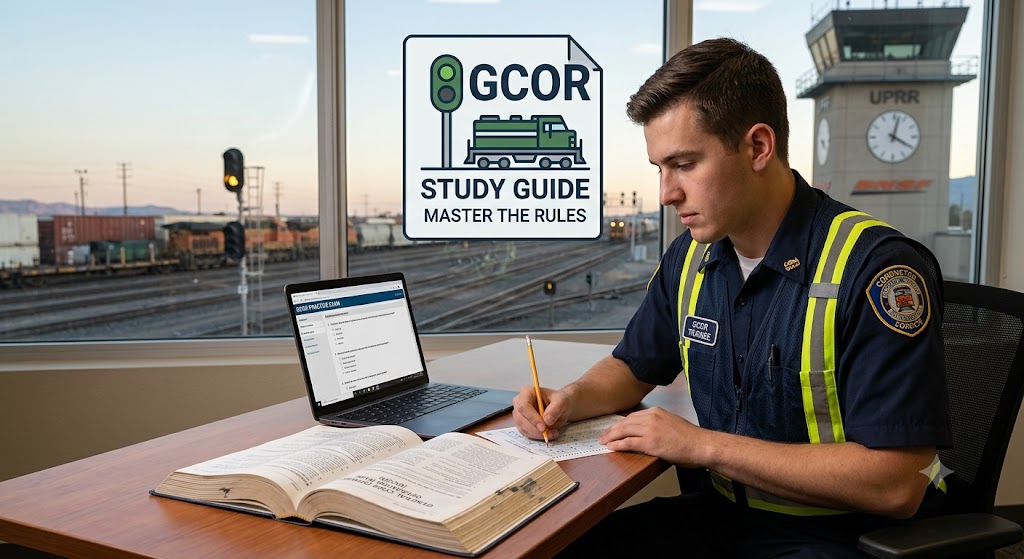
Additional Information
What the Course Entails and Exam Details
The path to GCOR qualification involves rigorous study of
the rulebook and practical application. A standard GCOR training course and the
final assessment cover a vast array of safety topics:
- Rule
Issuance and Interpretation: Understanding the hierarchy of rules,
timetable, special instructions, and general orders.
- Safety
First: Core responsibilities of all employees, alertness, hazard
reporting, and accident/injury procedures.
- Signals
and Aspects: Comprehensive mastery of all fixed, hand, and radio
signals and their required responses.
- Train
Movement Authority: Detailed knowledge of the methods to authorize
movement, including Track Warrant Control (TWC), Centralized Traffic
Control (CTC), and Yard Limits.
- Speed
Restrictions: Strict adherence to all maximum authorized and
restricted speeds.
- Switch
and Derail Operation: Safe procedures for handling switches and
derails by hand, power, or dual control.
- Flag
Protection: How and when to use red, yellow, green, and blue flags for
track and equipment protection.
- Radio
and Communication: Precise rules for transmitting and receiving
safety-critical information via radio.
What to Expect in
the Final Exam
The final GCOR assessment is a challenge, designed to
confirm an employee can operate safely. In the real railroad environment, this
is often a passing requirement to become a certified Conductor or Locomotive
Engineer.
Exam Format: The test is most commonly a closed-book,
multiple-choice or true-false examination, though some railroads incorporate
fill-in-the-blank questions or detailed scenario-based assessments.
Passing Score and Time Limit: A very high score is
required for this safety-critical test—typically 85% or 90% or higher. There
may be a loose time limit, but the focus is on accuracy, not speed.
Retake Policy: If an employee fails, they usually
have limited opportunities to retake the exam after a remediation period, but
multiple failures can lead to disqualification from training.
How to Study and Exam Centers
Preparation is the key to success. Here are actionable study
strategies and methods for this demanding assessment:
- Review
the Rulebook (The Bible): Obtain and memorize the latest
version of the GCOR, paying close attention to definitions and 'Must/Must
Not' rules. (Check your specific railroad, as many have unique
supplements).
- Scenario-Based
Practice: Do not just recall rules; practice applying them. Describe
how you would react to a specific combination of signals, switch
positions, and track warrants.
- Flashcards:
Use digital or physical flashcards for definitions, signal aspects, and
key speed restrictions.
- Study
Groups: Discussing rule applications with peers can expose gaps in
understanding.
- Practice
Tests: Utilize reputable online GCOR practice tests. Focus on
understanding why an answer is correct, not just memorizing the
answer key.
How to Take the Exam: The GCOR Practice Test is
widely available on various educational and test-prep websites, often
accessible instantly online. The official qualification exam is
administered directly by the railroad hiring process or their designated
physical testing center. There are no general public testing centers like
Pearson VUE for the actual qualification; you must be an employee or trainee of
a railroad.
Job Opportunities
from the Course
A GCOR qualification is the gatekeeper to a wide array of
stable and high-paying careers in the US railroad industry:
- Conductor:
Responsible for the train and all its operations.
- Locomotive
Engineer: Safely operates the train's locomotive.
- Train
Dispatcher: Directs and controls all train movements on a specific
territory.
- Trainmaster
/ Road Foreman of Engines: Supervisory roles overseeing train crews
and locomotive operations.
- Yardmaster:
Directs the movement of all trains and cars within a specific railroad
yard.
- Car
Inspector / Mechanical Dept. Employee: Roles requiring GCOR for moving
equipment safety.
- Track
Supervisor / Maintenance of Way: Roles needing GCOR knowledge to
safely access and work on tracks.
- Signal
Maintainer: Needs GCOR understanding for signal systems interaction
and safe work procedures.
Frequently Asked Questions
Reviews
5.0
Based on 0 reviews
Leave a Review
No reviews yet. Be the first to review!