
US Military Chain of Command and Army Basic Knowledge Practice Test
$69.00
- Buy to unlock unlimited access to all Quiz questions.
- After purchase you can print a PDF of the whole quiz at any point. The PDF will contain the questions and the correct answers.
About this Exam
This article serves as a comprehensive study guide for the US Military Chain of Command and Army Basic Knowledge Practice Test.
This essential practice tool is specifically designed for individuals preparing for initial entry into the United States Army, including those in the Delayed Entry Program (DEP), ROTC cadets, and OCS candidates. It is also an excellent resource for current service members looking to refresh their fundamental knowledge before promotion boards or professional military education courses.
By mastering the concepts covered in this practice test, candidates demonstrate their commitment to becoming standard-bearing soldiers and future leaders in the US Army
Ready to test your knowledge?
Buy Now to Access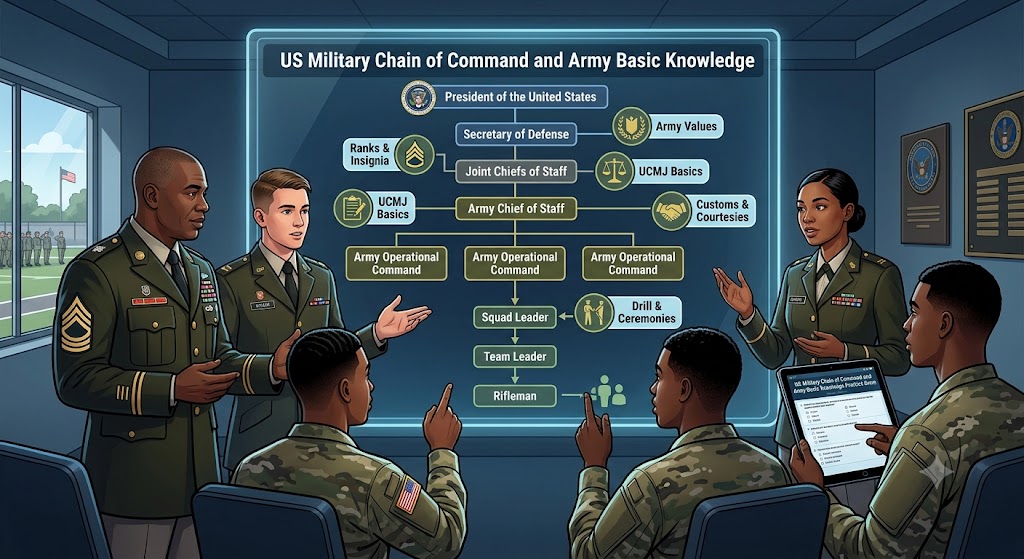
Additional Information
What the Course Entails and Exam Details
The practice test is designed to validate a candidate's
grasp of foundational military knowledge. The exam content focuses on core
areas that every soldier must memorize and understand. The core topics covered
in this comprehensive resource include:
- The
US Military Chain of Command: You must be able to identify key leaders
from the President of the United States down to the squad level. This
includes both the operational chain of command and the administrative
chain of command (the Secretaries of the military departments).
- Army
Ranks and Insignia: You will be tested on your ability to recognize
and name all enlisted, warrant officer, and commissioned officer ranks,
and correctly identify their accompanying insignia.
- The
Army Values: This section tests deep understanding of the seven core
values: Loyalty, Duty, Respect, Selfless Service, Honor, Integrity, and
Personal Courage (LDRSHIP).
- UCMJ
Basics: Expect fundamental questions regarding the Uniform Code of
Military Justice, non-judicial punishment (Article 15), and the rights of
the accused.
- Customs
and Courtesies: This critical section covers saluting protocols,
rendering honors to the flag, behavior during the National Anthem, and
addressing superior officers and non-commissioned officers.
- Drill
and Ceremonies: While a practice test cannot evaluate movement, it can
evaluate your knowledge of stationary commands, marching steps, and
ceremonial procedures.
What to Expect in
the Final Exam
While the exact structure of an official qualification exam
may vary slightly by the testing agency (e.g., Initial Entry Training vs. an
ROTC board), this practice test mirrors the format of typical military
knowledge evaluations.
The exam generally follows these parameters:
- Format:
The test is composed of 50 to 100 questions. It uses a variety of question
formats, including multiple-choice, true/false, and matching (specifically
for ranks and insignia).
- Scoring:
A passing score is typically set at 80% or higher, reflecting the
Army’s standard that fundamental knowledge must be mastered, not just
recalled.
- Time
Limit: To simulate the stress of a real military evaluation, most
versions of this practice test are timed, allowing approximately 60
seconds per question (e.g., a 60-minute limit for 60 questions).
- Aids:
No outside resources, notes, or smart devices are permitted during the
examination. This is a "closed book" test that evaluates
retention.
How to Study and
Exam Centers
Effective preparation requires a blend of rote memorization
and practical application.
How to Study:
- Use
Active Recall: Create flashcards (physical or virtual) for the Chain
of Command (by name and position) and for all Ranks and Insignia. Simply
reading the information is insufficient.
- Recite
the Army Values daily: Do not just memorize the acronym (LDRSHIP);
understand the definition of each value and how it applies to everyday
soldierly conduct.
- Leverage
Practice Tests: Taking this practice test repeatedly is the single
best way to improve retention and build confidence. Focus on the questions
you get wrong and understand why the correct answer is right.
- Visual
Aids: Study visual charts of the Chain of Command that are regularly
updated to reflect current leadership.
Exam Centers:
This practice test is an unofficial, educational resource
and is typically accessed online through a training portal. However, if you are
required to take an official proctored military knowledge test, these are
generally administered in professional environments:
- Initial
Entry Training (IET): Testing occurs at your Basic Combat Training
(BCT) or Advanced Individual Training (AIT) location.
- ROTC/OCS
Programs: Evaluations are held on-site at the college detachment or
the Officer Candidate School.
- Army
Education Centers: Often located on military installations for current
service members.
- MEPS
(Military Entrance Processing Station): While the ASVAB is the primary
test here, DEP members may sometimes take initial knowledge validation
tests.
Job Opportunities
from the Course
Mastering this foundational knowledge is the mandatory first
step for dozens of career paths within the US Military structure. Success in
this area is a strong indicator of potential for advanced training and
leadership. This knowledge is not just required for entry; it is a prerequisite
for every job title in the US Army.
Examples of job paths and titles that build upon this
foundation include:
- Enlisted
Combat Arms: Infantryman (11B), Cavalry Scout (19D), Special Forces
Candidate (18X).
- Enlisted
Support Roles: Combat Medic (68W), Human Intelligence Collector (35M),
Unit Supply Specialist (92Y).
- Warrant
Officer Corps: (Specialized technical experts following enlisted
service, e.g., Rotary Wing Aviator).
- Commissioned
Officer: (Leadership roles across all branches: Infantry Officer,
Logistics Officer, Intelligence Officer).
- Non-Commissioned
Officer (NCO): (Success on promotion boards for Sergeant and above
depends entirely on a deep understanding of this basic knowledge).
Frequently Asked Questions
Reviews
5.0
Based on 0 reviews
Leave a Review
No reviews yet. Be the first to review!