
US Bank Cardholder (CH) and Approving Official (AO) Practice Exam
$69.00
- Buy to unlock unlimited access to all Quiz questions.
- After purchase you can print a PDF of the whole quiz at any point. The PDF will contain the questions and the correct answers.
About this Exam
The US Army Sniper School (USASS) is an elite, seven-week course designed to train selected individuals in the demanding arts of advanced marksmanship, fieldcraft, observation, and intelligence gathering. This course is not for the faint of heart; it is intended only for highly motivated, qualified soldiers who have already demonstrated exceptional aptitude within their units. Graduates become certified U.S. Army Snipers, assuming one of the most specialized and critical roles on the modern battlefield.
Ready to test your knowledge?
Buy Now to Access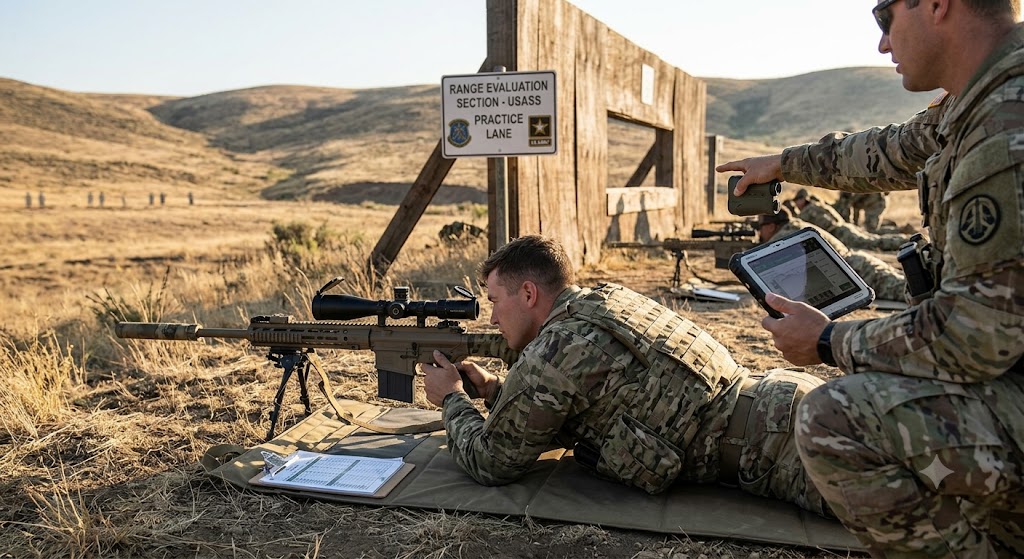
Additional Information
What the Course Entails and Exam Details
The USASS curriculum is intensive and demanding, requiring
perfect execution under duress. The course is broken down into multiple phases,
emphasizing core areas:
- Phase
I: Basic Marksman Skills. Candidates must master advanced rifle
mechanics, ballistics (the science of flight paths), and zeroing
procedures. This is the foundation upon which all other skills are built.
- Phase
II: Fieldcraft. This phase focuses on survival and operational
stealth. Soldiers learn detailed camouflage techniques, tactical movement
(stalking), selection and construction of hides/observation posts (OPs),
and land navigation without modern technology.
- Phase
III: Advanced Marksmanship and Employment. Candidates move beyond
fixed ranges, practicing on unknown distance (UKD) targets, moving
targets, and firing from diverse platforms (such as helicopters or urban
positions). Training also includes observation, target detection, and
call-for-fire procedures.
What to Expect in the Final Exam
The "final exam" of the US Army Sniper School is
not a single sitting, but a multi-faceted evaluation phase where failure in any
single component means dismissal.
The critical final assessments include:
- The
Technical Knowledge Test: A rigorous written exam that covers all
aspects of the curriculum, including ballistics calculations, mission
planning, and international law of war.
- The
Field Evaluation Phase (Stalking): Candidates must successfully
navigate complex terrain, move undetected past multiple trained observers,
and engage targets with blanks, all within a specific time limit. This
often has the highest attrition rate.
- The
Unknown Distance (UKD) Range Qualification: Soldiers must engage
multiple silhouette targets at various distances (from 300 to over 800
meters) where the distance is not provided. They must use their equipment
and knowledge to estimate range and achieve a high hit percentage.
- Timely
Observation and Reporting: Candidates are evaluated on their ability
to set up an observation post quickly, detect hidden targets within a
field of view, and accurately communicate target information (SALUTE
reports).
A perfect score isn't just a goal; in some critical safety
or weapon mechanics areas, anything less than 100% is a fail. There are strict
time limits for every event, adding immense pressure to already complex tasks.
How to Study and Exam Centers
Preparation for the actual USASS course is as intense as the
course itself. Candidates must arrive physically elite, with exceptional
cardiovascular endurance and upper body strength. Study focus areas should
include:
- Rote
Memorization of Ballistics Data: You must know your weapon’s 'DOPE'
(Data on Previous Engagements) inside and out, knowing the required
adjustments for different ranges, temperatures, and elevations instantly.
- Physical
Stalking Practice: Spend time practicing low-crawl, high-crawl, and
'monkey-crawl' techniques over various terrain in a full Ghillie suit.
- Land
Navigation: Master the use of map and compass. Practice navigating
both day and night without a GPS.
Exam Center Location:
It is vital to understand that the definitive certification,
the actual award of the "S" (Sniper) additional skill identifier
(ASI), only happens upon successful completion of the course physically located
at Fort Moore (formerly Fort Benning), Georgia. There are no authorized online
or private-sector testing centers for this certification.
However, practice tests (like the one referenced in
this article's title) are often offered by unofficial, specialized military
prep websites or internal unit leadership to help candidates assess their
readiness. These are internal tools used for preparation and carry no official
certification weight.
Job Opportunities from the Course
Upon graduation and receiving the "S" ASI,
numerous unique career paths and opportunities open up within the military and
later in civilian life:
- Sniper/Sniper
Team Leader: The direct progression, serving as a dedicated marksman
in an Infantry, Airborne, or Ranger battalion.
- Special
Operations Forces (SOF) Operator: Many special operations units, such
as the 75th Ranger Regiment or Green Berets, value sniper qualification
during selection or assignment.
- Instructor,
US Army Sniper School: Exceptional graduates may be recruited to
return and train the next generation of snipers.
- Long
Range Reconnaissance Platoon (LRRP) Member: Specialists in covert
observation and intelligence gathering.
- Sniper
Section Sergeant: Leading a full team of snipers and observers.
- Department
of Energy (DOE) Specialized Security: Protecting sensitive nuclear and
research facilities.
- Specialized
Law Enforcement: SWAT or counter-terrorism sniper units often recruit
from former military snipers.
Frequently Asked Questions
Reviews
5.0
Based on 0 reviews
Leave a Review
No reviews yet. Be the first to review!