
UPT Aerospace Physiology Practice Test
$69.00
- Buy to unlock unlimited access to all Quiz questions.
- After purchase you can print a PDF of the whole quiz at any point. The PDF will contain the questions and the correct answers.
About this Exam
Welcome to your essential study guide for the UPT Aerospace Physiology Practice Test.
This practice exam is specifically designed for candidates within the United States Air Force Undergraduate Pilot Training (UPT) program. Aerospace Physiology is a foundational component of flight safety and operational effectiveness.
The actual, high-stakes examination validates a pilot candidate's critical understanding of how the human body reacts to the unique stressors of flight, from hypoxic altitudes to extreme G-forces. Mastering this content is a mandatory requirement to move forward in the rigorous UPT pipeline and eventually earn your wings.
This practice test serves as your primary diagnostic tool, simulating the rigor and scope of the real exam to build your knowledge, confidence, and physiological resilience.
Ready to test your knowledge?
Buy Now to Access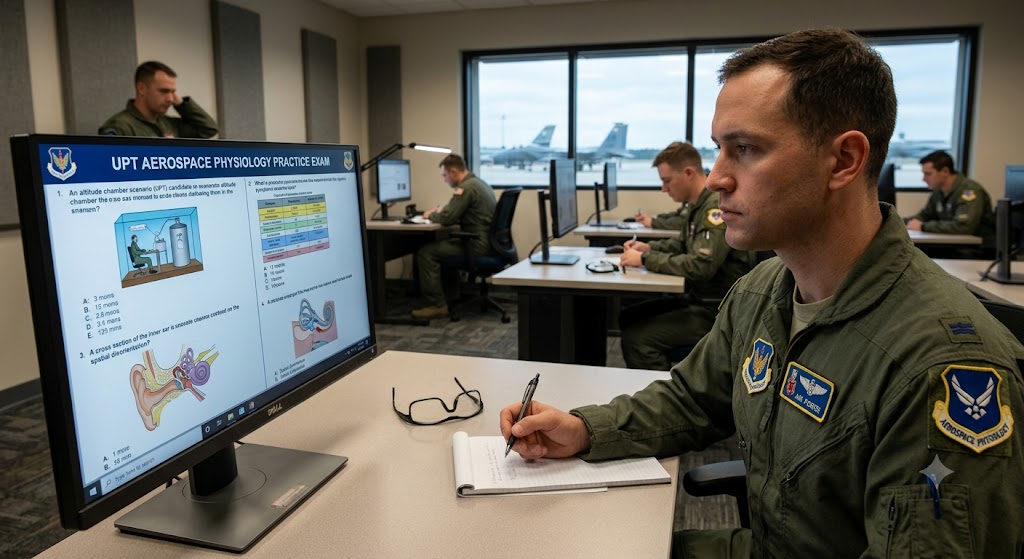
Additional Information
the Course Entails and Exam Details
The UPT Aerospace Physiology curriculum is extensive and
scientifically detailed.
You will delve into the physics of the atmosphere and the
biology of the human respiratory and circulatory systems under stress. This
practice test is structured to cover all core syllabus areas.
Expect detailed questions focusing on these critical
domains:
- Physics
of the Atmosphere: Pressure changes, gas laws, and altitude effects.
- Respiration
and Circulation: How oxygen is transported and utilized.
- Hypoxia:
Recognizing the types (Hypoxic, Hypemic, Stagnant, Histotoxic), symptoms, and
immediate corrective actions.
- Hyperventilation:
Causes, symptoms, and differentiation from hypoxia.
- Decompression
Sickness (DCS): Trapped and evolved gases, including the Bends and
Chokes.
- Cabin
Pressurization and Decompression: Systems, effects, and rapid
decompression scenarios.
- Gravitational
Forces (G-Forces): Understanding +Gz, -Gz, and G-LOC (G-induced Loss
of Consciousness), tolerance factors, and the Anti-G Straining Maneuver
(AGSM).
- Spatial
Disorientation: The vestibular system, visual illusions, and coping
strategies.
- Sensory
Physiology: Vision (night vision, limitations) and hearing in flight.
- Toxic
Substances and Gasses: Carbon monoxide and other cockpit hazards.
- Stress,
Fatigue, and Nutrition: Impact on performance and countermeasures.
What to Expect in
the Final Exam
While a practice test, this resource is modeled after
the actual comprehensive Aerospace Physiology examination administered
by USAF physiologists during your training.
The final official exam typically follows this format:
- Format:
Multiple-choice questions, often involving detailed diagrams, scenarios,
and data interpretation (e.g., altitude charts or G-force tolerance
graphs).
- Number
of Questions: Expect a substantial number, likely 50 to 100 questions,
designed to test both broad knowledge and nuanced understanding.
- Time
Limit: The exam is timed, typically 60 to 90 minutes, requiring you to
work efficiently under time pressure.
- Passing
Score: A high passing score (often 80% or higher) is required, as
complete mastery of this safety-critical subject is non-negotiable for
future pilots.
- Rules:
Cell phones and external resources are prohibited. All answers are final
upon submission.
How to Study and Exam Centers
Effective preparation is the key to success. Don't simply
memorize answers; you must internalize the principles of flight physiology.
- Actionable
Study Strategies:
Utilize Official AFMANs and
Handbooks: Your primary source should be the relevant Air Force Manuals
(AFMAN) and Air Force Pamphlets (AFPAM) provided by your training squadron.
Review Lecture Materials:
Go back through your classroom notes and official slides repeatedly.
Use Diagrams: Visualize
the concepts. Draw your own respiratory system or vestibular apparatus
diagrams.
Practice the AGSM:
Physiological conditioning is also tested. Practice the timing and execution of
the Anti-G Straining Maneuver.
Simulate and Repeat: Take
this practice test multiple times. Review all missed questions to understand
the underlying physiologic principle you got wrong. Use a timer to mimic exam
conditions.
- Exam
Centers: The practice test may be available through your
training squadron's internal learning management systems or secure online
portals. It is designed for self-study.
The actual, official Aerospace Physiology Examination is
administered on-site at the specified Aerospace Physiology Training Flight
(APTF) located at your respective UPT base (e.g., Vance AFB, Laughlin AFB,
Sheppard AFB, Columbus AFB). You will not register via commercial testing
centers like Pearson VUE.
Job Opportunities from the Course
Successfully completing the Aerospace Physiology curriculum
and passing the final exam is a prerequisite to continue flying training. This
knowledge is not a standalone qualification but is critical to unlocking the
entire spectrum of specialized military aviation roles.
Passing this milestone moves you closer to careers such as:
- United
States Air Force Pilot: This is the ultimate goal. You may specialize
as a:
- Fighter
Pilot (e.g., F-22, F-35, F-16)
- Bomber
Pilot (e.g., B-2, B-1, B-52)
- Mobility/Transport
Pilot (e.g., C-17, C-5, C-130)
- Tanker
Pilot (e.g., KC-135, KC-46)
- Special
Operations Pilot (e.g., CV-22, MC-130)
- Intelligence,
Surveillance, and Reconnaissance (ISR) Pilot
- Remotely
Piloted Aircraft (RPA) Pilot: Command sophisticated drones like the
MQ-9 Reaper (requires physiology training, though not identical to manned
UPT).
- Other
Military Aviation Roles: Including flight instructors and potentially
test pilot school candidates.
Frequently Asked Questions
Reviews
5.0
Based on 0 reviews
Leave a Review
No reviews yet. Be the first to review!