
UPCAT Earth Science Practice Test
$69.00
- Buy to unlock unlimited access to all Quiz questions.
- After purchase you can print a PDF of the whole quiz at any point. The PDF will contain the questions and the correct answers.
About this Exam
The UPCAT Earth Science Practice Exam is an essential tool designed to help high school students prepare for one of the major components of the University of the Philippines College Admission Test (UPCAT). A stellar performance on the UPCAT is a primary requirement for admission into the country’s premier state university system. This section-specific practice test is specifically tailored for graduating high school students who aim to strengthen their understanding of geological and atmospheric sciences before taking the official admission exam. For many aspiring UP students, a strong score in the Science subtest, which includes Earth Science, is a critical step toward securing a slot in their desired degree programs and campuses.
Ready to test your knowledge?
Buy Now to Access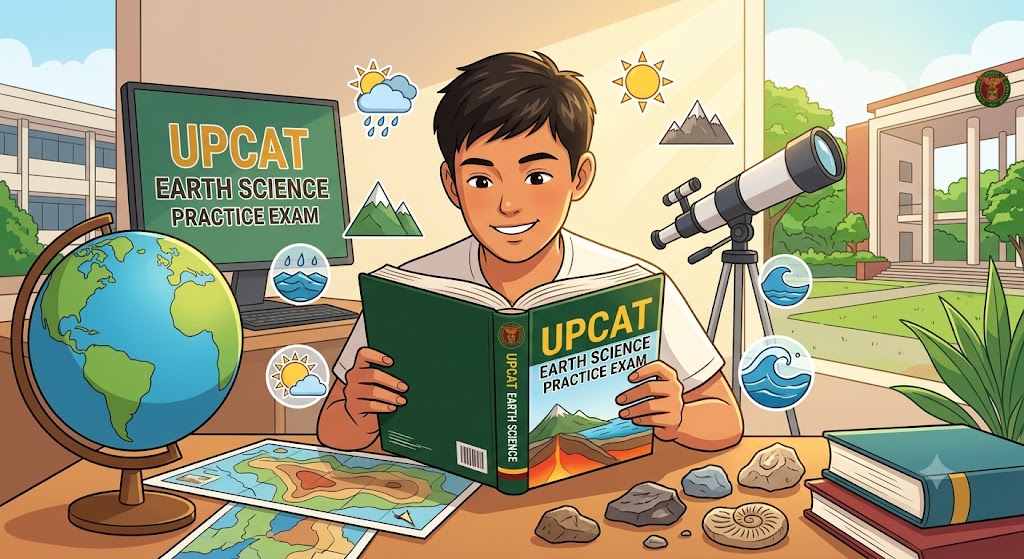
Additional Information
What the Course Entails and Exam Details
This "course," in the context of the practice
exam, entails a comprehensive review of fundamental Earth Science concepts
typically covered in secondary education. While the official UPCAT does not
have a separate score just for Earth Science, it is a significant part of the
wider Science subtest. The Earth Science section will test your knowledge and
application of principles across several core domains.
Key topics you will cover in this practice material include:
- Geology:
The composition of the Earth, rocks and minerals, the rock cycle, plate
tectonics, internal processes (earthquakes and volcanoes), and surface
processes (weathering and erosion).
- Meteorology:
Earth's atmosphere, layers, weather patterns, climate, air pressure, wind,
and severe weather phenomena.
- Oceanography:
Ocean basins, properties of seawater, ocean currents, tides, and waves.
- Astronomy:
The solar system, planets, stars, galaxies, lunar phases, eclipses, and
space exploration.
- Natural
Resources and Environment: Types of resources, conservation, natural
hazards, and human impact on the environment.
The UPCAT Science section itself, which contains these
topics, will assess not only your factual recall but also your scientific
reasoning, interpretation of data, and ability to apply concepts to new
situations.
What to Expect in
the Final Exam
When sitting for the official UPCAT, you should expect the
Science subtest to be one of four major sections.
The full UPCAT is a paper-and-pencil or computerized
multiple-choice test (this depends on the latest UP guidelines). It is not a
test where a single "passing score" guarantees admission. Instead,
your performance across all sections (Science, Mathematics, Language
Proficiency, and Reading Comprehension), combined with your high school grades,
will produce a University Predicted Grade (UPG). Admission is highly
competitive and depends on your UPG ranking against other applicants and the
specific quota of the campus and program you applied to.
For the Science section specifically:
- Format:
Multiple choice, with several options for each question.
- Question
Type: Ranging from straightforward knowledge recall to complex
problem-solving and critical analysis of scientific scenarios and data.
- Time
Limits: The entire UPCAT is a time-pressured exam. While Earth Science
questions are integrated into the wider Science subtest, you will have a
specific time limit for that entire section, requiring you to
manage your time efficiently across all science subjects (Biology,
Chemistry, Physics, and Earth Science).
- Rules:
Standard exam rules apply. It is a proctored test. No calculators, mobile
phones, or outside notes are typically allowed during the Science subtest.
How to Study and
Exam Centers
Preparation for the UPCAT is a marathon, not a sprint. To
succeed in the Earth Science component, you must adopt structured and active
learning strategies.
Actionable Study Strategies:
- Review
Core Concepts: Go back to your high school Earth Science (or general
science) textbooks and notes. Build a solid foundation of key principles
and terminology.
- Use
Practice Tests: Actively take practice exams like this one. This not
only builds subject knowledge but also familiarizes you with the question
format and helps you identify your weak areas.
- Time
Your Practice: Simulate exam conditions by timing your practice
sessions. This will improve your speed and help you manage test anxiety.
- Analyze
Mistakes: After completing a practice test, thoroughly review both
your correct and incorrect answers. Understanding why an answer is
correct is just as important as knowing the answer itself.
- Consider
Review Centers: Many students benefit from enrolling in reputable
UPCAT review centers, which offer structured programs, practice materials,
and test-taking strategies.
- Stay
Updated: Always check the official UP Admissions website for the most
accurate and up-to-date information on exam coverage, rules, and
schedules.
Exam Centers: Unlike professional certifications that
use centers like Pearson VUE, the UPCAT is a standardized national university
admission test. It is typically administered simultaneously in multiple testing
centers across the Philippines. These centers include various UP campuses (such
as UP Diliman, UP Los Baños, UP Manila, UP Visayas, etc.) and designated high
schools in regional hubs throughout the country to make the test accessible to
a wide range of students. It is an in-person, proctored exam.
Job Opportunities
from the Course
A strong performance on the UPCAT is a critical stepping
stone to admission into the University of the Philippines. While the exam
itself is not a professional "course" that directly grants job
titles, securing a high score, particularly in the Science subtest, opens the
door to numerous prestigious science, engineering, and resource management
degree programs. Graduating with a degree from UP, the national university,
unlocks countless career opportunities.
A strong scientific foundation, enhanced by your UPCAT
preparation, can lead to careers in these specific fields after you complete
your undergraduate and potential graduate studies:
- Geologist
- Meteorologist
/ Climatologist
- Oceanographer
- Environmental
Scientist / Specialist
- Civil
Engineer (incorporating geotechnical principles)
- Environmental
Engineer
- Volcanologist
/ Seismologist
- Hydrologist
- GIS
(Geographic Information Systems) Specialist
- Remote
Sensing Specialist
- Earth
Science Teacher / University Professor
- Scientific
Researcher (in geology, atmospheric science, or oceanography)
- Natural
Resource Manager
- Paleontologist
The scientific skills you hone for the UPCAT are
transferable and in demand across many sectors, paving the way for a rewarding
career in understanding and managing our planet.
Frequently Asked Questions
Reviews
5.0
Based on 0 reviews
Leave a Review
No reviews yet. Be the first to review!