
Unit 4 AP Precalculus Practice Test 2026
$69.00
- Buy to unlock unlimited access to all Quiz questions.
- After purchase you can print a PDF of the whole quiz at any point. The PDF will contain the questions and the correct answers.
About this Exam
The AP Precalculus course is an essential stepping stone for high school students aiming to succeed in higher-level mathematics and college-level STEM pathways.
Specifically, Unit 4 serves as the critical transition point where foundational algebraic and trigonometric skills meet the advanced conceptual tools required for Calculus, Linear Algebra, and Physics.
This Unit 4 Practice Test for 2026 is expertly designed to diagnose your understanding of complex function behavior, preparing you for success on both your class assessments and the final Advanced Placement exam.
It targets students who need to master mathematical modeling using systems beyond standard Cartesian functions, bridging the gap between abstract algebra and practical application.
Ready to test your knowledge?
Buy Now to Access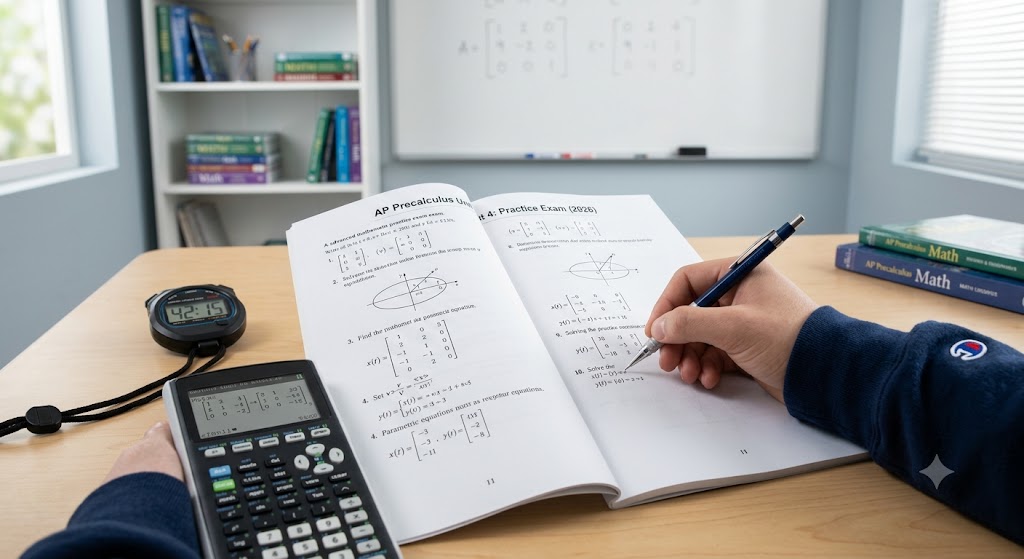
Additional Information
What the Course Entails and Exam Details
AP Precalculus Unit 4 focuses heavily on advanced algebraic and spatial modeling techniques. The core syllabus covered by this practice exam includes three primary pillars of modern mathematics.
First, you must master functions involving parameters. This includes analyzing and graphing parametric equations to model motion in a plane, understanding how a single variable ($t$) determines both $x$ and $y$ positions, and analyzing implicit curves and conic sections like ellipses and hyperbolas.
Second, the unit introduces vectors. You will be tested on your ability to represent vectors geometrically and algebraically, perform operations like addition, subtraction, and scalar multiplication, and apply vectors to solve real-world problems involving force and velocity.
Finally, you will delve into matrices and their applications. This section covers matrix arithmetic, calculating determinants, finding inverse matrices, and using matrices to solve systems of linear equations or perform linear transformations in the plane.
Mastering these skills is crucial because they provide the language for multivariable calculus and advanced scientific modeling.
What to Expect in the Final Exam
While this is a Unit 4 practice test, it is modeled after the rigor and structure of the full AP Precalculus Exam.
A standard Unit 4 assessment provided by your teacher typically lasts between 45 and 60 minutes and includes a mixture of question formats to test different cognitive levels.
You should expect multiple-choice questions that test rapid conceptual recall and basic calculation.
Additionally, free-response questions will require you to show all your work, justify your mathematical reasoning, and apply multiple Unit 4 concepts (such as using parametric equations to model a scenario and then using vectors to describe motion at a specific time) to solve a complex problem.
Regarding scoring, standard AP assessments require a deep understanding of the material. There are no standardized passing scores for individual unit tests, but achieving a consistently high percentage in practice is strong evidence of readiness for the official AP exam, where a score of 3, 4, or 5 is generally considered passing for college credit.
Typically, your teacher will allow the use of a graphing calculator for specific sections of the unit test, mirroring the structure of the final AP exam, so you must practice active problem-solving with and without technology.
How to Study and Exam Centers
Effective preparation for the Unit 4 exam demands a blend of conceptual review and rigorous active practice.
Your first step should be to review your class notes and ensure you have memorized key formulas, such as the vector magnitude formula, the rotation matrix formula, and standard parametrizations for conic sections.
Utilize official College Board resources, including AP Daily videos available through My AP, to review targeted topics you find challenging.
Once you have reviewed the theory, take this practice exam under timed conditions in a quiet environment. Simulate exam rules: clear your desk, set a timer, and use only an approved graphing calculator when permitted.
After completing the practice exam, do not just check your answers; meticulously review the detailed explanations for every question you missed or guessed on.
Understanding why you got a question wrong is more valuable than just knowing the correct answer, as it allows you to correct conceptual misunderstandings. Rework those missed problems until you can solve them confidently without assistance.
Regarding exam locations, this practice test is a self-administered study tool. The official full AP Precalculus Exam in May 2026 will be administered at authorized schools, typically your own high school, or other designated physical testing centers.
Job Opportunities from the Course
A strong foundation in the concepts covered in AP Precalculus Unit 4 is not just for college credit; it unlocks career paths in some of the fastest-growing and highest-paying STEM fields.
While Precalculus itself is not a terminal qualification for most professional roles, mastery of parameters, vectors, and matrices is prerequisite knowledge for the following career paths:
Software Developer (particularly in 3D Graphics and Game Design)
Aerospace Engineer
Data Scientist / Data Analyst
Financial Analyst or Quantitative Analyst (Quant)
Civil Engineer
Biomedical Engineer
Architect
High School Mathematics Teacher
Frequently Asked Questions
Reviews
5.0
Based on 0 reviews
Leave a Review
No reviews yet. Be the first to review!