
UAS Safety Practice Exam
$69.00
- Buy to unlock unlimited access to all Quiz questions.
- After purchase you can print a PDF of the whole quiz at any point. The PDF will contain the questions and the correct answers.
About this Exam
The UAS Safety Practice Exam is a vital educational resource specifically engineered for individuals aiming to become certified under the Federal Aviation Administration (FAA) Part 107 regulations for small Unmanned Aircraft Systems (sUAS), commonly known as drones. This comprehensive guide serves a critical dual purpose: it acts as a diagnostic tool for commercial drone pilots and simultaneously ensures that hobbyist aviators operate responsibly. The material is meticulously curated for a broad spectrum of individuals, ranging from total beginners seeking their first professional aviation license to seasoned Remote Pilots who require a rigorous skills and knowledge refresher before undertaking recurrent training. This exam focuses specifically on the safety and regulatory frameworks required for authorized, legal, and responsible aerial operations.
Ready to test your knowledge?
Buy Now to Access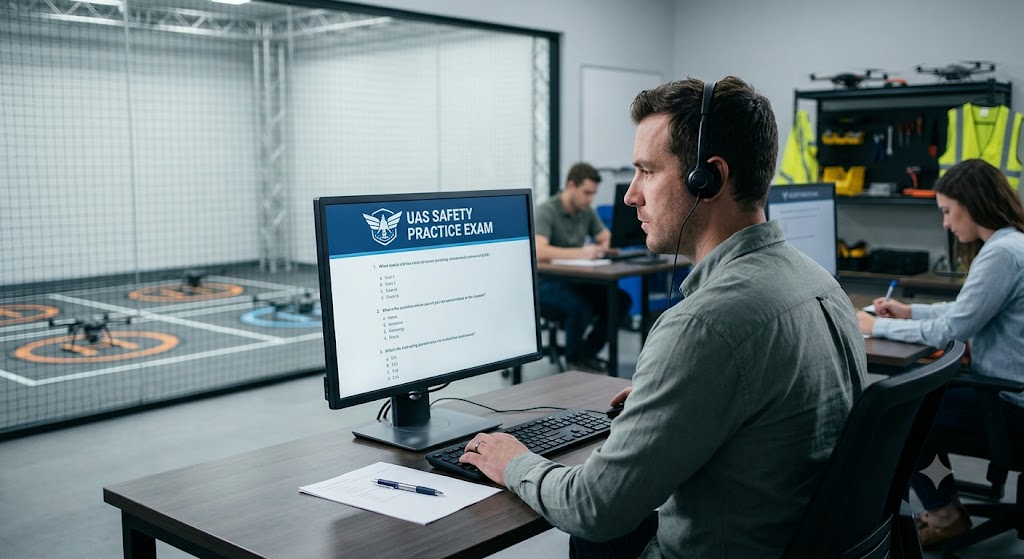
Additional Information
The UAS Safety Practice Exam is a vital educational resource specifically engineered for individuals aiming to become certified under the Federal Aviation Administration (FAA) Part 107 regulations for small Unmanned Aircraft Systems (sUAS), commonly known as drones. This comprehensive guide serves a critical dual purpose: it acts as a diagnostic tool for commercial drone pilots and simultaneously ensures that hobbyist aviators operate responsibly. The material is meticulously curated for a broad spectrum of individuals, ranging from total beginners seeking their first professional aviation license to seasoned Remote Pilots who require a rigorous skills and knowledge refresher before undertaking recurrent training. This exam focuses specifically on the safety and regulatory frameworks required for authorized, legal, and responsible aerial operations.
What the Course Entails and Exam Details
This specialized practice exam does not constitute a singular "course," but rather serves as the definitive assessment instrument for the FAA Part 107 remote pilot knowledge requirement curriculum. The content is rigorously structured across five specific knowledge domains established by the FAA, mirroring the actual aeronautical knowledge test syllabus. Candidates will find detailed sections on Regulatory Awareness, which includes specific rules under Part 107 regarding registration, flight limitations, and required waivers. An extensive module focuses on Airspace and Operations, testing the pilot’s ability to interpret section charts, understand temporary flight restrictions, and determine necessary authorizations for controlled airspace. Specialized units cover Aviation Weather, specifically its unique effects on small, low-altitude aircraft. Critical topics such as sUAS Aircraft Performance and loading are thoroughly covered, alongside modern Emergency Procedures and a substantial focus on Crew Resource Management (CRM) and safety decision-making for drone operators.
What to Expect in the Final Exam
When sitting for the official FAA Unmanned Aircraft Systems (sUAS) Safety Exam (or "Part 107 Initial"), candidates must prepare for a rigorous, formal test. This final exam consists of 60 single-choice questions, which are randomized and sourced from a vast database. The test is strictly timed, giving candidates a total of 120 minutes (two hours) to answer all questions. There is no open-book portion allowed during the official exam. The questions often require interpretive analysis of diagrams, charts, and official aviation graphics provided in a testing supplement. Crucially, in order to pass the exam and obtain their temporary license, the remote pilot candidate must achieve a minimum score of 70%.
How to Study and Exam Centers
The most effective strategy for success on the UAS Safety Exam is a mixed-method approach that begins with official primary sources. Candidates are strongly urged to first download and master the full FAA Remote Pilot Study Guide (FAA-H-8083-24) and the Pilot’s Handbook of Aeronautical Knowledge. Once the core concepts are understood, they should then repeatedly utilize comprehensive practice testing tools, such as the UAS Safety Practice Exam detailed in this article. These specific diagnostic exams are critical for mimicking the actual testing pressure, identifying specific knowledge deficiencies, and building critical interpretation skills for aviation sectionals and weather charts. When it is time to take the formal FAA Part 107 test, candidates cannot complete it online from home. All official FAA knowledge exams are exclusively administered in person at specifically authorized, FAA-approved Knowledge Testing Centers, which include select local flight schools and major professional testing networks such as PSI Services (which replaced Pearson VUE for FAA testing).
Job Opportunities from the Course
Successfully passing this UAS Safety Certification is the mandatory gateway that legally authorizes a Remote Pilot to operate a drone commercially, making it an extremely valuable credential in a rapidly expanding industry. Possessing an FAA Part 107 license is either legally required or extremely advantageous for numerous career paths and specific job titles:
Drone Pilot (Commercial & Recurrent Operations)
Aerial Photographer & Videographer
Precision Agriculture Drone Specialist (Crop Spraying & Scouting)
UAV/UAS Inspector (Infrastructure, Construction, Energy)
Drone Mapping & Photogrammetry Technician
Public Safety Drone Operator (Fire/Police)
sUAS Safety Manager
UAS Instructor or Remote Pilot Trainer
Real Estate Marketing UAS Specialist
Frequently Asked Questions
Reviews
5.0
Based on 0 reviews
Leave a Review
No reviews yet. Be the first to review!