
UAS Remote Pilot Practice Exam
$69.00
- Buy to unlock unlimited access to all Quiz questions.
- After purchase you can print a PDF of the whole quiz at any point. The PDF will contain the questions and the correct answers.
About this Exam
The UAS (Unmanned Aircraft Systems) Remote Pilot certification, commonly referred to as a "drone license," is the official credential from Kenya's Civil Aviation Authority (KCAA) that permits individuals to operate drones for commercial and institutional purposes. This certification is a fundamental requirement under Kenya's comprehensive UAS Civil Aviation Regulations (RPAS Regulations, 2020), designed to integrate unmanned aircraft safely into the national airspace system. The exam is designed for aspiring professional drone pilots, photographers, surveyors, engineers, and conservationists—essentially anyone who wishes to fly a drone beyond the 'hobbyist' category in Kenya and benefit from the vast opportunities this technology offers in agriculture, film, security, and humanitarian efforts.
Ready to test your knowledge?
Buy Now to Access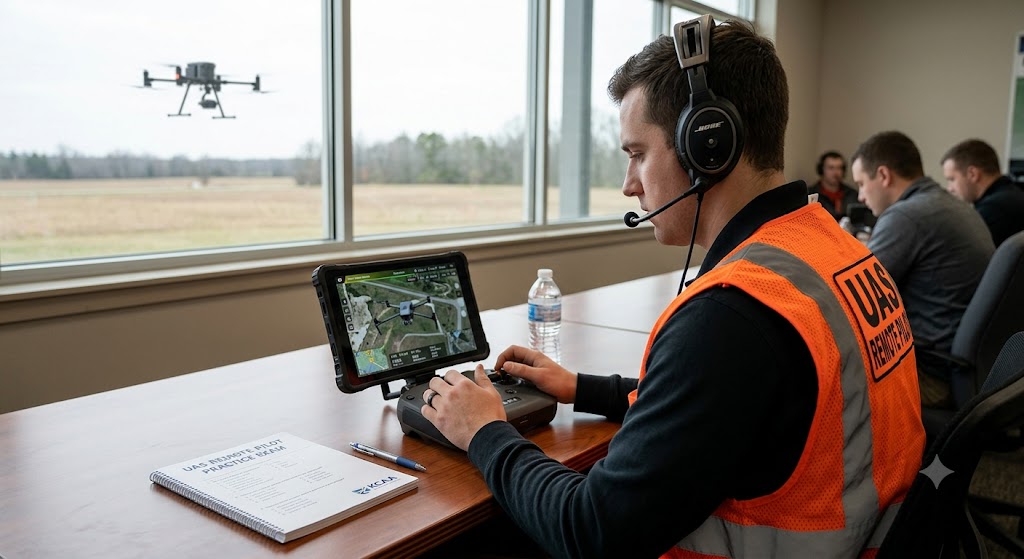
Additional Information
What the Course Entails and Exam Details
To achieve this certification, students must master both the
theoretical knowledge and the practical skills required for safe and
responsible drone operation.
The course theoretical syllabus is comprehensive and covers
the following core topics:
- Kenya
RPAS Regulations 2020 and KCAA Directives: The foundational laws
governing drone ownership, operations, permissions, and airspace structure
in Kenya.
- Airspace
Classification and Operating Requirements: Understanding the
difference between Controlled Airspace (e.g., around airports) and
Restricted Areas, and the rules for each.
- Aviation
Weather Services and Effects of Weather: Learning how to read aviation
weather reports and understanding how conditions like wind, humidity, and
temperature affect flight performance.
- Small
Unmanned Aircraft Performance and Systems: The mechanics of drones,
including flight dynamics, battery management, and system limitations.
- Crew
Resource Management and Human Factors: Understanding physiological
effects, decision-making, and risk management for the pilot in command.
- Operational
Procedures, Risk Assessment, and Safety: Procedures for pre-flight,
in-flight, and emergency situations, and how to conduct a safety risk
assessment (SRA).
Following theoretical training, the process generally
includes a structured practical training phase to ensure flight proficiency.
What to Expect in
the Final Exam
The final certification process consists of two primary
components: a theoretical examination and a practical flight test (flight
assessment).
Part 1: Theoretical Knowledge Test
- Format:
The theoretical exam is typically a structured multiple-choice question
format.
- Passing
Score Requirements: Candidates must achieve a score of at least 70% to
pass the theoretical knowledge test.
- Time
Limits: A specific time limit is allotted for completion, often around
90 minutes.
Part 2: Practical Flight Test
Once you have passed the theoretical test, you are eligible
to take the Practical Flight Assessment. This exam is conducted in person by a
KCAA-authorized examiner. During this test, you must demonstrate real-world
proficiency in drone operations, covering pre-flight setup, basic and advanced
maneuvers, following an operational plan, risk management, and emergency
response. Both components must be successfully completed to be awarded the
Remote Pilot Licence (RPL).
How to Study and Exam Centers
Effective study for the UAS Remote Pilot Exam combines
rigorous academic review with immersive practice. Start by thoroughly reading
and summarizing the full text of Kenya's RPAS Civil Aviation Regulations 2020,
paying close attention to terminology and legal requirements. Invest in
reputable UAS training courses offered by recognized drone schools. Actively
utilize practice question banks; repeatedly taking simulated, multiple-choice
practice exams helps build familiarity with KCAA test question styles and
identifies knowledge gaps. To prepare for the practical test, obtain a reliable
drone and dedicate significant flight hours to mastering smooth, precise flight
maneuvers and practice executing the standard operational procedures you
learned in training.
In Kenya, both the theoretical and practical examinations
are administered exclusively through KCAA-authorized testing facilities and
flight training organizations. You will need to register for your training and
the accompanying exam directly with one of these schools or through a KCAA
operational portal as designated. These specific locations and approved schools
are listed and regularly updated on the Civil Aviation Authority (KCAA)
official website.
Job Opportunities
from the Course
A Remote Pilot Licence (RPL) in Kenya unlocks diverse and
lucrative career paths across multiple industries. This professional credential
qualifies individuals to enter fields such as:
- Commercial
Drone Pilot
- Aerial
Photographer and Videographer (Real Estate, Events, Tourism)
- Mapping
and Surveying Analyst
- Drone
Flight Instructor
- UAV/UAS
Operations Manager
- Agricultural
Drone Specialist (Crop Monitoring, Spraying)
- Infrastructure
Inspector (Bridges, Cell Towers, Pipelines)
- Search
and Rescue UAV Operator
- Conservation
and Wildlife Monitoring Drone Specialist
- Journalism
and News Gathering Drone Pilot
Frequently Asked Questions
Reviews
5.0
Based on 0 reviews
Leave a Review
No reviews yet. Be the first to review!