
Ttcaa Pilot Practice Test & Exam Prep | Trinidad & Tobago
$69.00
- Buy to unlock unlimited access to all Quiz questions.
- After purchase you can print a PDF of the whole quiz at any point. The PDF will contain the questions and the correct answers.
About this Exam
The Trinidad & Tobago Civil Aviation Authority (TTCAA) pilot knowledge examinations are the essential theoretical hurdle for anyone aspiring to earn their wings in the twin-island republic. These exams are meticulously designed to ensure that prospective pilots possess the necessary aeronautical knowledge to operate safely and effectively in both local and international airspace. Whether you are aiming for a Private Pilot License (PPL) to fly for recreation, or a Commercial Pilot License (CPL) to launch a professional career, mastering this theory is mandatory. The certification process is tailored for individuals who have already begun their flight training or are about to enroll in an approved ground school, providing the standard for aviation safety in Trinidad & Tobago.
Ready to test your knowledge?
Buy Now to Access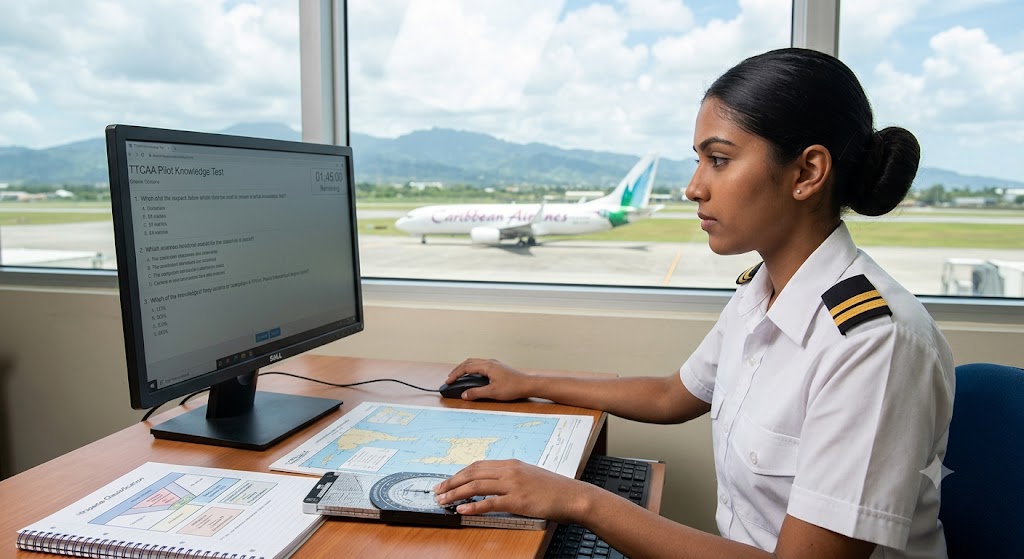
Additional Information
What the Course Entails and Exam Details
To succeed, candidates must demonstrate a deep understanding across a broad spectrum of aviation disciplines. The curriculum covered in your preparation—usually delivered through an Aviation Training Organization (ATO) ground school—aligns strictly with the TTCAA requirements. This is not just about memorizing facts; it is about applying principles to real-world flight scenarios.
The core syllabus encompasses the following critical subjects:
Aviation Law: Regulations specific to Trinidad & Tobago and international ICAO standards.
Meteorology: Understanding weather patterns, interpretation of aviation forecasts, and the impact of tropical weather on flight.
Navigation: Chart reading, dead reckoning, radio navigation aids, and the use of the flight computer (E6B or similar).
Aircraft General Knowledge: Principles of flight, airframes, engines, systems, and instruments.
Human Performance & Limitations: Physiological factors affecting pilot performance, including hypoxia, fatigue, and spatial disorientation.
Operational Procedures: Safety protocols, emergency procedures, and standard operating practices.
Flight Performance and Planning: Weight and balance calculations, takeoff and landing performance, and fuel planning.
Communications: Correct phraseology for radio communication with Air Traffic Control.
What to Expect in the Final Exam
The TTCAA final examination is a formal, computerized knowledge test administered under strict proctored conditions. You should arrive prepared for a rigorous assessment that challenges your understanding of the syllabus.
Here are the key details you must know about the exam format:
Format: The exam consists entirely of objective, multiple-choice questions.
Passing Score: The minimum required passing score is 75 percent. There is no averaging; you must pass each subject test individually.
Time Limit: For the Private Pilot License (PPL-A), the exam typically contains 60 questions, and you are allowed a maximum of 3.0 hours to complete it.
Rules and Conduct: Communication with other candidates is strictly forbidden. While programmable electronic aids are generally prohibited, you are permitted to use approved mechanical flight computers, plotters, and simple, non-programmable calculators. You will be provided with specific reference materials, such as charts or performance tables, relevant to the questions asked. Upon completion, you will receive an official Airman Test Report detailing your score.
How to Study and Exam Centers
Preparation is the cornerstone of success for any aviation exam. Do not rely solely on cramming. We recommend a structured, multi-faceted approach. First, complete a comprehensive ground school course at a TTCAA-authorized ATO; this provides your foundational knowledge. Second, utilize specialized TTCAA practice test question banks. Regular, timed practice exams are crucial for identifying weak areas and becoming accustomed to the phrasing of aviation questions. Third, study the primary reference texts, including the Trinidad & Tobago Civil Aviation Regulations (TTCARs) and standard aviation textbooks like the Jeppesen Manual or FAA handbooks. Group study with fellow student pilots can also provide valuable perspective.
You cannot take the official exam online. It must be taken at an authorized physical testing location.
How to Register: You must receive an endorsement from your authorized flight or ground instructor stating you have completed the required ground training and are prepared for the test. You then schedule your exam directly with the TTCAA.
Exam Center Location: The primary location for taking the computerized knowledge tests is the TTCAA’s own Computer Knowledge Test Centre, located at their headquarters at Piarco International Airport, Trinidad.
Job Opportunities from the Course
Successfully navigating the TTCAA knowledge exams is the critical theoretical foundation that unlocks every stage of a pilot's career path. Achieving your pilot licenses allows you to pursue diverse and exciting roles.
This certification path unlocks the following opportunities:
Private Pilot: Allows you to fly single-engine aircraft for recreational purposes, travel with friends or family, or participate in volunteer pilot organizations.
Flight Instructor: With further training and experience, you can teach aspiring pilots, gaining valuable flight hours while sharing your passion for aviation.
Commercial Pilot (Single/Multi-Engine): This is the entry level for professional flying, enabling you to work in aerial photography, crop dusting, air charter services, and sightseeing tours.
First Officer (Regional Airline): A mandatory step for flying for regional carriers, operating turbo-prop or small jet aircraft within the Caribbean.
Captain (Corporate Aviation): Fly private jets for corporations or high-net-worth individuals, offering flexible schedules and sophisticated operations.
Captain (Major Airline): The pinnacle of the career, commanding large commercial airliners on international routes.
Drone Operator (Commercial): While separate, a strong grasp of TTCAA aviation law and meteorology is increasingly required or preferred for advanced, heavy-lift commercial drone operations in controlled airspace.
Frequently Asked Questions
Reviews
5.0
Based on 0 reviews
Leave a Review
No reviews yet. Be the first to review!