
TSFA Floral Certification – Floral Design Practice Test
$69.00
- Buy to unlock unlimited access to all Quiz questions.
- After purchase you can print a PDF of the whole quiz at any point. The PDF will contain the questions and the correct answers.
About this Exam
The Texas State Florists' Association (TSFA) Floral Certification (Level 1) is a prestigious credential designed to validate the essential skills and knowledge required for entry-level employment in the floral industry. This certification program is particularly geared towards high school students, hobbyists, and individuals seeking to begin a career in floral design. By achieving this certification, candidates demonstrate their proficiency in basic floral design techniques, flower and foliage identification, care and handling, and industry terminology, providing them with a competitive edge in the job market.
Ready to test your knowledge?
Buy Now to Access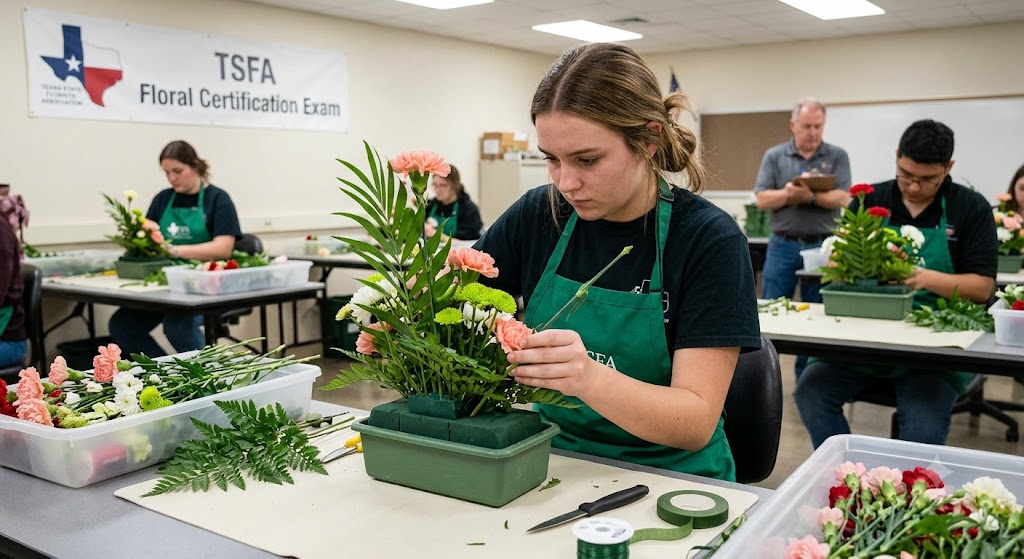
Additional Information
What the Course Entails and Exam Details
The certification process is comprehensive, covering both theoretical knowledge and practical design skills. The course content and exam evaluate understanding across several key domains:
Flower and Foliage Identification: Recognizing common commercial flowers and greenery.
Care and Handling: Best practices for receiving, processing, and maintaining the freshness of cut flowers.
Floral Design Principles and Elements: Understanding concepts such as balance, proportion, rhythm, focal point, color theory, and line.
Design Mechanics and Techniques: Master techniques for using floral foam, wiring and taping, and constructing foundational arrangements.
Industry Terminology: Familiarity with standard terms used in a professional floral shop environment.
What to Expect in the Final Exam
The TSFA Level 1 Certification exam consists of two distinct components that candidates must pass to earn the credential:
Knowledge-Based Online Exam: This component evaluates theoretical understanding through multiple-choice questions. It covers flower identification, care and handling practices, design terminology, and principles. Candidates typically have a set time limit (e.g., 60 minutes) to complete this portion, and a passing score (usually 70% or higher) is required.
Hands-On Design Skill Assessment: This is the practical portion of the exam where candidates must demonstrate their floral arrangement skills in person. Under the supervision of TSFA-approved evaluators, candidates are required to create specific floral designs—most commonly a symmetrical triangle arrangement and a boutonniere—within a strict time limit (e.g., 60 to 90 minutes). These designs are graded based on a rubric focusing on mechanics, technique, application of design principles, and neatness.
How to Study and Exam Centers
Preparation is key to succeeding on the TSFA Floral Certification exam. Candidates should adopt a dual study approach:
Studying for the Knowledge-Based Exam:
Review Official Materials: Thoroughly study the study guides, vocabulary lists, and resources provided by the TSFA.
Utilize Practice Tests: Take online practice tests (like this one!) to familiarize yourself with the question format and identify areas needing improvement.
Flashcards: Use flashcards to memorize flower names, foliage identification, and key terminology.
Practicing for the Design Skill Assessment:
Hands-On Practice: The most crucial element is physical practice. Repeatedly create the required arrangements (boutonniere and symmetrical triangle) using the exact materials and tools specified by TSFA.
Focus on Mechanics and Timing: Pay close attention to proper mechanics (hiding tape/wire, secure insertions). Practice completing the designs efficiently within the allotted time frame.
Seek Feedback: If possible, have an experienced floral designer or instructor critique your work based on the TSFA grading criteria.
Exam Centers: The TSFA Level 1 Certification exam is primarily administered through participating high schools across Texas as part of their Agricultural Science or Floral Design programs. For students, the testing location is usually their own high school or a designated regional testing site coordinated by TSFA. Adult individuals interested in taking the exam should contact the Texas State Florists' Association directly to find upcoming testing dates and authorized testing locations available to the public.
Job Opportunities from the Course
Earning the TSFA Floral Certification opens doors to various entry-level positions within the floral industry. Potential job opportunities include:
Floral Designer / Arranger: Creating arrangements for daily orders, events, and holidays in retail flower shops.
Floral Assistant: Supporting lead designers with preparation, processing, and basic arranging tasks.
Flower Shop Sales Associate: Assisting customers, taking orders, and maintaining the shop floor.
Grocery Store Floral Department Clerk: Managing inventory, assisting customers, and creating basic designs in a supermarket setting.
Event/Wedding Floral Assistant: Helping with the preparation and setup of floral decorations for weddings, parties, and corporate events.
This certification serves as a valuable foundation for those aiming to advance their careers and eventually pursue Level 2 certification or specialist roles within the vibrant world of floral design.
Frequently Asked Questions
Reviews
5.0
Based on 0 reviews
Leave a Review
No reviews yet. Be the first to review!