
TSAAS Air Assault Phase 1 Practice Test
$69.00
- Buy to unlock unlimited access to all Quiz questions.
- After purchase you can print a PDF of the whole quiz at any point. The PDF will contain the questions and the correct answers.
About this Exam
The TSAAS Air Assault Phase 1 Practice Exam is a comprehensive study tool designed for United States Army Soldiers preparing to challenge the first critical stage of the prestigious Sabalauski Air Assault School (TSAAS).
Often referred to as the "Combat Assault Phase," Phase 1 focuses on the academic foundation and essential skills required to operate safely and effectively during rotary-wing aircraft operations.
This practice test is an invaluable resource for active-duty, National Guard, and Reserve personnel, as well as ROTC cadets, who must master complex information under pressure to earn the right to advance to the physical and practical challenges of the subsequent phases and ultimately wear the Air Assault Badge.
Ready to test your knowledge?
Buy Now to Access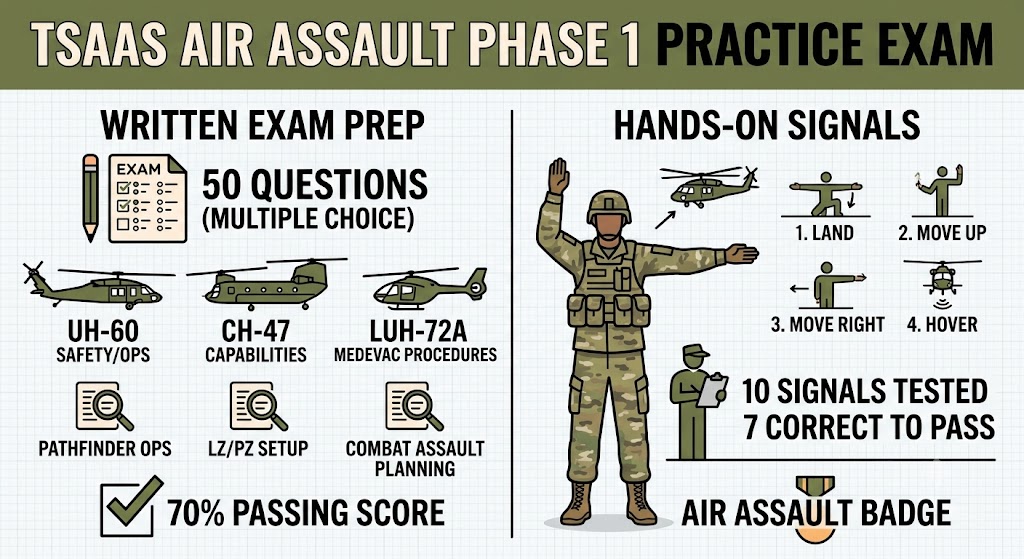
Additional Information
What the Course Entails and Exam Details
TSAAS Air Assault Phase 1, known as Combat Assault, is an intensive 3-day course that transforms students from helicopter passengers into integrated members of an air assault operation. The curriculum is rigorous, requiring memorization and rapid recall.
The core areas of study, which are all covered in this practice exam, include:
Aircraft Safety: Mandatory procedures for approaching, entering, and exiting rotary-wing aircraft, and immediate actions to take in emergency scenarios.
Aircraft Orientation: Detailed characteristics and capabilities of primary Army helicopters, such as the UH-60 Blackhawk, CH-47 Chinook, and LUH-72A Lakota.
Aero-Medical Evacuation (MEDEVAC): Procedures for requesting and managing evacuation missions, casualty loading, and the capabilities of specialized medical aircraft.
Pathfinder Operations: The principles of establishing, operating, and marking standard landing zones (LZ) and pickup zones (PZ).
Combat Assault Operations: Tactical planning, including the ground tactical plan, landing plan, air movement plan, loading plan, and staging plan, and their interdependence.
Hand-and-Arm Signals: Mastering the 10 specific signals used to communicate with aircraft during ground operations.
The actual Phase 1 final test, administered on Day 3 of the course, is divided into two distinct components that a student must pass to continue:
Written Examination: A 50-question, multiple-choice exam that covers all the academic topics listed above. Students must achieve a minimum score of 70% to pass.
Hand-and-Arm Signal Performance Test: A practical, hands-on test where students must correctly and precisely demonstrate 7 of the 10 standard hand-and-arm signals, individually, under the direct supervision of an instructor.
Successful completion of both the written and hands-on tests is mandatory to progress to the Sling-Load Phase (Phase 2). Students are typically allowed only one re-test per exam component.
What to Expect in the Final Exam
You must enter the testing facility mentally prepared for a high-pressure, detail-oriented assessment.
The written exam will probe your knowledge of specifics: the exact passenger capacity and lift capabilities of a CH-47, the definition of a "chalk" versus a "serial" in air assault planning, the unusable space in a landing zone based on obstacle height, and the exact meaning of specific acronyms like "DROP." A slight misinterpretation can lead to an incorrect answer.
The performance test for hand-and-arm signals is just as critical. Instructors will look for clear, deliberate, and precise movements. A casual or ambiguous signal is a point of failure. You must recall the signal and perform it flawlessly on demand. Expect to be tested in a field-like environment that simulates operational stress.
Failure to pass any component will results in a retest; a second failure will lead to a drop from the course and return to your home unit, making preparation paramount.
How to Study and Exam Centers
Preparation for TSAAS Phase 1 begins long before you arrive at Fort Campbell or any other authorized testing location. This practice test is designed to be a key part of your strategy. Here are actionable study methods:
Use the TSAAS Handbook: This is your primary source document. Every question on the written exam comes directly from this manual. Study it cover to cover, repeatedly.
Utilize This Practice Exam: The TSAAS Air Assault Phase 1 Practice Exam replicates the format, structure, and difficulty of the actual 50-question written test. Use it to identify weak areas and track your progress. Review the correct answers and the corresponding handbook references.
Flashcards and Mnemonics: Create flashcards for critical data, such as aircraft speeds, capacities, and signal definitions. Use mnemonics for sequential procedures.
Peer-to-Peer Training: Practice hand-and-arm signals with your peers. One person can act as the instructor and evaluate the accuracy and clarity of the signals. This is the most effective way to prepare for the hands-on test.
Review FM 3-99 and FM 3-21.38: Familiarize yourself with the primary Army field manuals that govern airborne and air assault operations and LZ/PZ operations for additional context.
The Sabalauski Air Assault School (TSAAS) is the primary testing center, located at Fort Campbell, Kentucky. However, the Army also conducts "Mobile Training Teams" (MTTs) that travel to other major installations, including Fort Drum, New York; West Point, New York; and locations in Hawaii and Germany.
All enrollment and attendance are coordinated through your unit’s training and operations (S-3) office.
Job Opportunities from the Course
Upon graduation from TSAAS, you will earn the right to wear the coveted Air Assault Badge and gain a qualification that is respected across the Army.
This certification not only enhances your current role but also creates a clear path to special assignments, leadership positions, and more advanced technical schools. Specifically, an Air Assault qualified Soldier is unlocked for:
Air Assault Operations: Planning and executing missions involving helicopter insertion and extraction.
Sling-Load Operations: Leading and supervising teams responsible for preparing and inspecting equipment for aerial movement.
Rappelling Operations: Performing duties in units requiring rappelling capabilities, including fast-rope insertion (FRIES) and special patrol insertion/extraction (SPIES) systems.
Pathfinder School: This course is a significant prerequisite for the demanding U.S. Army Pathfinder School, where you will become a subject matter expert in setting up LZs and conducting air-ground integration.
FRIES/SPIES Master or Rappel Master: These certifications enable you to supervise and instruct other Soldiers in advanced insertion and extraction techniques.
Enhanced Tactical Proficiency: Air Assault qualification makes you a more valuable asset to any unit, demonstrating dedication, technical proficiency, and the ability to operate under stress.
By utilizing this comprehensive practice exam, you are taking the essential first step towards proving you have what it takes to join the ranks of the Air Assault qualified and excel in these vital roles.
Frequently Asked Questions
Reviews
5.0
Based on 0 reviews
Leave a Review
No reviews yet. Be the first to review!