
TSA Electrical Applications Practice Test
$69.00
- Buy to unlock unlimited access to all Quiz questions.
- After purchase you can print a PDF of the whole quiz at any point. The PDF will contain the questions and the correct answers.
About this Exam
The TSA Electrical Applications event is a highly engaging competition designed for middle and high school students who are members of the Technology Student Association (TSA). This comprehensive assessment challenges young innovators to demonstrate a deep understanding of basic electrical and electronic theory, moving beyond simple textbook knowledge to real-world practical application. It is a fantastic opportunity for students interested in STEM fields to showcase their technical prowess and problem-solving skills, serving as a stepping stone towards a future career in engineering and technology.
Ready to test your knowledge?
Buy Now to Access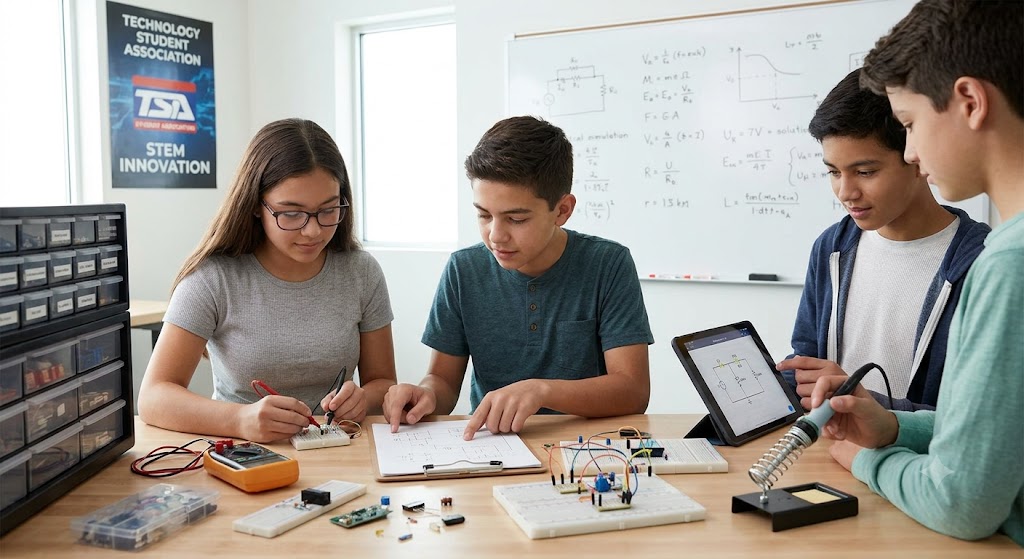
Additional Information
What the Course Entails and Exam Details
This event requires participants to master a detailed curriculum that forms the foundation of modern electronics. Key topics and skills covered include:
Fundamental Electrical Theory: A thorough grasp of voltage, current, resistance, and Ohm’s Law.
Electronic Components: Understanding the function, identification, and measurement of resistors (including color code decoding), capacitors, inductors, diodes, and transistors.
Circuit Analysis: Mastery of series, parallel, and combination circuits, including calculating total resistance and voltage drops.
Schematic Reading: The ability to interpret technical drawings and translate schematic diagrams into functional, physical circuits.
Practical Laboratory Skills: Experience with essential tools and equipment, such as breadboards, multimeters for measuring voltage and resistance, and connecting circuits correctly.
Safety Protocols: Knowledge of standard electrical safety practices to prevent injury and damage to equipment.
What to Expect in the Final Exam
The full evaluation for the TSA Electrical Applications event is a multi-stage process that assesses both theoretical knowledge and hands-on capability:
1. Preliminary Round: The Written Test
Format: The initial phase is typically a comprehensive multiple-choice test.
Content: This component focuses on basic electrical and electronic theory, component identification, and circuit calculations.
Scoring: Students take this test individually. In team competitions, individual scores may be averaged to determine the team score for qualification.
2. Semifinalist Round: The Onsite Challenge
Format: Top-scoring individuals or teams from the written test advance to this practical phase.
Challenge: Semifinalists receive a specific schematic diagram and a set of materials. They must assemble the specified circuit from the schematic under a time limit.
Evaluation: Participants are required to make electrical measurements to verify their circuit is working correctly and then explain their entire solution and reasoning during a brief interview with evaluators.
How to Study and Exam Centers
Preparing for the TSA Electrical Applications event is a journey that blends study and action. Here are some effective strategies to help you excel:
Build a Solid Foundation: Revisit core physics and technology textbooks, focusing on the chapters on electricity and electronics. Create detailed flashcards for key terms, formulas, and component symbols.
Get Hands-On: Theory comes alive with practice. Invest in a basic electronics kit with a breadboard, a multimeter, and common components. Practice building simple circuits from schematics you find online or in textbooks. The more comfortable you are with the hardware, the faster and more accurate you will be during the onsite challenge.
Practice Schematic Interpretation: Don't just look at a diagram—understand how current flows and how each component interacts. Challenge yourself to build more complex circuits as your skills improve.
Review Past Exams: Search for sample questions or past written tests from previous TSA competitions to get a feel for the style and level of difficulty.
Regarding testing centers, the TSA Electrical Applications initial online exam is typically administered during the State Qualifier at designated schools or online portals, as determined by your state's TSA organization. Semifinalists will complete the onsite practical challenge and interview directly at the State or National TSA Conference, requiring teamwork and real-time critical thinking. Check with your TSA advisor or the official TSA website for specific registration details, locations, and schedules.
Job Opportunities from the Course
Participating in and excelling in the TSA Electrical Applications competition is an outstanding way to kickstart a rewarding career in a technology-driven world. The foundational skills you build are directly applicable to many sought-after career paths, opening doors to various job opportunities:
Electrical Engineer: Design and develop complex electrical systems, products, and applications.
Electrical Technician: Install, maintain, and troubleshoot electrical equipment and systems.
Electrician: Plan, install, and repair wiring and electrical fixtures in buildings.
Electronic Analyst: Test, analyze, and repair electronic equipment and data systems.
Electronic Designer: Create blueprints and specifications for new electronic products.
Research Assistant: Support engineering teams in developing new technologies and conducting experiments.
Earning recognition in this competition provides a competitive edge for college applications and future job hunts, proving your technical expertise and dedication.
Frequently Asked Questions
Reviews
5.0
Based on 0 reviews
Leave a Review
No reviews yet. Be the first to review!