
TSA CBT Practice Test
$69.00
- Buy to unlock unlimited access to all Quiz questions.
- After purchase you can print a PDF of the whole quiz at any point. The PDF will contain the questions and the correct answers.
About this Exam
Prepare for a career on the front lines of national security with our comprehensive TSA CBT Practice Test. This Computer-Based Test (CBT) is a critical step in the hiring process for aspiring Transportation Security Officers (TSOs) and potentially other key roles within the Transportation Security Administration (TSA). The exam is designed to assess the essential visual, linguistic, and cognitive skills needed to effectively screen passengers and baggage, ensuring safe and secure travel across all modes of transportation. Passing this rigorous test is your doorway to joining a dedicated team committed to protecting the traveling public. Whether you are a fresh graduate or looking for a meaningful career change, this practice exam is the invaluable tool you need to confidently demonstrate your potential.
Ready to test your knowledge?
Buy Now to Access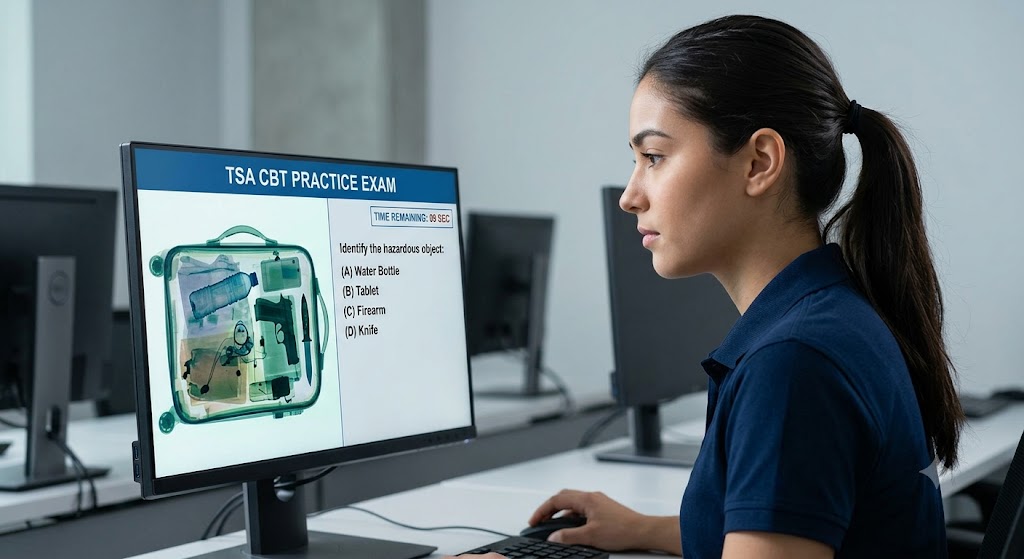
Additional Information
What the Course Entails and Exam Details
This comprehensive practice program mirrors the two main types of the TSA Computer Based Test that candidates often encounter. The legacy version and common practice materials typically include modules on English language proficiency—covering vocabulary, reading comprehension, and written communication—and an intricate Object Recognition Test (ORT), which challenges your ability to identify prohibited items in complex X-ray images. The course content is meticulously crafted to familiarize you with the visual cues, color-density coding, and varied orientations of potential threats, as well as test your precision in reading and interpreting written instructions. The dynamic TSO Assessment Battery (TAB) version may also feature components testing spatial awareness (e.g., 2D-to-3D shape matching), logical reasoning (e.g., connect-the-dots sequences), and speed in image recognition. Our course is designed to equip you with the skills and confidence to excel in any variation of this critical examination.
What to Expect in the Final Exam
The actual TSA CBT is a multiple-choice, computer-based exam. You will likely encounter distinct sections dedicated to the types of skills covered in the practice—including, but not limited to, X-ray image analysis, English proficiency, and visual reasoning. The legacy test could take up to 2.5 hours to complete, while newer versions like the TAB might be significantly shorter, often 30-40 minutes in total, but demanding higher speed and precision. Although the TSA does not publish an official passing score, scores generally place candidates into categories like "Qualified," "Highly Qualified," and "Best Qualified." Higher scores not only increase your chances of passing but also improve your standing and potential speed of selection within the Ready Pool. The final exam is proctored, typically taken at authorized testing centers with strict identification requirements and no personal electronic devices or unauthorized aids allowed. Remember, only your correct answers count, so there is no penalty for guessing; ensure you answer all questions within the given time.
How to Study and Exam Centers
Maximize your potential by engaging with this thorough practice exam. Simulate real test conditions by timing your practice sessions and taking full-length tests in a quiet environment. Diligently review sample questions and explanations to understand both correct and incorrect answers. Pay special attention to the visual analysis components: practice identifying various prohibited items in X-ray images and honing your spatial reasoning and matching speed. The actual CBT is typically scheduled after you submit an initial application through USAJOBS.gov and receive an official invitation via email. This email will contain a unique link to schedule your exam, which is almost always held in person at specific, designated testing centers across the country, such as those operated by major assessment and certification vendors. Make sure to choose a testing center and date well in advance to secure your preferred slot and location. Please note that while the final exam is conducted at a testing center, this online practice course is available from any computer with internet access.
Job Opportunities from the Course
Passing the TSA CBT is the essential gateway that unlocks diverse and impactful career paths within the TSA, particularly in aviation and other transportation sectors. Here are some specific job titles and the career progression potential that open up for successful candidates who complete the hiring process:
Transportation Security Officer (TSO)
Lead Transportation Security Officer (LTSO)
Supervisory Transportation Security Officer (STSO)
Training Instructor
Transportation Security Specialist – Explosives Detection Canine Handler (TSS-EDCH)
Behavior Detection Officer (BDO) (and other specialized roles, with experience and further training)
Various administrative and support positions within the larger TSA structure, where experience as a TSO can be a strong foundation.
Frequently Asked Questions
Reviews
5.0
Based on 0 reviews
Leave a Review
No reviews yet. Be the first to review!