
TREC Roof Systems 200 Hr Practice Test
$69.00
- Buy to unlock unlimited access to all Quiz questions.
- After purchase you can print a PDF of the whole quiz at any point. The PDF will contain the questions and the correct answers.
About this Exam
The [TREC Roof Systems Practice Exam] is an essential tool designed to help you master the crucial roofing component of the comprehensive Texas Professional Real Estate Inspector examination. The official license is governed by the Texas Real Estate Commission (TREC) and is a requirement for anyone seeking to legally perform real estate inspections in the state of Texas.
The "200 Hr" component of the course reflects the minimum 200 hours of required pre-licensing education a candidate must complete before qualifying to take the state and national exam modules. The practice test focuses specifically on the extensive roof systems material, which is one of the most challenging and critical modules of the overall curriculum and exam. It is designed for aspiring professional real estate inspectors, construction management professionals, and tradespeople looking to make the career transition into inspection.
Ready to test your knowledge?
Buy Now to Access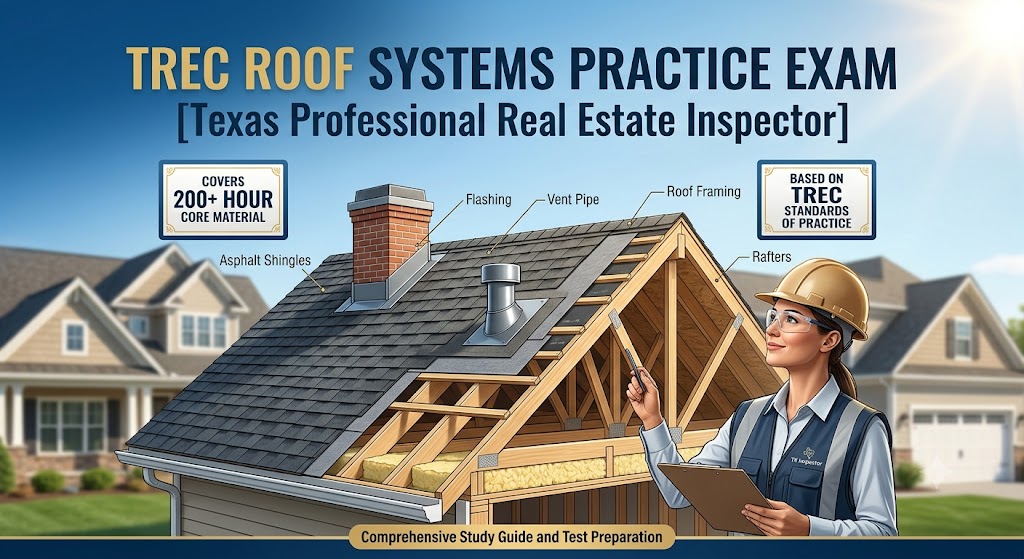
Additional Information
What the Course Entails and Exam Details
This practice test simulates the rigorous requirements you will face in the official TREC inspector examination. The content is directly aligned with the topics covered in your TREC-approved 200-hour core education, specifically focused on the structural and structural systems modules.
You will encounter questions that test your mastery of a vast array of topics, including:
Core Knowledge Areas:
TREC Standards of Practice (SOP): Mastery of the exact rules (§535.228) that dictate what a Texas inspector must and must not report.
Roof Materials & Installation: Detailed understanding of asphalt shingles, metal roofing, clay and concrete tile, wood shakes, and various low-slope (flat) roofing systems like TPO, EPDM, and modified bitumen.
Structural Components: Understanding roof framing (trusses, rafters, hips, valleys, ridges), roof decks, and load distribution.
Roof Intersections & Flashing: Comprehensive knowledge of proper flashing for valleys, chimneys, vent pipes, dormers, and rake edges (gable ends).
Ventilation & Insulation: Principles of balanced ventilation (intake vs. exhaust), the impact of moisture, and interaction with insulation.
Defect Recognition: Recognizing common roofing deficiencies, installation errors, hail damage, deterioration, and leaks.
Estimation: Calculating "squares" of material, waste factors, and measurement.
What to Expect in the Final Exam
While this is a practice tool for the Roof Systems component, it is important to understand the format of the final official Texas Professional Real Estate Inspector Examination you are preparing to conquer. The practice test is designed to provide you with the same level of difficulty and question structure you will face on game day.
Official TREC Exam Format:
Format: The full TREC exam is computer-based and primarily multiple-choice. The State Module portion focuses heavily on the TREC SOPs, including the detailed roofing requirements.
Question Types: Includes scenario-based questions, identification of components, and application of specific rules from the Standards of Practice.
Passing Score: A passing score of 70% or higher is required for each module (State and National).
Time Limit: The total exam time for both modules is substantial, typically several hours. (Example based on search context: Florida's main contractor trade exam is 5 hours; you should be prepared for a focused, long-form testing environment).
Open Book? The TREC inspector exam is not open-book, unlike some other trade certifications. All Standards of Practice and technical knowledge must be memorized and understood.
How to Study and Exam Centers
Successfully passing the roofing portion of the exam requires dedicated, strategic preparation. Do not underestimate the breadth of the material covered within the TREC 200-hour core requirement.
Actionable Study Strategies:
Immerse Yourself in the SOPs: Print out §535.228 (Roof Systems) and learn it verbatim. Make flashcards on "must report" versus "not required to report."
Master Roof Geometry: Be comfortable with terms like pitch, slope, rake, valley, hip, and ridge. Understand how ventilation impacts these zones.
Take Unlimited Practice Tests: Utilize [TREC Roof Systems Practice Exam] questions repeatedly. Focus on understanding why a correct answer is right and why the distractors are wrong.
Visualize Components: Review many sample inspection photos, construction manuals, and manufacturer installation guides for different roof types.
Utilize Your 200-Hour Coursework: Review all structural and structural systems lesson plans, texts, and quizzes from your primary education provider.
Exam Center and Registration Details:
Registration: To take the actual Texas Professional Real Estate Inspector Exam, you must first have your 200 hours of education certificate approved by TREC. Once you receive your "Authorization to Test" (ATT) email from TREC, you can register.
Authorized Center: The exam is proctored and administered at dedicated physical testing centers. The current primary exam provider for TREC is typically Pearson VUE, which has many authorized testing locations across Texas and the US. You must schedule your time in advance through their portal.
Job Opportunities from the Course
Earning the designation that this practice test supports unlocks several lucrative and secure career paths. The core knowledge and eventual licensure as a professional inspector position you as a vital expert in the real estate industry.
Career Paths and Specific Job Titles Unlocked by This Certification:
Texas Professional Real Estate Inspector: The primary and most direct role, allowing you to legally perform all aspects of real estate inspection.
Real Estate Inspector: A general title applicable in other states, using your foundational knowledge.
Home Inspector: Specific to residential properties.
Commercial Property Inspector: Specializing in larger, more complex building systems, including extensive roof areas.
Roof Consultant / Roof Inspector Specialist: A highly specialized niche, working for insurance companies, litigation, or roofing contractors to analyze specific roof conditions.
Risk Assessment Specialist: Roles within insurance companies or financial institutions evaluating property risk based on condition.
Construction Quality Control Inspector: Using your expertise to ensure installations meet code and standards.
Frequently Asked Questions
Reviews
5.0
Based on 0 reviews
Leave a Review
No reviews yet. Be the first to review!