
TPC Schematic and Symbols Practice Test
$69.00
- Buy to unlock unlimited access to all Quiz questions.
- After purchase you can print a PDF of the whole quiz at any point. The PDF will contain the questions and the correct answers.
About this Exam
The TPC Schematic and Symbols exam is a foundational certification designed for maintenance technicians, operators, and individuals entering industrial and technical fields. It validates a critical skill: the ability to read, interpret, and troubleshoot complex technical drawings across multiple disciplines, including electrical, fluid power (hydraulic and pneumatic), and piping systems. This exam ensures proficiency in the universal language of symbolic diagrams, a prerequisite for safety and efficiency in industrial maintenance and operation roles.
Ready to test your knowledge?
Buy Now to Access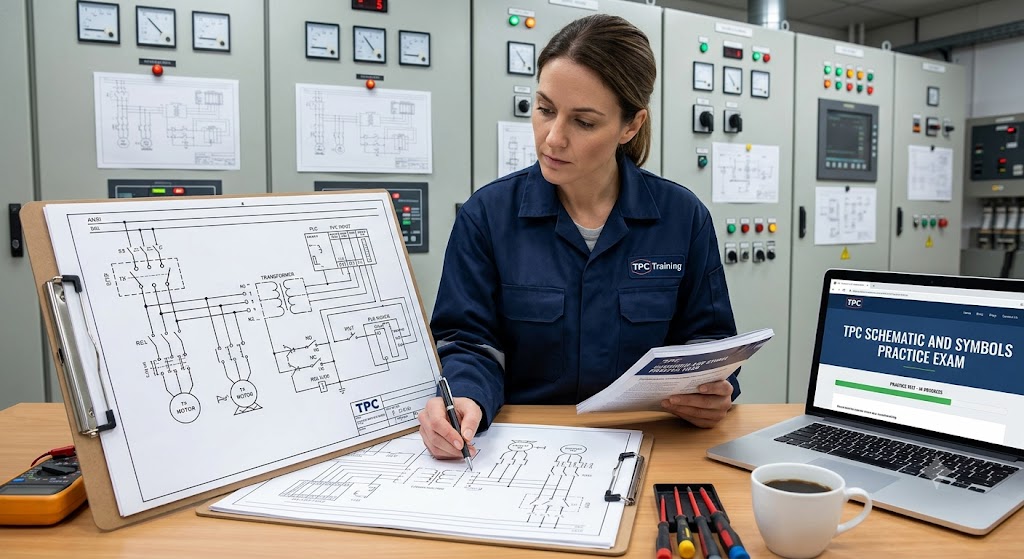
Additional Information
What the Course Entails and Exam Details
This course of study covers a comprehensive array of standard schematics and symbols, primarily adhering to ANSI and IEC standards, which are prevalent in modern industrial settings. The core syllabus encompasses:
Electrical Schematics: Interpreting symbols for contacts, switches (NO/NC), motors, transformers, circuit breakers, fuses, relays, and basic logic flow like ladder logic.
Fluid Power and Piping Diagrams: Understanding symbols for valves (check, globe, solenoid-operated, multi-position), pumps, actuators, gauges, and piping connections.
Interpretation Strategies: Learning efficient techniques for analyzing drawing titles, parts lists, and notes; understanding grid-based coordinate systems for cross-referencing; and distinguishing between one-line and comprehensive wiring diagrams.
Practical Application: The focus is on practical interpretation, enabling technicians to use schematics for identifying components, understanding system operation, and isolating faults.
What to Expect in the Final Exam
The final TPC Schematic and Symbols exam is typically a closed-book, multiple-choice assessment, designed to test the candidate's understanding of the symbolic language and its application. It often consists of approximately 50 to 100 questions.
Format: Candidates will be presented with schematic snippets and symbols, and must identify their correct meaning, function, or the logic of the circuit shown.
Passing Score: To successfully earn the certification, a passing score of at least 70% is generally required.
Time Limit: The exam is timed, often allowing between one to two hours to complete, demanding both accuracy and speed.
Rules: The test must be completed in a controlled environment, which may include live or recorded remote proctoring if taken online.
How to Study and Exam Centers
Preparation is key to succeeding on the TPC Schematic and Symbols exam. Recommended study strategies include:
TPC Course Material: Thoroughly review the TPC 102 Reading Schematics and Symbols course material or equivalent training content.
Use Flashcards: Utilize digital or physical flashcards to memorize common electrical, fluid power, and piping symbols and their functions.
Practice Tests: Take multiple practice exams to become familiar with the types of questions, difficulty level, and time management constraints.
Real-World Application: Practice interpreting actual, detailed industrial schematics from various sources to build practical skills.
The exam is primarily delivered through the TPC Training online learning management system. While there may be authorized training centers or schools, most candidates take the exam remotely from an approved computer, following strict identity verification and proctoring procedures to maintain the exam's integrity.
Job Opportunities from the Course
Earning a certification in schematic interpretation and symbol reading significantly enhances career prospects in technical roles. Common job titles that utilize these skills include:
Maintenance Technician (Industrial, Electrical, or Mechanical)
Field Service Technician
Industrial Electrician
Plant Operator
Electro-Mechanical Technician
Instrumentation and Control Technician
Automation Technician
Process Operator
Technical Sales Representative
Frequently Asked Questions
Reviews
5.0
Based on 0 reviews
Leave a Review
No reviews yet. Be the first to review!