
TPC Basic Electricity and Electronics Practice Test
$69.00
- Buy to unlock unlimited access to all Quiz questions.
- After purchase you can print a PDF of the whole quiz at any point. The PDF will contain the questions and the correct answers.
About this Exam
The TPC Basic Electricity and Electronics program is a foundational coursework sequence designed for individuals pursuing careers in industrial maintenance, multi-skilled technician roles, and facility engineering.
It provides a comprehensive introduction to core electrical concepts, moving from essential safety practices to basic electronic circuits.
This program is typically targeted at entry-level technicians, maintenance personnel looking to upskill, and students in vocational technical programs who need to validate their foundational knowledge before advancing.
Ready to test your knowledge?
Buy Now to Access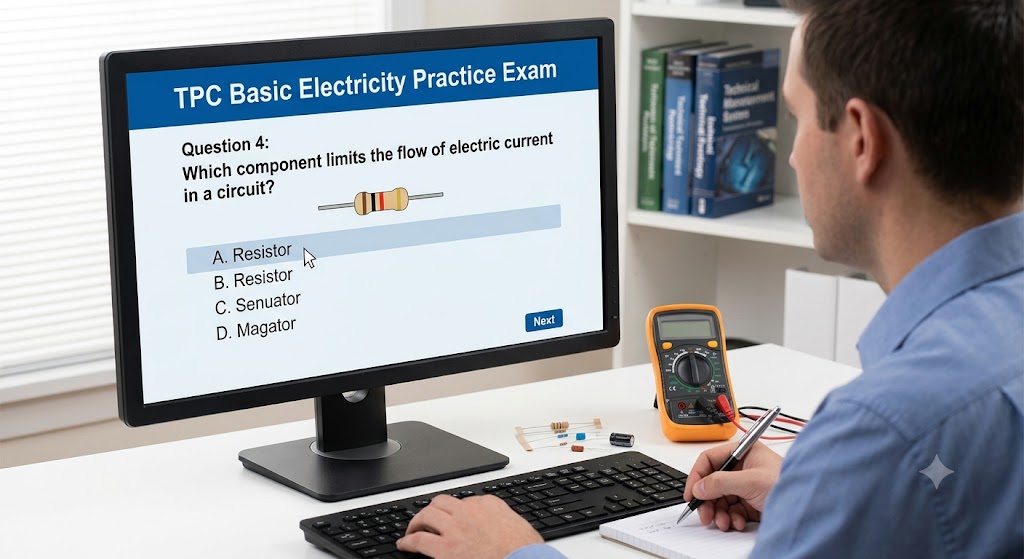
Additional Information
What the Course Entails and Exam Details
This extensive coursework covers the fundamental principles governing both AC and DC electrical systems.
The curriculum is structured into specific modules that address key areas, ensuring a thorough understanding of essential electrical theory and application.
Core topics typically include safe electrical work practices, fundamentals of voltage, current, and resistance (Ohm’s Law), series and parallel circuits, and electrical measurements using multimeters.
Students also dive into complex topics like alternating current principles, inductors, capacitors, transformers, and the basic operation of semiconductor devices such as diodes and transistors.
The ultimate goal is to equip learners with the theoretical knowledge needed to troubleshoot and maintain common electrical systems.
What to Expect in the Final Exam
The final assessment of the TPC Basic Electricity and Electronics coursework serves as a validation of the knowledge gained throughout the program.
It is generally administered as a timed, multiple-choice exam, delivered through a digital platform.
The exam typically comprises a set number of questions—often 50 or more—designed to test comprehension across all covered modules.
To pass, candidates must demonstrate a minimum proficiency, usually requiring a competitive score, such as 70% or higher, depending on the specific program or employer requirements.
While specific practical "hands-on" components may not be in the multiple-choice section itself, successful completion of the coursework often implies successful completion of integrated lab exercises.
How to Study and Exam Centers
Preparation for this exam begins with a thorough review of the official TPC Training course materials, including textbooks, online modules, and completed lab assignments.
Utilizing dedicated practice tests, such as the TPC Basic Electricity Electronics Practice Exam, is arguably the most effective way to identify knowledge gaps and get comfortable with the exam's format and pacing.
Students should focus on mastering key formulas (like those derived from Ohm's Law and Power Law), understanding circuit schematics, and confidently interpreting electrical measurement readings.
Regarding test administration, the final exam is typically accessed directly through the TPC online learning portal, often proctored by an employer or a training coordinator.
In some cases, authorization can be arranged through specific physical testing centers or authorized vocational schools that partner with TPC Training for workforce development.
Job Opportunities from the Course
Mastering the fundamentals of basic electricity and electronics unlocks diverse career paths in technical and industrial sectors. This foundational knowledge is essential for numerous entry-level and intermediate roles, including:
Maintenance Electrician
Industrial Machinery Mechanic
HVAC Technician (Heating, Ventilation, and Air Conditioning)
PLC Technician (Programmable Logic Controller)
Automation Specialist
Electrical/Electronics Installer and Repairer
Facility Maintenance Technician
Wind Turbine Technician
Solar Installation Technician
Frequently Asked Questions
Reviews
5.0
Based on 0 reviews
Leave a Review
No reviews yet. Be the first to review!