
TNCC Trauma Nursing Process (TNP) Practice Test
$69.00
- Buy to unlock unlimited access to all Quiz questions.
- After purchase you can print a PDF of the whole quiz at any point. The PDF will contain the questions and the correct answers.
About this Exam
The Trauma Nursing Core Course (TNCC) is a widely recognized certification that equips registered nurses with the knowledge and skills necessary to provide expert care to trauma patients.
A crucial component of this certification is the Trauma Nursing Process (TNP), a systematic assessment and management framework that guides trauma nurses through the initial resuscitation and stabilization of critically injured individuals.
This practice test is designed to help nurses prepare for the TNP portion of the TNCC provider exam, offering a range of simulated scenarios and questions that mirror the structure and content of the actual assessment.
Ready to test your knowledge?
Buy Now to Access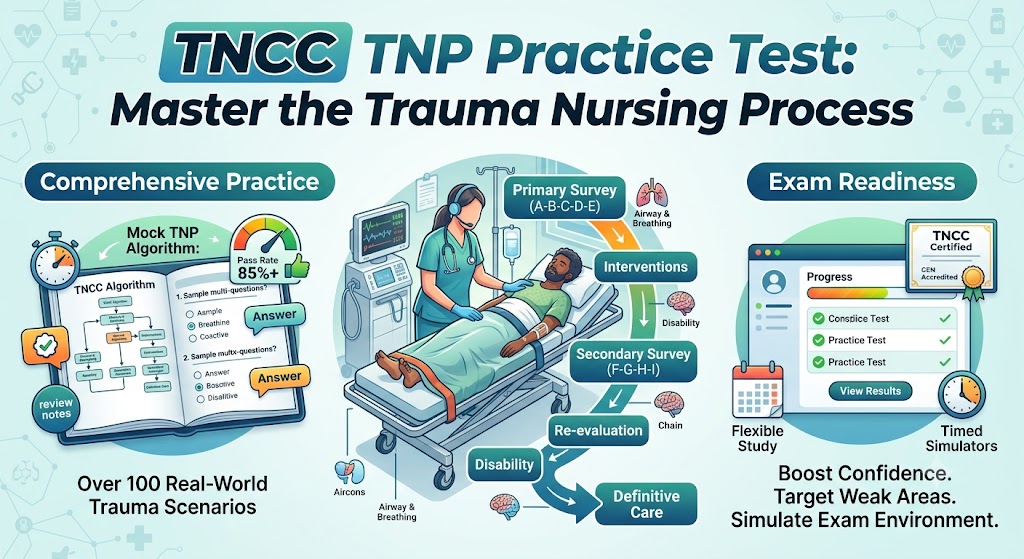
Additional Information
What the Course Entails and Exam Details
The TNCC provider course covers a comprehensive range of topics related to trauma nursing, including:
Primary and Secondary Surveys: Systematic assessment of airway, breathing, circulation, disability, and exposure (primary survey), followed by a head-to-toe evaluation (secondary survey).
Airway and Ventilation Management: Techniques for securing and maintaining a patent airway, providing oxygen therapy, and managing mechanical ventilation.
Shock Management: Identification and treatment of different types of shock, including hypovolemic, cardiogenic, and distributive shock.
Trauma to Specific Body Systems: Detailed assessment and management strategies for injuries to the head, spine, chest, abdomen, pelvis, extremities, and burns.
Special Populations: Considerations for managing trauma in pediatric, geriatric, and pregnant patients.
Disaster Management: Roles and responsibilities of trauma nurses in disaster response.
The Trauma Nursing Process (TNP): A systematic framework for patient assessment, intervention, and evaluation.
What to Expect in the Final Exam
The TNCC provider exam typically consists of two parts:
Multiple-Choice Examination: This part assesses your theoretical knowledge of trauma nursing concepts and principles.
TNP Psychomotor Skill Station: This part evaluates your ability to apply the TNP in a simulated clinical scenario.
Format: You will be presented with a scenario involving a simulated trauma patient. You will be expected to demonstrate your assessment skills, identify life-threatening injuries, prioritize interventions, and evaluate the patient's response.
Time Limit: The TNP skill station is typically timed, adding a layer of realism and pressure.
Passing Score: To pass the TNP psychomotor skill station, you must achieve a passing score based on predetermined criteria, which are usually outlined in the TNCC provider manual.
How to Study and Exam Centers
Preparing for the TNP psychomotor skill station requires a combination of knowledge acquisition and practical skill development.
Review the TNCC Provider Manual: This is your primary resource. Pay close attention to the chapters detailing the TNP and the systematic assessment process.
Practice with Scenarios: Seek out resources that offer TNP practice scenarios, similar to those found in this practice test. This will help you become familiar with the format and develop your assessment skills.
Observe Experienced Nurses: Shadowing experienced trauma nurses and observing their assessment techniques can provide valuable insights.
Utilize Study Groups: Partner with other nurses preparing for the TNCC exam to review concepts, discuss scenarios, and practice your assessment skills.
Exam Centers:
TNCC provider courses and exams are typically offered through:
Hospitals and Healthcare Facilities: Many hospitals host TNCC courses for their nursing staff.
Nursing Schools: Some nursing schools offer TNCC courses as part of their continuing education programs.
Emergency Nurses Association (ENA): The ENA is the national organization that developed TNCC. They provide information on course availability and locations.
Authorized Training Centers: Certain independent training centers are authorized to provide TNCC courses and exams.
Job Opportunities from the Course
A TNCC certification is highly valued in various healthcare settings, demonstrating your expertise and commitment to providing quality care to trauma patients. It can open doors to exciting career opportunities, including:
Emergency Department (ED) Nurse: ED nurses frequently care for trauma patients, making TNCC certification essential.
Trauma Center Nurse: Levels I, II, III, IV, and V trauma centers actively recruit TNCC-certified nurses to staff their specialized units.
Flight Nurse: Flight nurses provide critical care transport to patients, including those with severe trauma, where TNCC knowledge is paramount.
Critical Care Nurse: While not solely focused on trauma, critical care nurses often manage complex cases, including patients with multisystem trauma.
Trauma Coordinator: In addition to clinical roles, TNCC certification is beneficial for leadership positions such as trauma coordinators, who manage trauma programs and coordinate care across disciplines.
Disaster Management Nurse: Nurses with TNCC certification are valuable assets in disaster response teams, where they can apply their skills in triage and critical care.
A TNCC certification not only enhances your clinical competence but also increases your marketability as a healthcare professional, demonstrating your dedication to patient safety and excellence in trauma nursing.
Frequently Asked Questions
Reviews
5.0
Based on 0 reviews
Leave a Review
No reviews yet. Be the first to review!