
TMC Self‑Assessment Examination (SAE) – Form A Practice Test
$69.00
- Buy to unlock unlimited access to all Quiz questions.
- After purchase you can print a PDF of the whole quiz at any point. The PDF will contain the questions and the correct answers.
About this Exam
The Therapist Multiple-Choice (TMC) Examination is the crucial gateway for aspiring respiratory therapists to begin their professional journey. Developed by the National Board for Respiratory Care (NBRC), it is designed to objectively measure essential knowledge, skills, and abilities required at entry into practice. Passing this comprehensive exam earns you the Certified Respiratory Therapist (CRT) credential and, depending on your score, determines your eligibility for the advanced Clinical Simulation Examination (CSE) to become a Registered Respiratory Therapist (RRT). To successfully navigate this critical milestone, taking an official NBRC Self-Assessment Examination (SAE), such as Form A, is not just beneficial—it is an essential strategic step in your preparation. These practice tests are the only tools that provide the actual rationale from the exam committees for the correct answers.
Ready to test your knowledge?
Buy Now to Access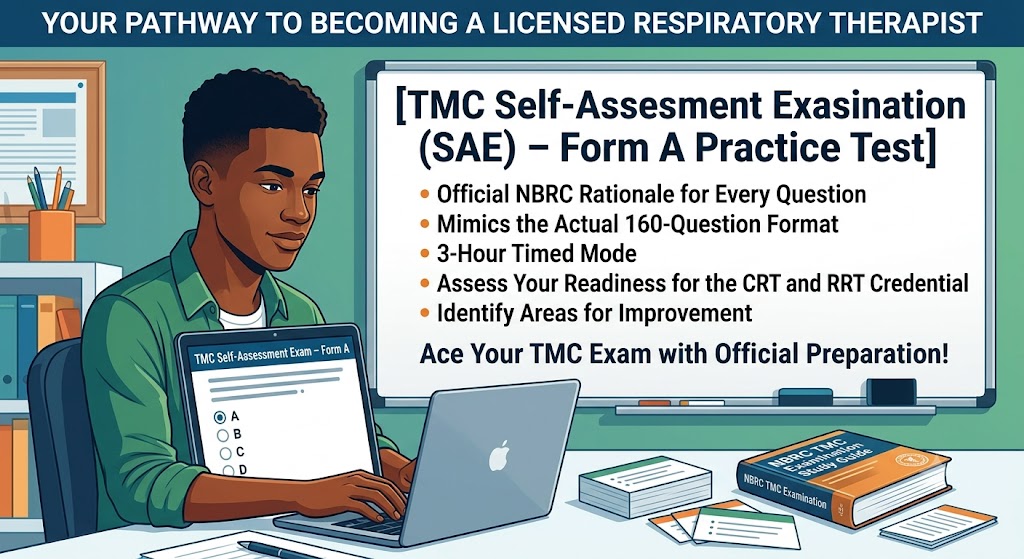
Additional Information
What the Course Entails and Exam Details
The TMC Self-Assessment Examination (SAE) – Form A is a high-fidelity simulation of the actual NBRC TMC credentialing exam. It is a vital tool that helps candidates assess their readiness and identify areas of weakness before attempting the final test. The content of Form A directly reflects the major domains and cognitive levels specified in the official TMC Detailed Content Outline. Taking this practice test helps you become familiar with the logic and structure of NBRC questions, giving you a distinct advantage.
The core content domains covered in both the SAE and the actual TMC Exam include:
A. Evaluate Patient Data: This domain accounts for a significant portion of the exam. It covers evaluating patient history, physical examination results, laboratory data, blood gas analysis, pulmonary function tests, imaging studies, and maternal/perinatal/neonatal history. Candidates must demonstrate the ability to apply this data to make appropriate clinical decisions.
B. Troubleshooting and Quality Control of Devices and Infection Control: This section tests your technical proficiency. You will be expected to demonstrate knowledge of assembling, maintaining, and troubleshooting equipment, as well as adhering to strict infection control protocols. Topics include managing lines, drains, and artificial airways, and ensuring equipment is safe and functional for patient use.
C. Initiation and Modification of Interventions: This largest domain tests your ability to initiate and manage patient care. It covers oxygen therapy, medical gas delivery, humidity and aerosol therapy, airway management, hyperinflation therapy, bronchial hygiene, pharmacology, mechanical ventilation (initiation, monitoring, and weaning), and noninvasive ventilation.
What to Expect in the Final Exam
While the SAE Form A is a practice tool, the final NBRC TMC Examination has a specific format that you must prepare for. The final exam consists of 160 multiple-choice questions. Of these, 140 are scored items, and 20 are pretest items which do not count toward your final score. Candidates are given three hours (3 hours) to complete the entire examination in one sitting.
There are two critical cut scores on the TMC Examination, which determine your outcomes:
Low Cut Score: Achieving this score earns you the Certified Respiratory Therapist (CRT) credential. In most states, this is the basis for state licensure, allowing you to begin working in the field.
High Cut Score: Achieving this higher score also earns you the CRT credential but, importantly, establishes your eligibility to take the Clinical Simulation Examination (CSE). Successful completion of the CSE is the required next step to earn the prestigious Registered Respiratory Therapist (RRT) credential, which is often preferred for advanced or supervisory roles.
How to Study and Exam Centers
Your preparation should be structured and comprehensive. The cornerstone of a successful study plan is the official NBRC materials. The TMC Self-Assessment Examination (SAE) – Form A is the most potent tool available because it provides the actual NBRC rationale for the correct answer to each question. This direct insight into the exam creators' logic is invaluable.
Recommended Study Strategies:
Utilize the NBRC Detailed Content Outline: This is your roadmap. Study the specific topics listed to ensure comprehensive coverage.
Take Multiple SAE Forms: The NBRC offers more than one form. Take Form A and other available forms to expose yourself to a wider range of simulated questions and get maximum feedback.
Review Rationales Thoroughly: After taking an SAE, don't just check your score. Read the detailed rationales for every question, both those you answered correctly and those you missed. This will teach you how to apply clinical reasoning the "NBRC way."
Simulate Exam Conditions: When taking an SAE, do it in a quiet environment, free of distractions, and adhere to the three-hour time limit. This builds mental stamina and time management skills.
Use Supplemental Study Guides and Respiratory Therapy Software: Many candidates benefit from additional resources that offer practice questions, explanations, and content reviews, though none can replace the authenticity of the NBRC SAEs.
Exam Center Information:
The actual NBRC TMC credentialing examination is not taken online from home. It is administered through authorized PSI testing centers across the United States. You can register for the exam on the NBRC website and select a testing center near you. You must present valid, government-issued photo identification to enter the testing site. Remember that the SAE practice tests can be purchased and accessed online directly from your own computer to provide flexible preparation leading up to your scheduled test center date.
Job Opportunities from the Course
Successfully passing the TMC exam to become a Certified Respiratory Therapist (CRT) or subsequently a Registered Respiratory Therapist (RRT) unlocks diverse and rewarding career paths. These credentials are standard for entry and advancement in the high-demand field of respiratory care.
Certified Respiratory Therapist (CRT): This is the immediate outcome of passing the TMC, allowing you to secure state licensure and begin your career. CRTs work in:
Hospitals
Rehabilitation centers
Skilled nursing facilities
Physician offices
Home care agencies
Patient transport systems
Registered Respiratory Therapist (RRT): Achieving the high cut score on the TMC and then passing the Clinical Simulation Exam (CSE) earns you the RRT. This advanced credential is often required or preferred for:
Supervisory and management positions
Advanced critical care specialties (ICU, NICU, PICU)
Educational roles in respiratory therapy programs
Specialized pulmonary function testing and research
Pulmonary rehabilitation and disease management
Frequently Asked Questions
Reviews
5.0
Based on 0 reviews
Leave a Review
No reviews yet. Be the first to review!