
TMC Respiratory Care Boards Practice Exam
$69.00
- Buy to unlock unlimited access to all Quiz questions.
- After purchase you can print a PDF of the whole quiz at any point. The PDF will contain the questions and the correct answers.
About this Exam
The TMC Respiratory Care Boards Practice Exam is an essential tool designed to help graduates of accredited respiratory care programs prepare for the Therapist Multiple-Choice (TMC) Examination. This critical exam, administered by the National Board for Respiratory Care (NBRC), is the entry-level credentialing process for aspiring Respiratory Therapists (RTs) in the United States. Successfully passing the TMC is the required pathway to earning the Certified Respiratory Therapist (CRT) credential, signifying entry-level competence in the field. This practice exam is specifically crafted to simulate the rigor, format, and content of the actual licensure test, providing candidates with a valuable opportunity to assess their knowledge, identify areas for improvement, and build the confidence necessary to succeed on exam day.
Ready to test your knowledge?
Buy Now to Access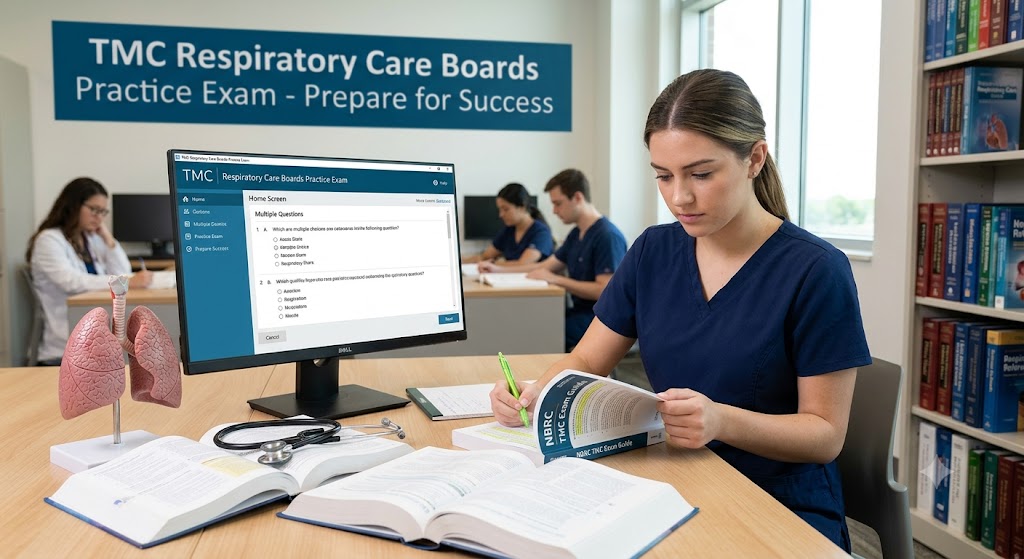
Additional Information
What the Course Entails and Exam Details
This preparation process focuses comprehensive content review aligned with the NBRC's complex matrix for the TMC exam. It entails mastering knowledge across multiple critical domains of respiratory care. Candidates must demonstrate proficiency in:
Patient Assessment: Including physical examination, analyzing medical history, and interpreting laboratory data.
Airway Management: Techniques for establishing and maintaining patent airways in various patient populations.
Mechanical Ventilation: Management of invasive and non-invasive ventilation strategies and initiating therapy.
Oxygen Therapy and Medical Gas Administration: Safe and effective delivery of therapeutic gases.
Pulmonary Function Testing: Performing and interpreting diagnostic lung function tests.
Pharmacology: Knowledge of medications used in respiratory care, including dosages, indications, and side effects.
Cardiopulmonary Resuscitation: Emergency procedures and Advanced Cardiovascular Life Support (ACLS) protocols.
Specialty Care: Basic concepts related to neonatal, pediatric, and geriatric respiratory care.
Professionalism and Ethics: Adhering to legal standards and ethical guidelines in practice.
What to Expect in the Final Exam
The official Therapist Multiple-Choice (TMC) Examination is a computerized, multiple-choice assessment. It consists of 160 questions, of which 140 are scored and 20 are pretest questions used for future exam development (which do not affect your score). Candidates are given a total of three hours (3 hours) to complete the entire exam.
What makes the TMC unique is that it has two distinct passing cut scores. Achieving the lower cut score grants the candidate the Certified Respiratory Therapist (CRT) credential. Achieving the higher cut score, however, not only earns the CRT credential but also fulfills the prerequisite written examination requirement to become eligible to take the Clinical Simulation Examination (CSE). Successfully passing both the TMC (at the higher score) and the CSE is required to earn the prestigious Registered Respiratory Therapist (RRT) credential, which is widely considered the standard of excellence for advanced respiratory care practice.
How to Study and Exam Centers
Effective preparation for the TMC exam involves a multi-faceted approach. Candidates should utilize official NBRC resources, including taking the officially sanctioned self-assessment exams (SAEs) which provide direct feedback on performance and highlight weak areas. Comprehensive review books, online practice question banks, flashcards for key terms and formulas, and participation in study groups are highly recommended strategies. Simulating exam conditions by taking full-length timed practice tests is crucial for building stamina and improving time management.
The actual TMC exam is administered year-round at authorized testing centers globally. These centers are typically managed by professional testing agencies, most commonly Pearson VUE. Candidates must first apply through the NBRC and receive an eligibility letter before scheduling their specific exam appointment at a convenient Pearson VUE physical testing location. Some authorized respiratory care schools may also serve as designated testing sites for their graduates.
Job Opportunities from the Course
Successfully challenging the TMC exam and earning the CRT credential (at minimum) dramatically expands career opportunities within the healthcare sector. Licensed respiratory therapists are in high demand across various settings. Potential job titles and career paths include:
Certified Respiratory Therapist (CRT) – Acute Care Hospitals
Staff Respiratory Therapist – Intensive Care Units (ICU/NICU/PICU)
Registered Respiratory Therapist (RRT) – (Requires passing TMC at higher score + CSE)
Home Care Respiratory Therapist
Pulmonary Rehabilitation Specialist
Sleep Disorder Center Technician/Technologist (Polysomnographic Technologist)
Diagnostic Pulmonary Function Technologist
Emergency Department/Transport Respiratory Therapist
Respiratory Care Educator or Clinical Instructor
Medical Equipment Sales Representative (Respiratory Specialty)
Clinical Research Coordinator in Respiratory Therapy
Frequently Asked Questions
Reviews
5.0
Based on 0 reviews
Leave a Review
No reviews yet. Be the first to review!