
TFM 12 Fire Alarm Technical Practice Test
$69.00
- Buy to unlock unlimited access to all Quiz questions.
- After purchase you can print a PDF of the whole quiz at any point. The PDF will contain the questions and the correct answers.
About this Exam
The TFM 12 Fire Alarm Technical exam is a critical step for professionals aiming to specialize in fire alarm and signaling systems. Specifically designed for individuals seeking licensure, such as the Texas Fire Alarm Technician License (FAL), this certification validates the technical proficiency and practical knowledge required to install, service, maintain, and certify fire alarm systems. It targets fire alarm technicians, inspectors, planners, and life safety professionals who need to demonstrate a deep understanding of industry-standard codes and technical application.
Ready to test your knowledge?
Buy Now to Access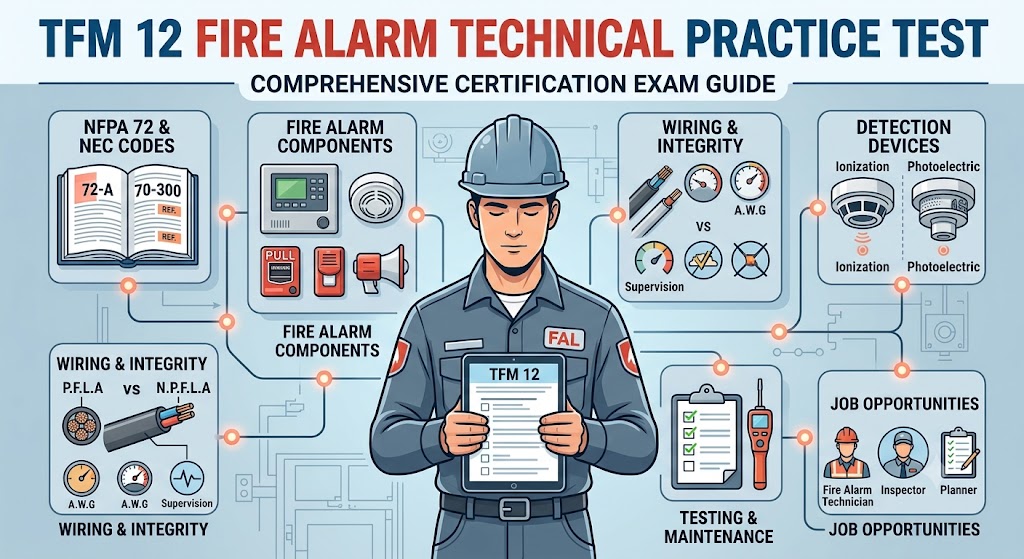
Additional Information
What the Course Entails and Exam Details
The TFM 12 exam is a "Technical" assessment, demanding rigorous knowledge of key safety standards. The core curriculum and exam syllabus are heavily rooted in:
NFPA 72: The National Fire Alarm and Signaling Code, covering fundamentals, system design, installation, and testing.
NFPA 70 (NEC): The National Electrical Code, focusing on proper wiring methods, materials, and system configurations for fire alarm circuits.
Key technical topics include:
Fire Alarm System Components & Functions: Control panels, initiating devices (manual and automatic), notification appliances, and power supplies.
Detection Devices: In-depth knowledge of smoke detectors (ionization, photoelectric, cloud chamber), heat detectors (spot type, rate compensation), and their proper placement on walls and ceilings.
Notification Appliances: Requirements for horns, strobes, and visual indicators, including spacing and synchronization.
Wiring Methods & Supervision: Differentiating between Power-Limited (P.F.L.A) and Non-Power-Limited (N.P.F.L.A) circuits, A.W.G. sizes, voltage ratings, and monitoring the system's electrical integrity.
System Testing, Inspection, & Maintenance: Periodic requirements, documentation, and operational protocols.
Alarm Initiation & Signaling: Proper integration with elevator recall, water flow switches, and supervisory signals (e.g., pressure tanks).
What to Expect in the Final Exam
Preparation is key, and knowing the format reduces stress. The final TFM 12 exam adheres to the following strict details:
Exam Format: It is a proctored, closed-book exam.
Question Type: Multiple Choice.
Total Questions: 50.
Time Limit: 120 minutes (2 hours).
Passing Score: 70%.
Candidates should expect questions derived directly from the NFPA 72 and NEC codebooks, often requiring the specific interpretation and application of a code section to a hypothetical technical scenario.
How to Study and Exam Centers
A successful outcome on the TFM 12 depends on an active, multifaceted study strategy. You are not only memorizing facts but learning to navigate complex technical documents.
Actionable Study Strategies:
Master the Codebooks: The NFPA 72 and NEC are your primary sources. Dedicate extensive time to reading and understanding their structure, definitions, and tables. Use highlighters and tabs to build familiarity.
Utilize Official Study Materials: Obtain study guides, training courses, and sample question banks approved by relevant industry bodies or authorized training providers. These will help focus your efforts on high-probability exam topics.
Engage in Practice Tests: The cornerstone of success is rigorous practice. Regular "TFM 12 Fire Alarm Technical Practice Tests" are essential for simulating the exam environment, managing your time, and identifying areas where you need further review.
Join Professional Groups: Connect with other fire alarm professionals through forums or local associations to discuss technical concepts, share resources, and gain insights.
Exam Centers and Administration:
The TFM 12 exam is officially administered by third-party testing services on behalf of the licensing authority (e.g., PSI testing centers for the Texas State Fire Marshal's Office). Exams are offered year-round at various physical testing locations. Candidates must typically register in advance through the testing service's online portal and schedule their exam date. Some jurisdictions may offer online proctoring options.
Job Opportunities from the Course
Successfully passing the TFM 12 exam unlocks numerous career paths in the high-demand fields of fire safety and life security. It is often a required prerequisite for obtaining professional licensure. Key roles include:
Fire Alarm Technician
Fire Alarm Inspector
Fire Alarm Planner / Designer
Fire Alarm Service Manager
Life Safety Systems Specialist
Fire Protection System Technician
Facility Manager (with a technical safety focus)
Frequently Asked Questions
Reviews
5.0
Based on 0 reviews
Leave a Review
No reviews yet. Be the first to review!