
Texas CDL Pre-Trip Practice Test
$69.00
- Buy to unlock unlimited access to all Quiz questions.
- After purchase you can print a PDF of the whole quiz at any point. The PDF will contain the questions and the correct answers.
About this Exam
The Texas Commercial Driver's License (CDL) Pre-Trip Inspection is a fundamental component of achieving a CDL in Texas, ensuring every driver can competently assess a vehicle’s safety condition before operating it. This comprehensive practice exam is specifically designed for aspiring commercial drivers preparing for the mandatory skills test administered by the Texas Department of Public Safety (DPS). It serves as an invaluable resource for candidates looking to master the exact inspection points and procedures required to demonstrate competence on a vast array of commercial vehicle configurations, including Class A combination vehicles, Class B straight trucks, and Class C vehicles. By practicing with this simulation, applicants can bridge the critical gap between theoretical knowledge and the practical, hands-on demonstration required to secure their Texas commercial license.
Ready to test your knowledge?
Buy Now to Access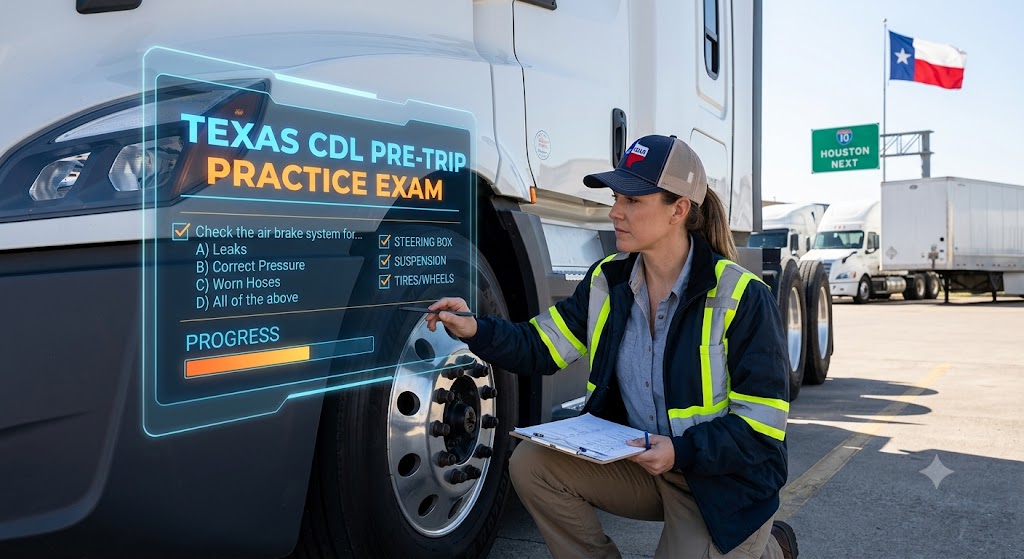
Additional Information
What the Course Entails and Exam Details
The practice test, and the actual Pre-Trip Inspection course it simulates, is built around a systematic, logical examination of all safety-critical components of a commercial motor vehicle (CMV). The core content covers every major system, including: detailed external and internal checks, engine compartment inspection (checking fluid levels, belts, hoses, and steering systems), the entire cabin area (verifying gauges, emergency equipment, and control operation), and exhaustive assessments of lighting, tires, wheels, brakes, and suspension on all sides of the vehicle. For Class A applicants, specific components like the tractor-trailer connection, including the fifth wheel and air lines, are also emphasized. The practice exam measures your ability to correctly identify each component, state its function, and verbally communicate its condition (such as "secure", "not leaking", "not damaged", or "properly mounted") according to rigorous Texas DPS standards.
What to Expect in the Final Exam
It is important to understand that the Pre-Trip Inspection component is not a multiple-choice written test; rather, it is a practical, in-person skills demonstration conducted by an authorized DPS examiner or third-party tester. Candidates will approach a specific commercial vehicle and be required to perform a step-by-step inspection, verbally explaining each check as they progress. The exam does not have a set number of points that translates to a passing score; instead, the applicant must successfully demonstrate proficiency in inspecting a predefined set of key safety items and correctly articulate their condition. Failure to identify a critical safety component or improper procedural execution can result in an automatic failure of this section. While there is typically no rigid time limit, the applicant is expected to complete the thorough inspection in a reasonable timeframe, following the standard sequence.
How to Study and Exam Centers
Effective study strategies involve a combination of rote memorization of the inspection sequence and frequent, hands-on physical practice on the exact type of vehicle you intend to drive commercially. Applicants must study the detailed inspection points provided in the official Texas Commercial Motor Vehicle Drivers Handbook. Practical repetition is paramount: practice inspecting a vehicle numerous times, forcing yourself to verbally describe every component and check until the entire process is muscle memory. Creating flashcards for key terms and using mobile apps that walk through the inspection points can reinforce learning. Simulating the exam experience with a knowledgeable partner or instructor who can provide critical feedback is highly recommended. The actual CDL skills tests, including the mandatory Pre-Trip Inspection, must be taken at a designated Texas DPS Driver License Division (DLD) office or an authorized third-party testing facility. Candidates are required to schedule an appointment online using the Texas DPS CDL Appointment System and are encouraged to book their slot well in advance.
Job Opportunities from the Course
Successfully mastering the Pre-Trip Inspection and obtaining your Texas CDL opens the door to a wide range of career opportunities across multiple industries. This certification component is essential for numerous driving roles. Potential career paths and job titles include:
Class A Commercial Driver: (Includes long-haul over-the-road trucking, regional transport, and local heavy delivery.)
Class B Commercial Driver: (Operating dump trucks, concrete mixers, delivery trucks, and larger single vehicles.)
Specialized Vehicle Driver: (Charter bus drivers, school bus operators, and passenger transport.)
Route Delivery Driver: (Local pick-up and delivery services.)
Fuel and Chemical Transport Driver.
Refuse and Recycling Collection Driver.
Heavy Equipment Operator: (Transporting construction equipment.)
Fleet Supervisor or Dispatcher: (Strong knowledge of inspection protocols enhances management effectiveness.)
Frequently Asked Questions
Reviews
5.0
Based on 0 reviews
Leave a Review
No reviews yet. Be the first to review!