
Texas CDL Practice Test 2
$69.00
- Buy to unlock unlimited access to all Quiz questions.
- After purchase you can print a PDF of the whole quiz at any point. The PDF will contain the questions and the correct answers.
About this Exam
Welcome, future commercial drivers! Congratulations on taking the crucial step towards launching an exciting career on the road in Texas. The Commercial Driver's License (CDL) is your passport to operating a wide variety of commercial vehicles, opening doors to a dynamic and in-demand industry. This study guide focuses specifically on providing highly effective preparation for your upcoming challenges, including resources like the highly recommended Texas CDL Practice Test 2. Designed for individuals aspiring to obtain their Class A, B, or C CDL in Texas, this comprehensive practice resource mirrors the official Texas written exam format, focusing on key knowledge areas and safety regulations. We understand that preparing for state exams can be daunting, but with the right resources and strategies, you can approach the testing center with confidence and readiness. Think of Texas CDL Practice Test 2 as a vital component of your educational journey, reinforcing your understanding and identifying areas that need further study. It’s an essential tool for all applicants, whether you're looking for an entry-level position or seeking to upgrade your existing license.
Ready to test your knowledge?
Buy Now to Access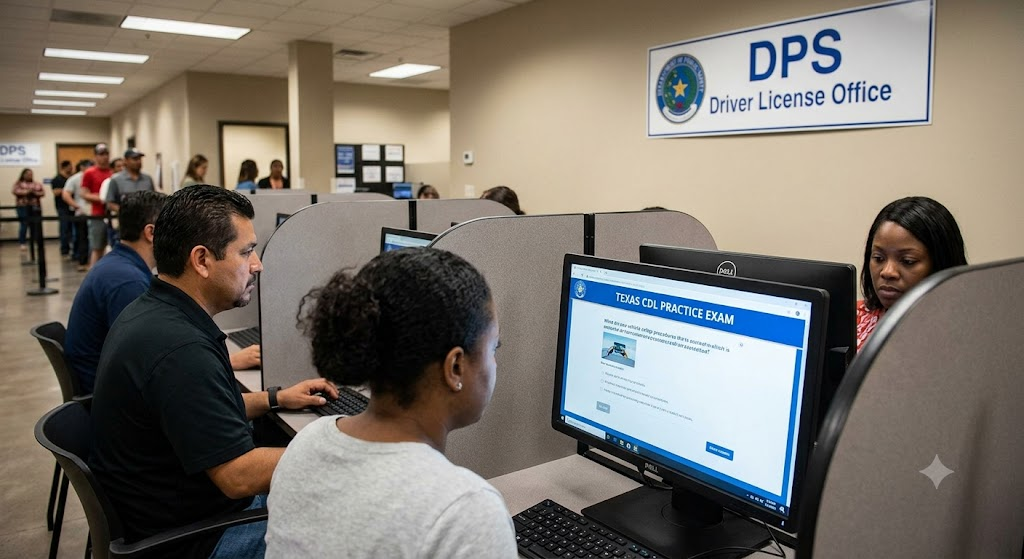
Additional Information
What the Course Entails and Exam Details
Preparing for a Texas CDL involves mastering a comprehensive curriculum detailed in the official Texas CDL Handbook, which serves as your primary learning resource. The knowledge you'll build spans various domains crucial for safe commercial vehicle operation. While the actual Texas Department of Public Safety (DPS) written exam covers a wide array of topics, Texas CDL Practice Test 2 typically focuses on a strategic selection of these core areas to provide focused and realistic practice. The potential domains covered across multiple practice test modules and the official state exam include:
Texas Commercial Vehicle Operation (Texas Rules): Specific Texas-specific laws, vehicle control systems, and operating procedures unique to the Lone Star State. This often acts as the first test you must pass.
General Knowledge: A broad overview covering everything from vehicle inspection procedures, basic control, and shifting gears, to cargo handling, night operating, adverse weather conditions, emergency procedures, and basic hazardous materials regulations applicable to all commercial driving roles.
Air Brakes: If you plan to operate a vehicle equipped with air brakes (which most commercial trucks and buses are), understanding system components, their functions, dual air brake systems, inspecting air brakes, and proper braking techniques under various conditions is critical.
Combination Vehicles: Required for a Class A CDL, this section covers the coupling and uncoupling procedures, characteristic handling, rollover prevention, and specific backing and turning techniques for multiple-unit vehicles.
Specific Endorsements: Depending on your career path, you may need to study and test for specialized endorsements. The knowledge base and practice resources can cover domains like:
Hazmat (Hazardous Materials): Regulations for transporting dangerous materials safely, including handling, loading, and emergency response. (Requires additional background checks and specific training).
Passenger Endorsement: For operating buses with a certain passenger capacity, covering passenger loading/unloading, emergency protocols, communication, and accessibility requirements.
Tanker Vehicles: Specific considerations for transporting liquids or gases, addressing liquid surge and vehicle handling.
Doubles/Triples: Knowledge for operating multiple trailer configurations.
School Bus: Safety procedures, student management, and special vehicle equipment for school bus drivers.
Remember, Texas CDL Practice Test 2 is just one of many practice tools available. The content within a specific practice test might vary slightly in its focus, but collectively, these resources are designed to prepare you across the key domains required for a Texas CDL. Always refer to the official Texas CDL Handbook to ensure you have comprehensive knowledge of all topics. We encourage you to use multiple practice sources to fully gauge your readiness and gain exposure to a wider variety of test questions. Your success is within reach, and this targeted practice is a significant milestone in achieving it!
What to Expect in the Final Exam
You’ve studied hard, reviewed the handbook, and consistently scored well on resources like Texas CDL Practice Test 2. Now, what happens on the day of the real, official Texas DPS written exam? Here’s a breakdown of what you can typically expect, so you can walk in with focus and confidence:
Format: The official Texas CDL written exam is computer-based and conducted on dedicated terminals at authorized Texas Department of Public Safety (DPS) driver license offices. You should anticipate a clear, user-friendly interface with questions presented sequentially.
Structure: All questions are in a multiple-choice format, designed to thoroughly evaluate your knowledge through scenarios, rule applications, and procedural understanding. You will be presented with a question and typically 3 or 4 possible answers.
Multiple Exams: Your testing journey involves several separate written exams, taken in a specific order: typically, the Texas Commercial Rules first, followed by General Knowledge, and then additional sections like Air Brakes, Combination, and any specialized endorsements you’ve applied for. Each of these sections is treated as a separate test, and you must pass all required sections to obtain your Commercial Learner’s Permit (CLP) or endorsement.
Question Counts: The number of questions varies by section. As examples, the General Knowledge section often contains 50 questions, while specific endorsements or the Texas Rules test might have fewer, ranging from 20 to 30. Your search findings indicate a required passing score is consistently 80% on each section to move forward. This means, for a 50-question test, you must answer at least 40 questions correctly.
Passing Score & Rules: The passing score for every single written test module you must take is 80%. This is a firm requirement, and the computer will typically provide your score immediately upon completion of each section. If you pass a section, that result is usually stored, allowing you to proceed to the next required module or a future testing date for other modules. If you fail a section, you will typically need to wait a specific period (like 24 hours, or potentially longer depending on attempts and local rules, but the immediate retest is standard for failed knowledge tests within limits) and pay applicable fees to retest for that specific portion. The process is fair but rigorous, emphasizing your thorough understanding of commercial driving safety and regulations.
Required Documentation & Prerequisites: Remember that you will need more than just knowledge on test day! Expect to bring all necessary identification, proof of residency, social security information, a current DOT Medical Card (confirming your health qualifications for commercial driving), and any other documentation required by the Texas DPS. Additionally, for the Hazmat endorsement, you must have already initiated a background check and completed specific required training before taking the written exam. For the actual CDL skills/practical exam (the driving portion), there will be other prerequisites such as having held a CLP for a minimum period (often 14 days). Focus now on preparing for the written exams—passing this stage is essential before you can progress to your behind-the-wheel training and practical testing.
Professional Environment: The DPS testing centers are professional environments. Arrive on time, and make sure you’ve pre-scheduled your appointment if that is the standard procedure for your chosen location, as many DPS offices now require appointments for CDL services. The staff is there to administer the official exam; adhere to all instructions and rules provided.
Approach your test date with determination, not fear. Every practice question answered and section passed is a step closer to earning your commercial license. You have the knowledge and tools; now it’s time to show the state of Texas that you are ready to operate a commercial vehicle safely and responsibly. You've got this!
How to Study and Exam Centers
Effective study and knowing how to navigate the exam process are crucial for a successful CDL journey. Here are some actionable strategies and essential information for your preparation and test day:
How to Study Effectively:
Make the Texas CDL Handbook Your Bible: This cannot be overemphasized. The official handbook, available from the Texas DPS website or local offices, is the primary source material for all exam questions. Read it thoroughly, not just once. Use a highlighter to mark key concepts, rules, and procedures. Pay close attention to sections relevant to the specific CDL class and endorsements you are pursuing (e.g., Class A applicants must study general knowledge, air brakes, and combination vehicle sections).
Leverage Multiple Practice Tests (Like Texas CDL Practice Test 2): Use reputable online practice resources and applications specifically designed for the Texas CDL written exams. Texas CDL Practice Test 2 is an excellent resource, but don't stop there. Aim for variety in question types and domains across different practice sets. These tests help you understand the question format, time constraints (even if not strictly timed, they build familiarity with pacing), identify your weak areas, and reinforce correct knowledge. Review both your correct and incorrect answers and understand the explanations provided for each question.
Create a Study Schedule and Consistency: Don’t cram at the last minute! Dedicate regular, scheduled study time each day or week. Consistency is key to retaining the vast amount of information required. Divide your study time among reading the handbook, taking practice tests, and reviewing weak spots. Set specific goals (e.g., “Master the Air Brakes section this week”).
Utilize Flashcards and Active Recall: For critical and often complex topics like air brake system components, Hazmat placarding, or combination vehicle coupling steps, create flashcards (physical or digital). Actively testing yourself using flashcards forces your brain to recall information, which strengthens memory retention more effectively than passive reading. Make a separate pile for cards you struggle with and focus extra attention on them.
Focus on Understanding, Not Just Memorization: Aim to truly understand the logic and rationale behind the regulations and safety procedures, not just memorize answers. This deeper understanding will serve you better on real-world scenarios and throughout your commercial driving career. Review tricky concepts, draw diagrams, or imagine how you would apply the rule on the road.
Practice with Time in Mind (Simulation): While not all practice tests are strictly timed, simulate test conditions occasionally. Go through a set of questions (e.g., a full 50-question General Knowledge module) without extensive breaks, aiming to build a good test-taking pace and reduce potential anxiety. Ensure you are getting at least an 80-90% score consistently on multiple practice tests before scheduling your real exam.
Form or Join a Study Group (Optional): Sometimes discussing concepts with others pursuing the same goal can clarify tricky points, offer new perspectives, and keep you motivated. However, ensure the group stays focused and provides accurate information.
Prioritize Rest and Proper Nutrition Before the Exam: The night before your real test is just as important as your final day of study. Get adequate sleep (7-8 hours) to ensure your mind is rested and focused. On exam day, eat a nutritious meal to maintain energy levels and mental alertness. Avoid last-minute, stressful cramming; trust the preparation you've put in.
Texas CDL Exam Centers & Procedures:
Written Knowledge Tests - Always at a Texas DPS Driver License Office: For the official Texas CDL written knowledge exams (not your educational practice tests!), you must visit an authorized Texas Department of Public Safety (DPS) driver license office or designated CDL knowledge testing center. These official government locations are equipped with the computer systems and proctoring necessary to administer the state exams. Do not expect to take the written portion of the state exam online or at private schools, unless explicitly stated otherwise by official DPS communications, as this is typically restricted to government facilities.
Find Your Local Office & Schedule an Appointment: Visit the official Texas Department of Public Safety website (www.dps.texas.gov) and look for the “Driver Licenses & ID Cards” or “CDL” section. There you will find tools to locate DPS offices near you that offer commercial driver license services. For the knowledge tests, many locations require you to schedule an appointment. This is becoming increasingly common to manage wait times and ensure available testing slots. Follow the online instructions carefully to select your location, date, and time for the specific written exams you plan to take. Some offices might still offer walk-in services, but it’s always best to verify or book ahead.
Required Documents & Fees: Double-check the Texas DPS website for the most current list of required documents. Generally, expect to bring:
Proof of citizenship or legal presence in the U.S.
Social Security information (card or document)
Valid identity documents
Proof of Texas residency
A current DOT Medical Certificate (ensure it is up-to-date and completed by an approved medical examiner)
Any other specifically requested forms or permits (including required ELDT documentation for practical tests, though usually not mandatory for the initial knowledge-only stage to obtain a CLP, it will be required before you can schedule your skills test).
Be prepared to pay applicable fees for the knowledge tests, license, or specific endorsement and background checks (especially for Hazmat). The website should list the current fee structure. Some applicants might find that the initial rules test can be done for a minimal fee, with subsequent written tests included in a larger package, but confirm all costs upfront.
Be Prepared for retakes: You can typically re-test if you fail a knowledge test, but there may be wait periods and fees associated with each attempt. The goal is careful preparation and aiming for success the first time, or after structured restudy for subsequent attempts.
Important: CDL Skills/Driving Test & School Options: Keep in mind that the process involves a written test phase followed by a practical skills test phase (behind-the-wheel). While your educational practice resources, and potentially some aspects of the required Entry-Level Driver Training (ELDT) theory, might be offered online or through private institutions/schools, the core official written knowledge tests to obtain your CLP are administered by the state at DPS offices. Once you have your permit and have completed any required ELDT practical training, you will need to schedule a CDL skills test appointment at a DPS office that offers commercial driving exams or through an authorized third-party skills tester (typically certain large employers or authorized schools). The DPS website will have specific information on locations for skills testing. You can choose to complete your required ELDT training and practical preparation through reputable commercial driving schools or programs, which are highly recommended for comprehensive practical training and are necessary as of 2022. These institutions provide structured learning and hands-on experience, often including access to the proper class of commercial vehicle for your skills test. Choose an authorized and respected program to ensure high-quality training that meets all state and federal standards.
Approach the entire process professionally. Be well-prepared, arrive on time with all required documents, and trust in the knowledge and skills you’ve developed through dedicated study and effective practice tools. Texas is waiting for you to hit the road!
Job Opportunities from the Course
A Commercial Driver's License (CDL) opens the door to a wide and exciting variety of career paths within the essential transportation industry, particularly in a large state like Texas with extensive road networks and diverse economic sectors. Earning your CDL, supported by comprehensive preparation including tools like Texas CDL Practice Test 2, equips you for numerous roles and allows you to specialize through endorsements. Here’s a list of potential job opportunities and career paths this certification unlocks:
Generic CDL Roles (Varying by Class):
Long-Haul Truck Driver (CDL-A): This classic role involves driving large articulated trucks (Class A combinations) across state lines and often across the country. Drivers transport vast amounts of cargo, experiencing freedom on the open road and potential high earnings. (Typically requires CDL-A and general knowledge).
Regional or Local Delivery Driver (CDL-A/B): Operating within specific geographic regions or localized areas, delivering goods for retail, industrial, food service, and other businesses. These roles often offer more regular schedules and more time at home compared to long-haul driving. Specifics depend on the vehicle type (Class A combination or Class B straight truck).
Construction Truck Driver (CDL-A/B): Driving large vehicles within construction sites or to and from sites, transporting materials like sand, gravel, heavy equipment, and more. Opportunities include operating dump trucks, mixer trucks, and flatbeds.
Local Distribution Driver (CDL-B): Focusing on delivery within a city or metropolitan area, typically driving straight trucks (Class B) to deliver goods to local businesses and consumers. Examples include beverage distribution, furniture delivery, and local food distribution.
Specialized Hauler: Depending on vehicle type and equipment, drivers might specialize in areas like:
Flatbed Hauling: Transporting cargo on open flatbed trailers, often bulky or irregularly shaped items.
Refrigerated (Reefer) Driving: Operating temperature-controlled trailers for transporting perishable goods.
Car Hauling: Driving specialized tractor-trailers to transport vehicles (often Class A).
Shuttle or Yard Driver: Working in terminals or manufacturing facilities, driving trucks or shuttle vehicles within a designated yard to move trailers and facilitate logistics. (Typically lower classes or special permits).
Endorsement-Specific Opportunities (Building on Core CDL):
Hazardous Materials (Hazmat) Driver (Requires CDL & Hazmat Endorsement, additional background check): Transporting materials classified as hazardous. These positions require specific safety procedures, careful handling, and a high degree of training and responsibility, often resulting in higher pay and benefits. (Applicable to both Class A and B vehicles).
Passenger Endorsement Roles (Requires CDL-B/C & Passenger Endorsement):
Charter Bus Driver: Driving motorcoaches for organized trips, tours, and special events.
Transit Bus Driver: Operating buses for municipal transit authorities, following fixed routes.
Shuttle Driver (Airport, Hotel, Event, Campus): Driving passenger shuttles between specific locations. (Depending on vehicle size, might require a lower class CDL/endorsement or simply a passenger endorsement on a standard license for smaller vehicles).
School Bus Driver (Requires CDL-B/C & School Bus and Passenger Endorsements): Operating school buses to transport students safely to and from school, educational activities, and events. These roles require patient interaction with children and a high commitment to student safety. (Often part-time or with specific benefits/schedule).
Tanker Vehicle Driver (Requires CDL & Tanker Endorsement): Transporting liquids or gases in bulk tankers. This requires knowledge of liquid surge and specialized vehicle handling techniques. (Applicable to both Class A and B vehicles).
Doubles/Triples Driver (Requires CDL-A & Doubles/Triples Endorsement): Operating multiple trailer configurations, requiring exceptional control and experience with complex combination vehicles. (Limited to Class A licenses).
Industry sectors employing CDL Holders in Texas (and beyond):
Transportation & Logistics Companies (Long-haul, regional, local)
Construction Firms
Delivery Services & Distribution Centers
Energy and Natural Resource Companies (Transportation of fuel, equipment, materials - potentially requiring endorsements like Hazmat and Tanker)
Manufacturing and Agricultural Industries (Moving products and materials)
Municipal and Public Transportation Authorities
School Districts and Private Transportation Providers (Charter bus, school bus, shuttle)
Retailers & Food Service Companies (For their own fleet operations)
Whether you’re drawn to the endless horizons of long-haul trucking, the service-oriented role of a bus driver, the specialized challenges of Hazmat transport, or the dynamic environment of construction driving, your Texas CDL is the vital credential that can launch you on a rewarding and secure career path. Continuous learning, safe driving practices, and experience will further increase your opportunities and earning potential within this essential industry. Focus on passing your exams with resources like Texas CDL Practice Test 2—your journey is just beginning, and the road ahead is full of potential!
Remember to use professional language and check your work carefully for errors. The best of luck on your commercial driving journey!
Frequently Asked Questions
Reviews
5.0
Based on 0 reviews
Leave a Review
No reviews yet. Be the first to review!