
Texas CDL Practice Test
$69.00
- Buy to unlock unlimited access to all Quiz questions.
- After purchase you can print a PDF of the whole quiz at any point. The PDF will contain the questions and the correct answers.
About this Exam
The Texas CDL (Commercial Driver's License) exam is the rigorous, mandatory assessment for individuals seeking to operate large, heavy, or placarded hazardous material vehicles within the state. This certification is crucial for ensuring public safety on Texas highways. The program is designed for aspiring professional drivers, including those moving into freight transportation, passenger transport, or specialized utility roles. Obtaining this license validates a driver's knowledge of federal and state regulations, vehicle safety systems, and the advanced skills required to manipulate commercial vehicles responsibly.
Ready to test your knowledge?
Buy Now to Access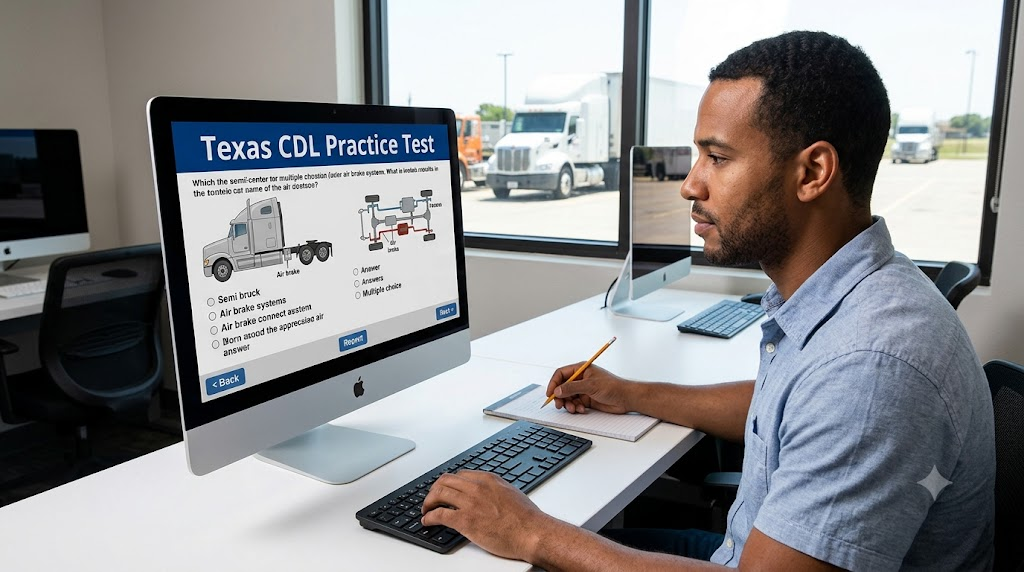
Additional Information
What the Course Entails and Exam Details
To secure a Texas CDL, applicants must master a broad syllabus focused on safe commercial operation. The journey generally begins with obtaining a Commercial Learner’s Permit (CLP), which requires passing written knowledge tests. The final licensure process entails a detailed skills test.
The comprehensive curriculum covers critical topics, including:
Comprehensive Commercial Vehicle Safety Inspection (Pre-Trip)
Basic Vehicle Control Skills (Alley Docking, Parallel Parking, Straight-Line Backing)
Safe Driving Procedures for various road environments
Air Brakes Systems operations and limitations (if applicable)
Combination Vehicle dynamics (for Class A licenses)
Transporting Passengers safely (for Passenger endorsement)
Hazardous Materials regulations and handling (for HazMat endorsement)
Tanker Vehicle operations
School Bus specific safety protocols
What to Expect in the Final Exam
The final Texas CDL examination consists of two primary, distinct components.
First, applicants must pass a series of written knowledge tests. These are administered via computer and feature multiple-choice questions derived directly from the Texas Commercial Motor Vehicle Drivers Handbook. The number of questions depends on the class of license and endorsements sought, but the core 'General Knowledge' test typically involves 50 questions. A passing score of 80% is required for each written segment.
Second, upon successful completion of the knowledge tests and holding a CLP for at least 14 days, applicants must schedule the comprehensive Skills Test. This practical exam is conducted by a certified examiner and includes:
The Vehicle Inspection Test: Demonstrating an ability to identify and inspect critical safety components.
Basic Control Skills Test: Executing mandatory backing maneuvers in a controlled environment.
The Road Test: Driving in real-world traffic scenarios, navigating turns, intersections, and changes in speed safely.
All components must be passed to be issued a Commercial Driver's License.
How to Study and Exam Centers
Preparation is paramount for the Texas CDL exam. A primary resource is the official Texas Commercial Motor Vehicle Drivers Handbook, available online via the Texas Department of Public Safety (DPS) website and at local driver license offices. Applicants are strongly advised to read this manual multiple times, as the written tests draw directly from its content.
Taking multiple CDL practice tests is a highly effective study strategy. These simulated exams help familiarize applicants with the phrasing of questions and identify knowledge gaps in critical areas like air brakes or combination vehicle regulations.
The written knowledge tests are administered at dedicated Texas DPS Driver License Offices throughout the state. Walk-ins may be accepted, but appointments are highly recommended to reduce wait times.
The required Skills Test must be scheduled in advance and is conducted at specific DPS-authorized testing locations. These locations have the necessary range space for the basic control skills component and established routes for the road test. Many applicants choose to complete their practical training and skills examination through accredited commercial driving schools, which often facilitate the testing process using their vehicles.
Job Opportunities from the Course
Earning a Texas CDL opens the door to a robust and diverse array of career paths within the essential transportation and logistics industry. Demand remains high for qualified commercial drivers.
Possible job opportunities include:
Long-Haul Truck Driver (Over-the-Road)
Regional/Local Delivery Driver
Owner-Operator Truck Driver
Bus Driver (City Transit, Charter, or School Bus)
Hazardous Materials (HazMat) Transport Specialist
Heavy Equipment Transporter
Fuel Tanker Driver
Concrete Mixer Driver
Specialized Utility Vehicle Operator
Frequently Asked Questions
Reviews
5.0
Based on 0 reviews
Leave a Review
No reviews yet. Be the first to review!