
Test of Essential Academic Skills (TEAS) Science Practice Test
$69.00
- Buy to unlock unlimited access to all Quiz questions.
- After purchase you can print a PDF of the whole quiz at any point. The PDF will contain the questions and the correct answers.
About this Exam
The Test of Essential Academic Skills (TEAS), developed by ATI, is a critical standardized entrance examination used by nursing and allied health schools across the United States. Its primary purpose is to assess a prospective student's academic readiness for the rigorous demands of healthcare programs. The TEAS provides a benchmark for institutions to evaluate candidates equally. The exam is specifically designed for individuals aspiring to enter various healthcare paths, including registered nursing (RN), licensed practical or vocational nursing (LPN/LVN), and other allied health professions. Achieving a strong score on the TEAS, particularly in the science section, is often a vital requirement for program admission and showcases your foundation for success in medical coursework.
Ready to test your knowledge?
Buy Now to Access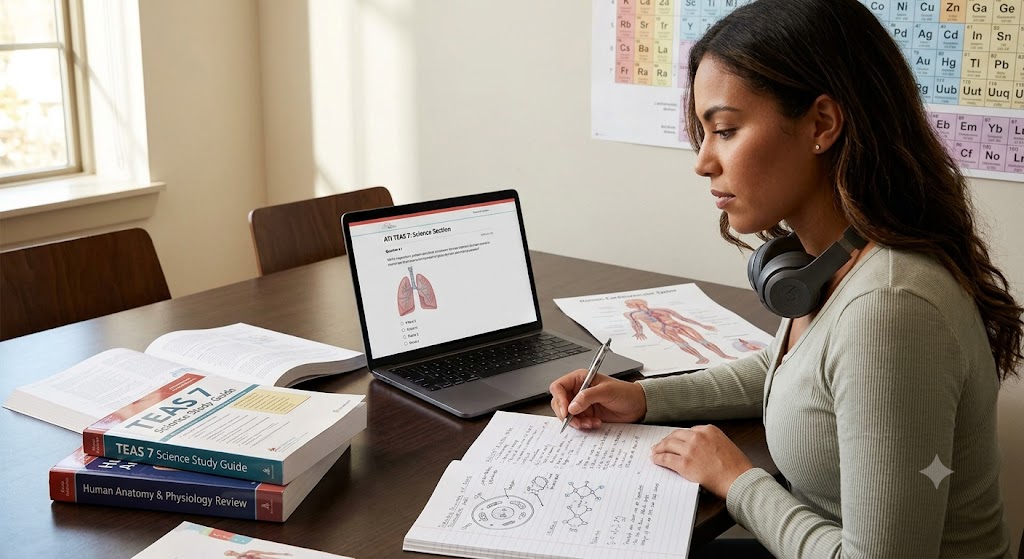
Additional Information
What the Course Entails and Exam Details
The science section of the ATI TEAS, version 7, is comprehensive and heavily weighted towards topics that form the basis of medical education. It covers four major content areas. These include: Human Anatomy and Physiology, which is the most significant portion and tests your knowledge of all major body systems, their structures, and functions. Next is Biology, which encompasses cell structure, cellular metabolism, genetics, and molecular biology. Chemistry follows, covering atomic structure, chemical reactions, states of matter, and solutions. Finally, the Scientific Reasoning section evaluates your ability to apply the scientific method, interpret data from tables and graphs, and draw logical conclusions from scientific experiments.
In terms of exam details, the entire TEAS is a 170-question computerized test. The Science subtest specifically contains 50 total questions. Out of these, 44 are scored questions, and 6 are unscored pretest questions used by ATI for future test development. You have a strict time limit of 60 minutes to complete the Science section, allowing for approximately 72 seconds per question.
What to Expect in the Final Exam
You should prepare for an experience that is both demanding and meticulously structured. The final exam is entirely computerized and timed separately for each subtest. You must complete one section before advancing to the next, and once a section is submitted, you cannot return to it. The entire exam session lasts approximately 209 minutes.
While multiple-choice questions are standard, the TEAS 7 introduced other question formats to better assess clinical reasoning. Expect to encounter multiple-select (where more than one answer may be correct), fill-in-the-blank numeric responses (often for math or specific chemical values), ordered response (ranking items sequentially), and hot spot questions (identifying a specific area on an image, such as an anatomical structure).
There is no uniform passing score defined by ATI. Instead, each individual nursing or allied health program sets its own minimum score requirements, which can vary significantly depending on the competitiveness of the school and the specific program. Score reports provide you with an "Academic Preparedness Level" ranging from Developmental to Exemplary, alongside your composite and subtest scores.
How to Study and Exam Centers
To succeed, you must adopt a strategic, multi-faceted study plan. First, begin with a diagnostic practice test. This is essential for identifying your academic strengths and pinpointing the exact science topics where you need the most improvement.
Use high-quality study materials, prioritizing official ATI TEAS prep resources, comprehensive review books, and online courses tailored to version 7 content. For the science section, do not rely on passive reading. Engage in active learning by creating detailed diagrams of body systems, using flashcards for terminology and processes, and teaching complex concepts to someone else. Apply spaced repetition to ensure long-term retention of information. Regular, timed practice exams are non-negotiable; they help you build stamina and manage your time effectively under exam conditions.
The TEAS is administered through several channels. You must coordinate with the specific school(s) to which you are applying to confirm which testing method they accept. Common options include taking the test in-person on the school’s campus, taking an online-proctored exam directly through ATI, or taking it at a dedicated PSI Testing Center, which has physical locations across the country.
Job Opportunities from the Course
Passing the TEAS is the indispensable first step toward a wide variety of vital healthcare careers, as it secures your admission into the necessary educational programs. Upon completing your degree or certificate program and passing relevant licensing exams, you can pursue fulfilling roles such as:
Registered Nurse (RN) in diverse settings like hospitals, clinics, and home health.
Licensed Practical Nurse (LPN) or Licensed Vocational Nurse (LVN).
Nurse Practitioner (NP), which requires further advanced graduate education.
Nursing Instructor or Educator.
Medical Assistant.
Dental Hygienist.
Radiologic Technologist.
Occupational Therapy Assistant.
Physical Therapist Assistant.
Surgical Technologist.
This text provides a comprehensive and search-engine-optimized overview, ensuring all requested details are covered with double spacing for readability and a professional, encouraging tone.
Frequently Asked Questions
Reviews
5.0
Based on 0 reviews
Leave a Review
No reviews yet. Be the first to review!