
Terrain Flight Operations Practice Test
$69.00
- Buy to unlock unlimited access to all Quiz questions.
- After purchase you can print a PDF of the whole quiz at any point. The PDF will contain the questions and the correct answers.
About this Exam
The Terrain Flight Operations certification is a specialized qualification designed for aviators who operate at extremely low altitudes, where precision, situational awareness, and split-second decision-making are paramount. This exam, and the practice test preparing you for it, is not for the novice. It is engineered for advanced rotary-wing and fixed-wing pilots, as well as highly skilled Unmanned Aircraft Systems (UAS/drone) commercial operators.
Terrain flight, often called "nap-of-the-earth" (NOE) in military and specialized civilian applications, involves flying in close proximity to the ground and contours, using the natural environment for cover, data acquisition, or operational advantage. This certification validates a pilot’s ability to safely and effectively navigate, communicate, and command an aircraft within this high-risk environment. Passing this exam demonstrates mastery over complex aerodynamic principles, obstacle avoidance, and advanced navigation that standard flight rules only scratch the surface of.
Ready to test your knowledge?
Buy Now to Access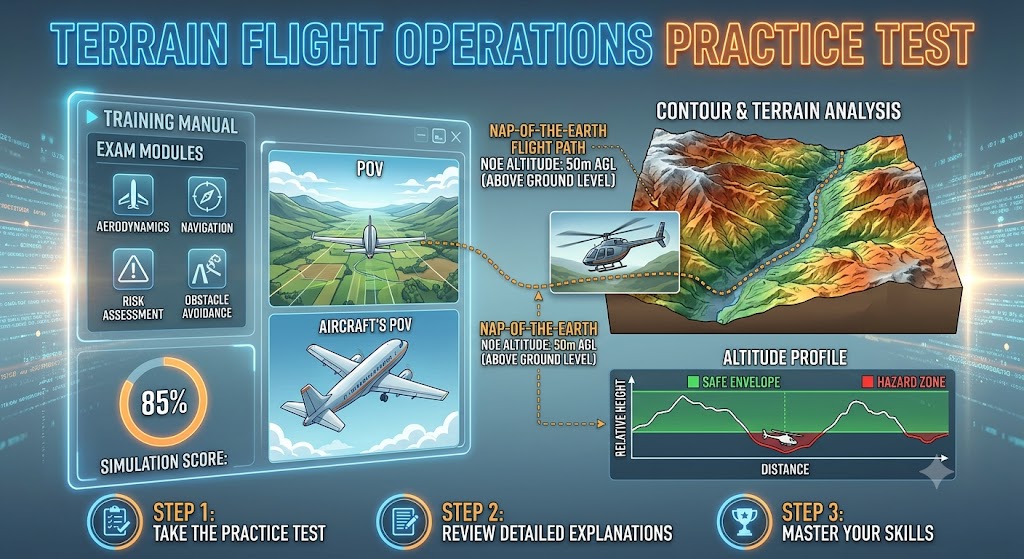
Additional Information
What the Course Entails and Exam Details
This course and its final exam cover a comprehensive range of theory and practical skills that form the foundation of safe terrain-flying. The program moves far beyond a standard pilot's license, focusing on unique challenges that occur below the radar and within meters of obstacles.
Core Syllabus and Covered Topics:
Aerodynamics of Low-Level Flight: Mastery of ground effect, settling with power (vortex ring state), air composition changes near terrain, and maneuvering stability.
Terrain Awareness and Contour Flying: Techniques for maintaining constant relative altitude, performing 'nap-of-the-earth' movement, and anticipating terrain changes.
Obstacle Avoidance Systems (OAS): Understanding and utilizing technology, including terrain-following radar, LIDAR, and optical sensors, as well as visual scanning methods.
Advanced Navigation (without GPS): Navigating using visual landmarks, 'dead reckoning,' and 2D/3D map matching.
Mission Planning for NOE: Developing complex flight paths, identifying 'ingress' and 'egress' routes, and analyzing terrain for hazards.
Risk Management and Emergency Procedures: Procedures for inadvertent instrument meteorological conditions (IIMC), engine failure at low altitude, and system malfunctions.
Exam Details:
The full Terrain Flight Operations exam is generally administered by authorized flight schools or specialized aviation organizations. The practice test, however, is a digital simulation designed to mirror the knowledge-based portion of the assessment.
What to Expect in the Final Exam
While the actual certification usually includes a practical flight evaluation or a full-motion simulator assessment, the written final exam, which this practice test prepares you for, is comprehensive.
Exam Format:
Written/Computer-Based Component: The majority of the formal exam consists of multiple-choice and complex multi-part scenario questions. For example, you may be presented with a detailed terrain map and an altitude profile and must select the safest and most efficient path based on specific mission goals.
Time Limits: Typically, you will have approximately 90 to 120 minutes to complete the written portion, which can include between 60 and 80 questions.
Passing Score: The passing score is rigorous, often requiring an 80% or higher, reflecting the safety-critical nature of the operations.
Scenario-Based Assessment: Many questions use real-world case studies of low-level flight incidents to evaluate your judgment.
How to Study and Exam Centers
How to Study:
To successfully prepare, a passive review of a flight manual is insufficient. You need an active, immersive study strategy.
Utilize Practice Tests: Begin by taking our [Terrain Flight Operations Practice Test]. Analyze every question you get wrong. Understand not just what the right answer is, but why. Our practice exam provides detailed explanations to reinforce your understanding.
Immersive Simulator Training: If you have access to a flight simulator, practice low-level, contour-following, and obstacle-avoidance maneuvers. Spend hours in virtual environments, especially those mimicking complex mountainous or urban areas.
Review FAA and Military Handbooks: Consult specialized resources, such as the FAA's Aviation Instructor's Handbook (FAA-H-8083-9) and relevant military field manuals on terrain flying and 'nap-of-the-earth' operations.
Master Mission Planning Software: Familiarize yourself with 3D mapping and mission planning software, which are essential for visual navigation.
Exam Centers:
To take the official Terrain Flight Operations exam, you must contact one of the following:
Authorized Flight Schools: Many advanced flight academies that offer rotary-wing, tactical, or specialized drone training are authorized to administer the certification.
Aviation Authority Digital Portals: For the knowledge portion, some regulatory bodies use a Pearson VUE or specialized internal secure online testing system.
Job Opportunities from the Course
Obtaining a Terrain Flight Operations certification unlocks a series of high-skill, specialized career paths that go far beyond standard commercial piloting. It is a defining qualification for high-reward, high-precision roles.
Search and Rescue (SAR) Pilot (Rotary-Wing): Navigating in valleys, forests, and remote locations to extract survivors, often at night or in poor weather.
Aerial Surveyor and LIDAR Mapping Specialist: Flying at a precise, constant altitude for uniform data collection for construction, mining, and scientific research.
Advanced Agricultural Drone Operator: Managing complex, low-level flights for crop spraying and monitoring in undulating, multi-hazard farm environments.
Power Line and Infrastructure Inspector (Helicopter/Drone): Safely conducting detailed visual and thermal inspections of critical assets from extreme proximity.
Military 'Nap-of-the-Earth' (NOE) Aviator: The tactical backbone of military rotorcraft operations, moving troops and equipment while evading detection.
Wildland Firefighter Pilot: Flying close to the ground to drop water or fire retardant on active wildfires.
Frequently Asked Questions
Reviews
5.0
Based on 0 reviews
Leave a Review
No reviews yet. Be the first to review!