
Teradata Associate Practice Exam
$69.00
- Buy to unlock unlimited access to all Quiz questions.
- After purchase you can print a PDF of the whole quiz at any point. The PDF will contain the questions and the correct answers.
About this Exam
The Teradata Associate certification is the ideal entry point for anyone wishing to establish a foundational understanding of Teradata's core technology and concepts.
This credential validates your grasp of the essential elements of data warehousing, fundamental SQL for Teradata, and basic system architecture. It is designed for students, recent graduates, and IT professionals who are new to Teradata and want to build a rewarding career in the burgeoning field of data management and analytics.
Achieving this certification demonstrates your dedication to mastering the basics, making you a strong candidate for entry-level roles and a variety of specialized career paths in the dynamic world of big data.
Ready to test your knowledge?
Buy Now to Access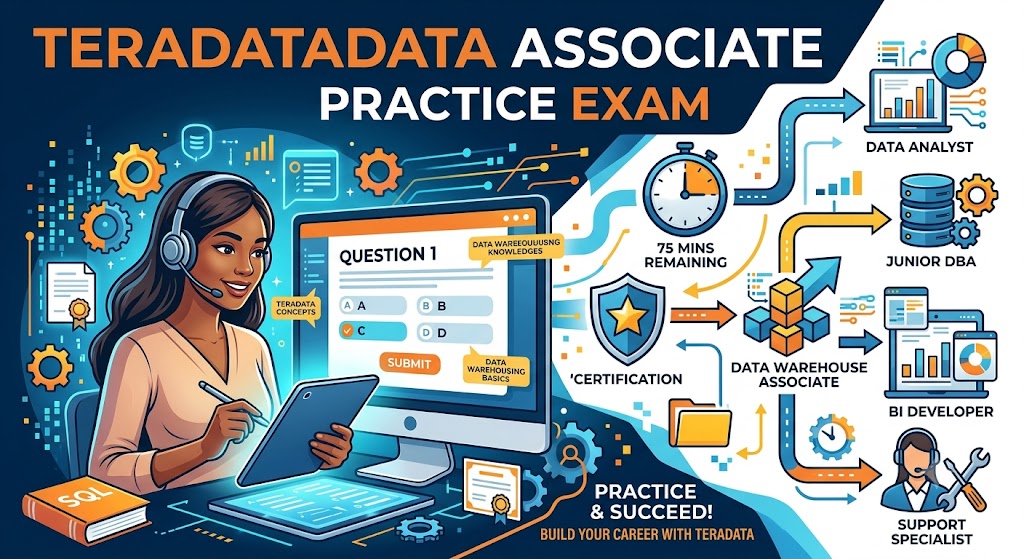
Additional Information
What the Course Entails and Exam Details
This associated course and the exam itself cover a broad but foundational range of topics essential for navigating the Teradata ecosystem.
Students will delve into key Teradata architectural principles, including the powerful parallelism that defines the platform, and gain insights into critical components like Access Module Processors (AMPs) and Parsing Engines (PEs).
The curriculum explores essential database concepts, the structure of Teradata tables, standard Teradata tools and utilities for data loading, extraction, and management. Basic SQL operations, including common join types and fundamental query syntax tailored for Teradata, are a significant component.
Crucially, the syllabus ensures a solid base in data warehousing concepts, preparing individuals for further, more specialized Teradata certifications and real-world projects.
What to Expect in the Final Exam
The Teradata Associate final exam usually follows a Multiple-Choice Question (MCQ) format.
Candidates should prepare to answer a specific number of questions – often around 60 to 70 questions – within a specified time limit, typically in the region of 75 to 90 minutes. While exact numbers and the current passing score can vary and are subject to update by Teradata, a score around 60-70% is generally required to pass.
The exam is typically proctored to maintain academic integrity, either in person at an authorized center or in a secure online environment. Practice exams are an exceptional tool to help you get comfortable with this format, the breadth of topics, and time management.
How to Study and Exam Centers
Preparation for the Teradata Associate exam should be comprehensive and combine theoretical learning with practical application.
Engaging in recognized training courses, either self-paced or instructor-led, is highly beneficial. Thorough study should involve reviewing official Teradata documentation, recommended textbooks, and authorized study guides to build a deep conceptual understanding.
Consistent practice with high-quality sample questions and full-length practice exams is absolutely critical. This helps reinforce knowledge, identify weak areas, and build confidence under timed conditions.
Teradata partner exams are commonly administered through reputable testing providers like Pearson VUE, which offers a global network of secure, proctored in-person testing centers. Many partners also offer secure, online proctored exam options, allowing candidates to take the test from their homes or offices, provided their technology and environment meet the strict security requirements. Registration must be completed through the official Teradata Certification website or the testing partner’s portal.
Job Opportunities from the Course
Achieving the Teradata Associate certification is a significant milestone that unlocks various career paths in the high-demand world of data and analytics. By validating your understanding of Teradata's fundamental principles, you become a competitive candidate for many exciting entry-level and foundational roles.
Job opportunities and common job titles for certified individuals include: Data Analyst Junior Database Administrator (DBA) Data Warehouse Associate Business Intelligence (BI) Developer (entry-level) Teradata Support Specialist System Administrator (with a focus on data systems) Database Support Analyst Data Engineer (entry-level)
Frequently Asked Questions
Reviews
5.0
Based on 0 reviews
Leave a Review
No reviews yet. Be the first to review!