
TEPC 5800: EC-12 Practice Test
$69.00
- Buy to unlock unlimited access to all Quiz questions.
- After purchase you can print a PDF of the whole quiz at any point. The PDF will contain the questions and the correct answers.
About this Exam
The TEPC 5800: EC-12 Practice Test is an essential preparation tool for aspiring educators seeking to launch their careers in the diverse and critical field of Early Childhood through 12th Grade education.
This practice material is specifically designed to simulate the final challenges of state-recognized educator certification exams. It allows candidates to assess their proficiency in core pedagogical principles, human development, instructional design, classroom management, and professional responsibilities—the precise knowledge and skills required to become a certified teacher for grades EC-12.
Whether you are a university student nearing graduation, a dedicated professional making a career change, or an individual striving to attain state-specific teaching credentials, this comprehensive practice test provides invaluable practice and realistic insights into the actual certification environment. Using the TEPC 5800 EC-12 Practice Exam helps bridge the gap between academic theory and practical application, empowering you to approach your official exam with confidence and mastery.
Ready to test your knowledge?
Buy Now to Access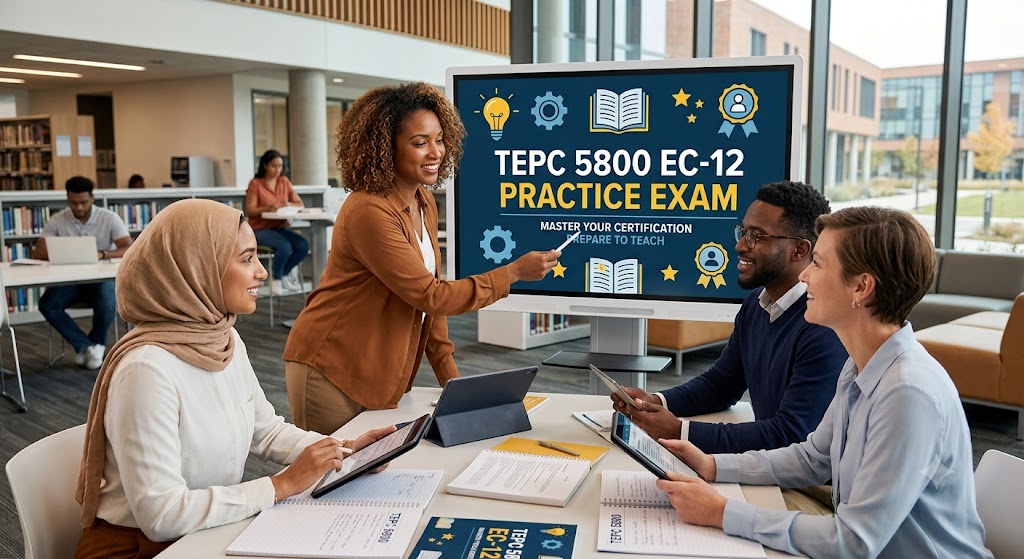
Additional Information
What the Course Entails and Exam Details
The course of study covered by this practice material, mirroring the content of comprehensive EC-12 educator certification exams, delves deeply into several vital domains. Students will master a wide range of theoretical frameworks and practical skills necessary for successful teaching across all grade levels, from early childhood to the conclusion of high school.
The core topics and skills include:
Human Development (EC-12): Understanding cognitive, physical, socioemotional, and moral development across distinct age groups.
Diverse Learner Needs: Strategies for addressing the needs of English Language Learners (ELLs), students with special needs (including IEPs and 504 plans), and gifted and talented students, fostering an inclusive classroom climate.
Instructional Design and Delivery: Planning coherent instruction, setting clear learning goals, implementing effective teaching strategies, and using educational technology to engage students in various learning contexts.
Classroom Environment: Techniques for creating safe, productive, and organized learning spaces, promoting positive student interactions, and managing behavior.
Assessment of Learning: Designing and implementing various types of assessments, analyzing data to inform instruction, and providing constructive feedback.
Professional Roles and Responsibilities: Understanding the legal and ethical requirements of educators, collaborating with families, engaging with the educational community, and committing to continuous professional growth.
The official, full certification exam (which often takes the form of a detailed pedagogy test like the TExES PPR EC-12, for example, but details vary by region) is a extensive computer-administered test (CAT) designed to thoroughly measure essential pedagogy knowledge and skills, typically across multiple domains or competencies. This practice exam is explicitly aligned to prepare candidates for the specific structures and content areas they will encounter in such standardized final tests.
What to Expect in the Final Exam
While exact details depend on the specific state certification program, the final certification exam that the TEPC 5800 practice material is modeled after typically presents a rigorous and structured testing experience. Candidates can generally expect:
Format: A significant portion (often 100 or more) of carefully designed selected-response (multiple-choice) questions that cover all defined domains of knowledge.
Time Limit: A comprehensive testing window, frequently spanning close to five hours (e.g., 4 hours and 45 minutes of actual testing time) as part of a longer appointment. Candidates must manage their time effectively to address all questions within the allotted period.
Passing Score Requirements: Scores are typically scaled. To pass, candidates are often required to achieve a specific scaled score (e.g., at least 240, though minimum requirements can vary and are determined by the state's educator certification board). Your raw score (number of correct answers) is converted based on the specific exam's difficulty.
Examination Rules: Standardized testing environments include a dynamic system. Candidates must check in with proper identification, agree to non-disclosure agreements (NDAs), follow all proctor instructions, and can only take breaks that will not pause the main exam timer. These tests are strictly timed and administered to ensure fairness and integrity.
The TEPC 5800: EC-12 Practice Test is engineered to familiarize you with these specific question types and to help build the stamina required for a lengthy and comprehensive real-world exam.
How to Study and Exam Centers
How to Study
A successful study strategy involves a multi-faceted approach, integrating practice with deep content review:
Step 1: Diagnostic Attempt: Begin your journey by taking the TEPC 5800 EC-12 Practice Test in a simulated test environment to identify your current knowledge level and areas for improvement.
Step 2: Analysis and Review: Carefully analyze your performance. Use the provided detailed feedback on both correct and incorrect answers to understand the pedagogical reasoning.
Step 3: Targeted Study: Focus your subsequent study sessions on specific domains and competencies where you are weaker. Utilize state study guides, textbooks on educational psychology, pedagogy, special education, instructional design, and course notes. Create flashcards for key terms and concepts.
Step 4: Continuous Practice: Take the practice test multiple times. Retake it to measure your progress and build confidence and speed.
Step 5: Collaborative Learning: Form study groups to discuss and internalize complex concepts and practice pedagogical decision-making.
Exam Centers
Your official certification exam is taken at officially authorized testing centers. To register:
Registration Portal: You must register for your real exam through the dedicated online portal of your state's educator certification program (for example, the Texas Nesinc portal for TExES exams, or a Pearson VUE portal for other certifications).
Scheduling: Upon registration, you can choose a convenient testing date and time and select an approved physical testing location. These centers are located in various regions, including professional testing centers (like Pearson VUE centers), and often at specific universities or authorized educational institutions.
Important Check: Always verify the specific state requirements and authorized providers. Registration, scheduling, and official test locations can differ significantly depending on the particular teaching certification program you are enrolling in.
Job Opportunities from the Course
Passing your real EC-12 educator certification exam unlocks a diverse and meaningful array of career opportunities across the educational spectrum, enabling you to make a profound impact on the lives of students in grades EC-12. Specific potential roles include:
Certified Elementary School Teacher (Grades K-5/6)
Certified Middle School Teacher (Grades 4-8) in your chosen subject area(s)
Certified High School Teacher (Grades 7-12) in specialized subjects (e.g., Mathematics, Science, English, Social Studies, Art, Music)
Special Education Teacher (often requiring supplementary certification)
Bilingual/ESL (English as a Second Language) Educator (often requiring supplementary certification)
Career and Technical Education (CTE) Instructor (depending on field and specific requirements)
Physical Education Teacher (EC-12)
Health Teacher (EC-12)
Instructional Specialist or Coordinator (with additional experience and/or higher degrees)
School Counselor (typically requires extensive post-graduate studies and experience)
School Administrator (Principal, Assistant Principal – requires separate certification and experience)
Your successfully attained educator certificate is a crucial credential for gaining employment in both public and private schools, non-profit educational organizations, and other learning environments that require state-recognized teaching qualifications for grades Early Childhood through 12.
Frequently Asked Questions
Reviews
5.0
Based on 0 reviews
Leave a Review
No reviews yet. Be the first to review!