
Tennessee Professional Counseling Jurisprudence Practice Exam
$69.00
- Buy to unlock unlimited access to all Quiz questions.
- After purchase you can print a PDF of the whole quiz at any point. The PDF will contain the questions and the correct answers.
About this Exam
Welcome to your essential resource for the Tennessee Professional Counseling Jurisprudence Practice Exam. This is a crucial step in the journey of aspiring counselors in the Volunteer State. This specific jurisprudence exam is designed for individuals seeking licensure as a Licensed Professional Counselor (LPC) or a Licensed Professional Counselor with Mental Health Service Provider designation (LPC/MHSP). Its core purpose is to evaluate your knowledge and practical understanding of Tennessee's state-specific laws, rules, and ethical standards that govern the safe and professional practice of counseling. A passing score is a non-negotiable requirement for licensure, demonstrating your readiness to operate within the state's legal framework. By using a dedicated practice exam, you gain the familiarity and confidence needed to navigate this important milestone and move forward in your mental health career.
Ready to test your knowledge?
Buy Now to Access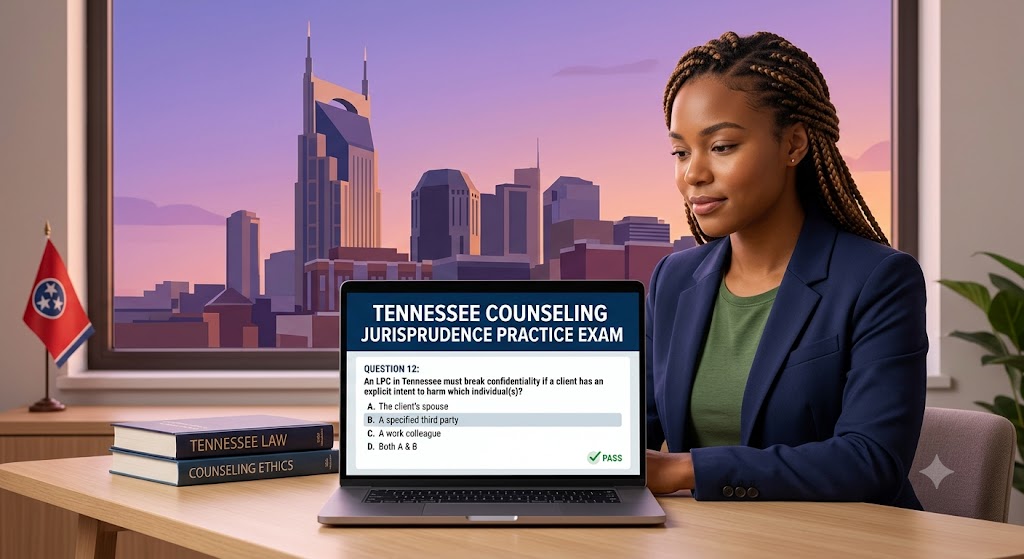
Additional Information
What the Course Entails and Exam Details
The Tennessee Professional Counseling Jurisprudence Exam is not a general ethics test; it is a deep dive into the regulatory landscape of Tennessee. A comprehensive practice exam course will meticulously mirror the official syllabus. You will find extensive content on Tennessee’s Practice Act (Tennessee Code Annotated, Title 63, Chapter 22) and the official Rules and Regulations of the Board for Licensed Professional Counselors, Licensed Marital and Family Therapists, and Licensed Clinical Pastoral Therapists (Rules 0450-01).
Core topics covered in detail within the course and practice exam include:
Tennessee’s Scope of Practice for LPCs and LPC/MHSPs.
The legal definition and management of confidentiality and its state-mandated exceptions.
"Duty to Warn" requirements when a client presents a serious threat to self or an identifiable third party.
Informed Consent requirements that must be provided to clients in Tennessee.
State rules regarding the proper creation, maintenance, and retention of client records.
Ethical guidelines on professional boundaries, conflicts of interest, and dual relationships.
Regulations surrounding the provision of telehealth services within Tennessee.
Continuing education requirements for licensure renewal.
The disciplinary process and potential grounds for licensure denial, suspension, or revocation.
What to Expect in the Final Exam
While exact details can change, the final Tennessee Jurisprudence Examination for Professional Counselors typically follows a predictable format administered online through the Center for Credentialing & Education (CCE). The official exam will likely consist of multiple-choice and true/false questions derived directly from Tennessee law and Board rules. You should also be prepared for scenario-based questions that ask you to apply the appropriate legal or ethical rule to a realistic clinical situation, testing your practical reasoning rather than simple rote memorization.
Information regarding the total number of questions, the exact time limit, and the precise passing score should be verified through your CCE account, but you should expect a challenging assessment designed to ensure you are thoroughly prepared. It is usually a non-proctored, open-book style exam, meaning you are expected to know where to find the answers and how to interpret the official source documents, making strong familiarity with the texts paramount.
How to Study and Exam Centers
Preparation is paramount for success on the jurisprudence exam. While the exam may be open-book, the vast amount of regulation makes it difficult to find answers under time pressure without pre-existing familiarity.
Effective study strategies include:
Download and Master the Source Material: Your primary study guide must be the official Tennessee Code and Board Rules, available on the Tennessee Department of Health website. Do not rely solely on third-party summaries for the final test.
Utilize a Targeted Practice Exam: A high-quality Tennessee Counseling Jurisprudence Practice Exam is invaluable. Use it to identify knowledge gaps, practice navigating scenario-based questions, and become comfortable with the wording common in state regulations.
Simulate Exam Conditions: For your final practice runs, simulate the real exam environment. Time yourself and see how effectively you can access information in the official documents.
Focus on 'Duty to Warn' and Confidentiality: Pay extraordinary attention to the exact language regarding confidentiality, informed consent, and mandatory reporting, as these are frequently heavily weighted areas.
As the exam is typically administered as an online assessment through the CCE Academy portal, you will take the test from your own location with a reliable computer and internet connection after you register and pay the fee.
Job Opportunities from the Course
Successfully navigating the Tennessee Professional Counseling Jurisprudence Exam and fulfilling all other state requirements unlocks diverse career paths in the mental health field throughout Tennessee. This certification is a required gatekeeper to independently and safely practice. Your career options include, but are not limited to:
Licensed Professional Counselor (LPC): Provide generalized counseling services in various agencies, hospitals, or private settings.
LPC with Mental Health Service Provider (MHSP) Designation: Diagnose and treat mental disorders in a wide array of clinical environments, including medical centers and private practice.
Clinical Mental Health Counselor: Offer specialized therapy for individuals dealing with mental health disorders, substance use, or crisis situations.
Agency Counselor: Work within community non-profits or government agencies, often focusing on specific populations or social services.
Private Practitioner: Establish an independent practice to offer counseling services directly to the public.
Substance Abuse Counselor: Provide specialized treatment to individuals struggling with addiction in residential or outpatient facilities.
Hospital-Based Counselor: Offer counseling and crisis intervention within medical centers or psychiatric units.
EAP Counselor (Employee Assistance Program): Deliver short-term counseling and referral services to employees of partner organizations.
Frequently Asked Questions
Reviews
5.0
Based on 0 reviews
Leave a Review
No reviews yet. Be the first to review!