
Tell Me About A Time (TMAAT) Behavioral Practice Test
$69.00
- Buy to unlock unlimited access to all Quiz questions.
- After purchase you can print a PDF of the whole quiz at any point. The PDF will contain the questions and the correct answers.
About this Exam
The [Tell Me About a Time (TMAAT) Behavioral Practice Test] is a specialized tool designed to help you prepare for a pivotal step in the modern hiring process: the behavioral interview. This exam is not for a traditional certification but is an essential simulation for anyone aspiring to secure positions in competitive fields, especially in leadership, corporate, and technical roles, such as aviation (where it is famously a central component of United Airlines' and other major carriers' interviews). This practice test is created for job seekers, current employees looking to level up, and individuals who want to master the art of articulating their past experiences to demonstrate their future potential.
Ready to test your knowledge?
Buy Now to Access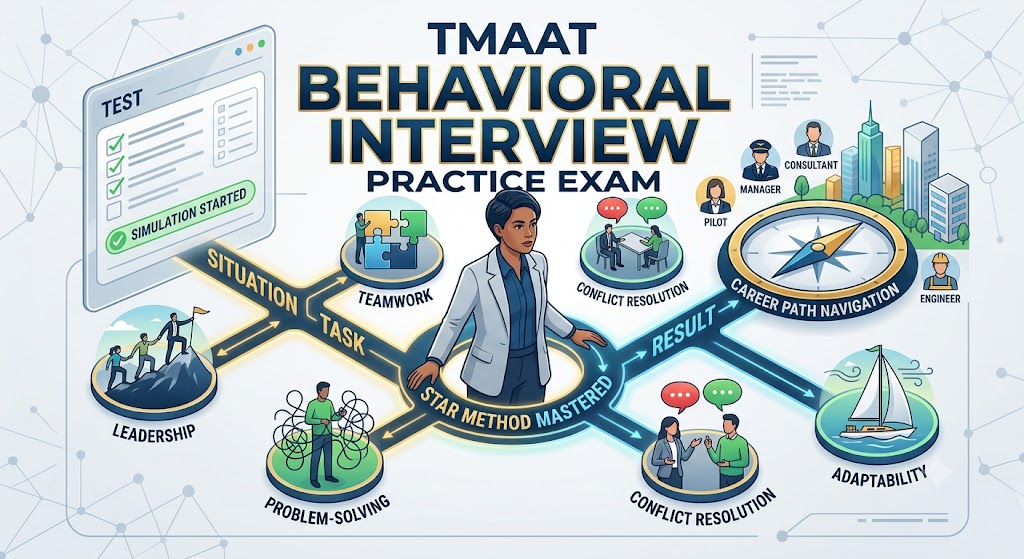
Additional Information
What the Course Entails and Exam Details
This behavioral practice test goes beyond just giving you a list of questions; it focuses on the methodology required to answer them effectively. The primary framework covered is the STAR method, which allows you to structure any "Tell Me About a Time" story comprehensively.
Behavioral Competencies: You will practice scenarios that test your ability to demonstrate key behavioral skills. These include leadership, teamwork, conflict resolution, problem-solving, communication skills, adaptability, ethical decision-making, and customer service excellence.
Story Banks: The practice exam encourages you to build a "story bank" of 6 to 12 strong, versatile narratives from your professional and personal life that can be adapted to various prompts.
STAR Method Mastery: You will learn to break down your experiences into the required four components:
Situation: Setting the scene and providing context.
Task: The specific challenge or responsibility you faced.
Action: The precise steps you took to address the task.
Result: The outcome, including quantifiable achievements and lessons learned.
What to Expect in the Final Exam
While not a final written exam with a score out of 100, the final behavioral interview itself is a high-stakes, practical evaluation of your communication and professional competency. The final exam in this context is the actual job interview with your targeted employer.
Exam Format: This is a live, often one-on-one or panel interview, which can be conducted in person, via video call (like Zoom or Teams), or occasionally, by phone.
Question Style: You can expect multiple-choice or practical scenarios, where the interviewer will ask five to ten open-ended questions beginning with, "Tell me about a time you..." or "Give me an example of when you...".
Time Limits: You should plan to deliver each STAR response concisely, typically within 90 seconds to two and a half minutes.
Evaluation: The passing score is subjective and determined by how well you can:
Use the STAR structure clearly.
Demonstrate the core competencies the role requires.
Articulate your individual impact (using "I" instead of "we" for actions).
Show a high degree of emotional intelligence and professional self-awareness.
How to Study and Exam Centers
Preparation for a behavioral interview is active and requires repetitive practice.
Study Strategies:
Map Stories to Competencies: Review the job description and list the required skills. Map your existing stories from your "story bank" to these competencies to ensure you have an example for everything.
Practice the STAR Method: Write out your responses in the Situation, Task, Action, Result format. Refine the details for clarity and impact.
Conduct Mock Interviews: The most effective study method. Practice with a friend, a mentor, or use an online mock interview platform. Have your partner ask common behavioral questions and give you constructive feedback on your delivery, content, and STAR structure.
Record Yourself: Record your mock answers. Watch for verbal fillers, non-verbal cues, and flow.
Exam Centers: Since this "exam" is the actual interview, your "testing center" is determined by the company you are applying to. It may be:
Virtual (Home): A video platform from the comfort of your own professional-looking home office.
Company Headquarters: A specific physical location for an in-person, on-site final round.
Assessment Centers: Large organizations sometimes use dedicated assessment days at external locations or their corporate facilities.
Job Opportunities from the Course
A strong performance on behavioral interview questions is often the key that unlocks the door to a vast array of high-potential career paths. Mastering these questions makes you a leading candidate for almost any professional job. Below is a list of some of the job titles and career paths that require excellent TMAAT performance to land.
Commercial Airline Pilot and First Officer (Especially at major carriers)
Corporate Manager and Team Leader
Project and Program Manager
Human Resources Director and Specialist
Operations and Logistics Manager
Customer Success and Account Manager
Healthcare Administrator
Sales Director and Account Executive
Software Engineering Lead and Technical Product Manager
Government and Public Policy Analyst
Consultant in strategy or management.
Frequently Asked Questions
Reviews
5.0
Based on 0 reviews
Leave a Review
No reviews yet. Be the first to review!