
Telehandler Practice Exam
$69.00
- Buy to unlock unlimited access to all Quiz questions.
- After purchase you can print a PDF of the whole quiz at any point. The PDF will contain the questions and the correct answers.
About this Exam
The Telehandler (or Telescopic Handler) Certification Practice Exam is a critical stepping stone for operators seeking to validate their skills on one of the most versatile pieces of heavy machinery in construction and agriculture. These machines combine the functions of a forklift, crane, and work platform.
This practice tool is designed specifically for aspiring and existing operators who need to pass their required certification exams (such as CPCS or regional equivalents) to operate these powerful, rough-terrain vehicles safely and efficiently. It builds confidence and identifies knowledge gaps before the real test.
Ready to test your knowledge?
Buy Now to Access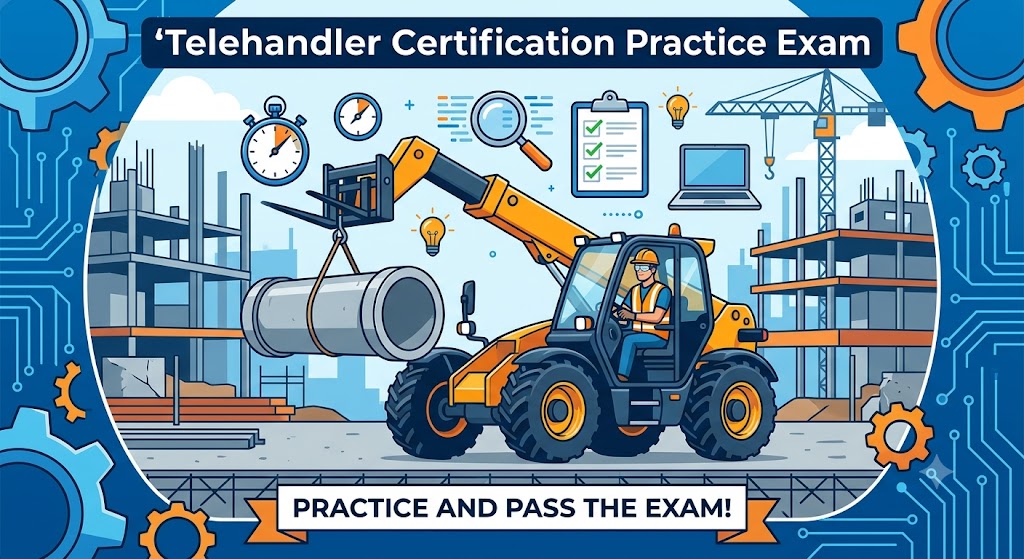
Additional Information
What the Course Entails and Exam Details
To excel in a telehandler certification, operators must master both theoretical knowledge and practical skill. A comprehensive course and the associated exam cover essential areas. These include: Understanding the machine itself, its main components (like the telescopic boom, chassis, and outriggers), and its different attachments.
Operators must learn to interpret crucial documents like load charts, which define safe lifting capacities at varying angles and boom extensions, and center of gravity dynamics. Safety is paramount, encompassing site hazards, overhead obstructions, ground conditions, stability principles, and pre-operational checks. Course work also delves into safe operation techniques, maneuvering in restricted spaces, rough terrain navigation, load handling, and understanding legal requirements (like OSHA or regional equivalents).
What to Expect in the Final Exam
The final certification is typically divided into two key components: a theory test and a practical test. For the theory part, candidates generally face a computer-based or written exam consisting of multiple-choice questions covering all theoretical aspects like load charts, safety regulations, machine components, and operating procedures. This part has a defined time limit (often around 60-90 minutes), and achieving a passing score—usually around 70-80%—is required to move on.
Following the successful completion of the theory test, candidates must demonstrate their proficiency in a practical exam under the supervision of a certified assessor. This involves completing a series of real-world tasks on a telehandler, including pre-use inspections, precise maneuvering, and handling loads safely at different heights and reaches, without making critical safety errors.
How to Study and Exam Centers
Preparation is key, and effective study involves combining theory with practical application. Thoroughly review all provided course manuals, and memorize essential facts, safety rules, and operating principles. Practice interpreting various load charts, as this is often a major component of the theory test.
The most effective strategy is taking multiple practice exams, which simulate the real testing experience and help highlight areas needing improvement. For the practical part, spend time operating a telehandler under supervision, ensuring precision and safety in every maneuver. The official certification exams can be taken at various authorized test centers worldwide. For the theory test, this may be in a computer-based testing center (like those from major provider networks or industry-specific organizations). The practical exam is conducted at designated training schools, specialized testing facilities, or even employer worksites that meet the requirements.
Job Opportunities from the Course
A telehandler certification is a high-demand credential that unlocks numerous lucrative career paths across multiple sectors. Industries such as construction, agriculture, logistics, manufacturing, and renewable energy heavily rely on skilled telehandler operators. A short list of potential career paths includes:
Telehandler Operator / Telescopic Handler Operator
Heavy Equipment Operator (with specialization)
Rough Terrain Forklift Operator
Construction Equipment Operator
Agricultural Machinery Operator
Site Supervisor (often requires operator knowledge)
Warehouse or Distribution Center Operator
Frequently Asked Questions
Reviews
5.0
Based on 0 reviews
Leave a Review
No reviews yet. Be the first to review!